.avif)

You’ve had a dynamic career. From Big Four audit to port development and real estate ventures. Tell us a bit about your journey.
I was born and raised in Jeddah in a humble household. My father worked in Saudi Arabia for nearly 40 years, and he always believed in both education and business. Studies build a foundation, but business brings its own blessings. That philosophy has guided me throughout my life. After schooling in Jeddah, I moved to Pakistan for higher education and came across ACCA, which was still relatively unknown at the time. Inspired by a family friend, I pursued it. It wasn’t easy, I failed some papers along the way, but those failures taught me more than my successes did. Completing ACCA in four years gave me a strong foundation. Like many Asian chartered accountants, I knew the best start was with a Big Four firm. So in 2003 I joined KPMG Karachi while still finishing my last paper. A year later, I returned to Saudi to support my family, and in 2004 I joined EY Jeddah, the then leading firm in the region. Over nine years, I worked with more than 100 clients and had excellent mentors. That period truly shaped who I am today and it was the foundation of my professional journey.
After EY, how did you transition into real estate and port development?
At EY, I advanced quickly, receiving seven promotions in nine years, but the demanding lifestyle was difficult to sustain, especially after marriage. The long hours made me consider a move into industry. At senior manager level, it wasn’t easy to find suitable roles, since most people advised moving out earlier, at assistant manager or manager level, but I kept searching. Eventually, I received an offer from King Abdullah Port, a startup at the time. They were specifically looking for someone with a Big Four background to help establish proper financial systems. When I joined, there were no proper accounting systems, policies, or reports, and even the last year's audit was pending. I rolled up my sleeves and cleaned the books myself, creating a trial balance that could be audited. It was a massive change from managing teams at EY to personally entering debits and credits, but it gave me invaluable hands-on experience. Over four years, I built the finance function from scratch, but eventually I wanted to grow further. Around 2018, after a series of recruiter-led interviews, including six or seven rounds, I was offered a senior role at a joint venture between Saudi Aramco and a large local group. Despite not having CFO experience at the time, they trusted my potential, and I joined. Since then, I have been with them for almost seven years, gaining exposure to large-scale real estate development, financing, and governance at the highest level.
When you're managing long-term capital in a region like KSA, what's the biggest challenge and how do you work around it?
Managing long-term capital in Saudi Arabia comes with several challenges. First is balancing long-term projects, which often run for 20 years or more, with the short-term regulatory changes that are frequent in the Kingdom. The government continuously introduces new regulations to improve the ease of doing business and attract investment, especially in real estate, where laws are still evolving. This requires agility to adapt without losing sight of long-term goals. Second is building strong banking relationships. For long-term financing, banks must be true partners, willing to provide flexibility and support through economic cycles. Fortunately, Saudi banks are becoming increasingly supportive and competitive, which makes these partnerships possible. Third is scenario planning. In a region where economic conditions shift frequently, companies must run flexible forecasts alongside their long-term budgets to ensure they stay aligned with strategic goals. Regularly testing different scenarios helps prepare for unexpected changes and ensures that after 20 years of investment, the company is still on track to achieve its objectives.
With Vision 2030, what shifts are you seeing on the ground, and where can finance leaders really make an impact?
Vision 2030 is transforming Saudi Arabia’s business landscape and requires a complete shift in mindset. Traditionally, companies focused mainly on generating profit and cutting costs, but today’s businesses must prioritize value creation. Success depends on identifying customer pain points and solving them in innovative, technology-driven ways. For example, retail may always have supermarkets, but introducing features like self-checkout or enhanced customer experiences creates real value. The government is actively driving this transformation, with PIF launching major projects like Alat, a tech and hardware company working with global leaders, and AI-focused ventures such as Humaniq. These initiatives show that Saudi Arabia is investing heavily to ensure it is at the forefront of global innovation. For finance leaders, this means a new role: moving from policing budgets to collaborating across departments. In the past, finance would send Excel sheets to other teams, compile numbers, and later criticize variances. Now, finance leaders must work closely with business heads, using data to help them achieve their goals. Finance holds all the company’s data, so the CFO’s job is to provide insights that enable strategy, not just report numbers. The CFO role has shifted from financial reporting to becoming a true partner to the CEO and leadership team, influencing long-term strategy and guiding companies toward Vision 2030 goals.
You have led multiple ERP and IFRS transitions, but transformation is never just about systems. What’s something you’ve learned the hard way about getting people to buy into change?
Transformation often fails not because of the wrong system or software partner, but because of people. Studies show that up to 80-90% of transformations collapse due to resistance from employees, usually driven by fear. When automation is introduced, for example, automating bank reconciliations, invoice processing, or reporting, employees worry they will lose their jobs. The most important lesson I’ve learned is that leaders must communicate the “why” clearly and show employees how the change benefits them. Instead of repetitive manual tasks, they can shift toward more valuable, decision-making roles. While it’s true automation may reduce some roles, history shows technology creates more jobs in the long run, Excel, once feared for eliminating accounting jobs, instead created countless new opportunities. To succeed, leaders must involve their teams early, celebrate small wins, and give ownership of results. It’s also vital to integrate systems properly; many companies buy the best tools but fail to connect them, leading to inefficiencies. Ultimately, transformation succeeds when people are engaged, motivated, and see technology as an enabler, not a threat.
You’ve invested heavily in leadership development at places like Stanford, Harvard, and London Business School. What’s one lesson from all that learning you apply most often today?
Continuous learning is essential. I qualified as an ACCA in 2003, and since then the world has changed dramatically, especially with the rise of AI and digital technologies. Knowledge quickly becomes obsolete, so if you don’t keep learning, you stop growing. While I may not apply every detail from my courses, I now know these ideas, frameworks, and technologies exist, so when the right situation arises, I can use them. Leadership training also reinforced that technical skills are not enough at senior levels. Nobody doubts a CFO’s ability to understand accounting; what matters is how well you lead, manage teams, and influence outcomes. Soft skills, communication, collaboration, empathy, are critical, and they require constant practice, not just one course. Leadership is a long-term investment, and these lessons guide me daily in balancing strategy, people, and change.
You’ve worked across organizations with very different speeds and cultures. When you walk into a new company, how do you assess what kind of finance team it needs?
Having worked in both established giants like EY and startups such as King Abdullah Port and my current housing development company, I’ve learned that building the right team depends on the stage and vision of the organization. In startups, you often have to create the entire finance function from scratch, hiring people who can adapt quickly and work without rigid structures. The most important trait I look for is attitude. Technical skills and qualifications matter, but they can be taught or developed; attitude cannot. One of my CEOs taught me that if a person has the right mindset, openness, willingness to learn and teamwork, they can be molded to succeed. He would often hire based on attitude more than resumes, and it always worked well. That experience shaped my own approach: I want good humans with strong attitudes, because skills can be learned, but attitude drives success and resilience.
When you’re hiring, what’s one trait that tells you someone is ready for a finance role in a fast-changing business?
The key trait is willingness to roll up your sleeves and do whatever is needed, regardless of title. In fast-moving companies, especially startups, you can’t afford to be rigid about roles. When I left EY as a senior manager with teams under me, I joined King Abdullah Port where I personally passed accounting entries for months to clean up the system. Later, at my current company, I was the second employee after the CEO. For six months I ran everything on Excel alone, closing books manually and reporting to the board until we implemented ERP. Those experiences taught me that no matter your title, adaptability and readiness to get hands-on are crucial. The right person for a finance role in a dynamic environment is someone who combines professional competence with humility and a can-do attitude.
AI is entering every part of finance. Which areas are really ready for automation, and which still need human judgment?
AI is best suited for rule-based, repetitive tasks. Processes like reconciliations, invoice processing, report generation, budgeting, and forecasting, as long as rules are well defined, can be automated efficiently. These are areas where AI can save time and reduce errors. However, when it comes to judgment, ethics, or decision-making, humans remain essential. AI can only analyze patterns from historical data; it cannot think contextually or ethically like humans. Therefore, I see AI as a co-pilot rather than a pilot, a support tool that augments human decision-making rather than replaces it. The future will be about collaboration between humans and AI, using automation to handle the routine while humans focus on strategy, creativity, and leadership.
If someone had only five minutes with you, what’s the one piece of advice you’d want them to walk away with?
My three pieces of advice:
- Gratitude. Take care of your parents and responsibilities, their support has been central to my success.
- Find your niche. You can’t be an expert at everything. Focus on one area and build deep expertise (FP&A, finance business partnering, BI, etc.).
- Don’t rely only on a paycheck. Build skills or side projects that give you independence and resilience.
-
Bio
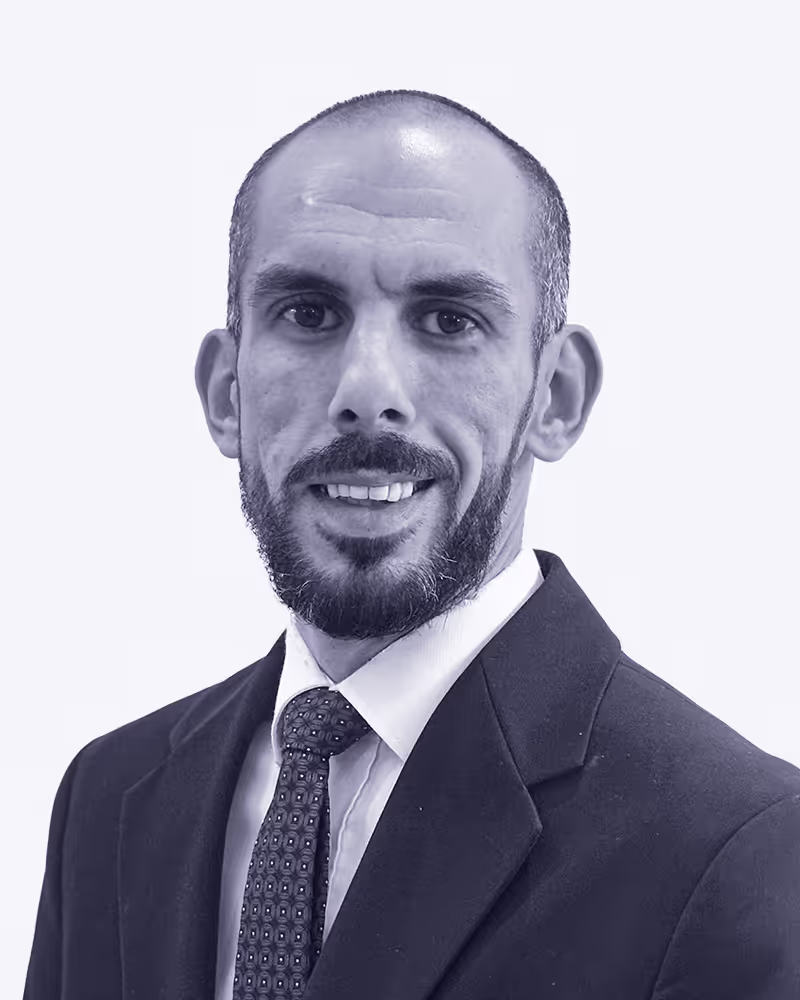
Muhammad Anis Younus is the Chief Financial Officer and Board Member of Al Fadhili Housing Company, a Saudi Aramco and MASIC joint venture. With over 20 years of experience spanning audit, ports, real estate, and infrastructure development, he has held leadership roles at KPMG, EY, and King Abdullah Port before moving into his current role. An ACCA-qualified professional, he is recognized for building finance functions from the ground up and driving long-term financial strategy.



.avif)