.avif)


The AED to INR rate sets what Indian suppliers and staff receive; provider margins scale with the transfer, so recurring India payments need close tracking.
- The AED to INR exchange rate is simply how many Indian Rupees one dirham buys, and it sets what your Indian suppliers, contractors, and remote staff actually receive when you pay them.
- The rate online is the mid-market rate; the rate a bank or transfer platform gives you usually carries a margin, and since that margin applies to the full amount, a 0.50 INR shift on a AED 50,000 payment moves the result by about INR 25,000.
- Because India is one of the UAE's largest business corridors, these payments recur often, so exchange differences add up across supplier bills, consulting fees, and payroll.
- For clean books, each payment needs its AED value, rate, INR amount, and invoice recorded together. Alaan handles this through Super Pay, capturing the data at payment time so reconciliation and month-end stay quick.
The AED to INR exchange rate determines how much Indian suppliers, contractors, and employees receive when UAE businesses make payments in Indian Rupees. For companies that regularly work with India, even small exchange rate movements can change the actual cost recorded in AED and affect overall expense planning.
This makes the exchange rate more than just a conversion number. It influences supplier pricing, budgeting accuracy, and financial reporting.
This guide explains what the AED to INR exchange rate means, why it changes, and how UAE finance teams manage its impact to maintain accurate, well-controlled international expense records.
TL;DR
- The AED to INR exchange rate directly affects business expenses: Even small rate differences can significantly change the AED cost of paying Indian suppliers and service providers.
- Provider exchange rate margins increase total conversion cost: The rate offered by banks and payment providers often includes a margin, which can cost more than the visible transfer fee.
- Exchange rate fluctuations impact budgeting and profitability: Changes in the AED to INR rate can affect cost forecasts, vendor payments, and overall financial planning.
- Accurate recording of foreign currency payments is essential: Finance teams must track exchange rates, invoices, and payment confirmations to maintain correct and audit-ready financial records.
- Alaan helps UAE businesses manage AED to INR expenses efficiently: With real-time visibility, automated documentation, and faster reconciliation, Alaan simplifies international expense management.
Understanding The AED To INR Exchange Rate
The AED to INR exchange rate determines how much an Indian supplier, contractor, or employee receives when a UAE business makes a payment. Even small movements in this rate can change the final cost recorded in AED and affect how much is credited in Indian Rupees.
For UAE finance teams, understanding how this exchange rate works is essential for accurate accounting, cost control, and financial planning.
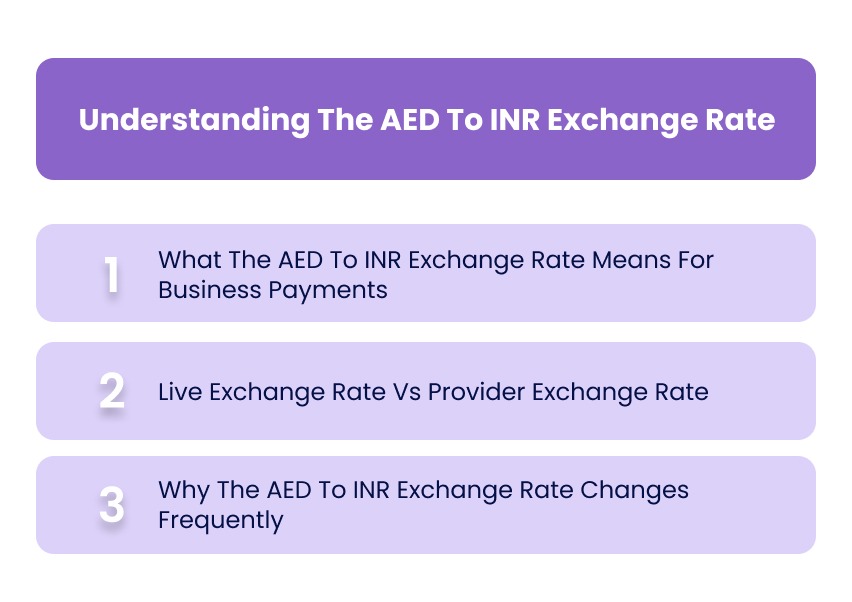
What The AED To INR Exchange Rate Means For Business Payments
The AED to INR exchange rate shows the value of one UAE Dirham in Indian Rupees. It defines how much INR the recipient receives for every AED paid.
This exchange rate is used in several common UAE–India business transactions, including:
- Supplier payments for goods and materials
- Contractor and consulting service fees
- Remote employee salaries and reimbursements
- Other operational transfers between UAE and India
For example, if the exchange rate is 1 AED = 22 INR, a payment of AED 10,000 would convert to approximately INR 220,000, before any provider fees or exchange margins are applied.
The conversion itself is simple. The AED amount is multiplied by the exchange rate to determine the INR value. However, the actual INR received may vary depending on the rate applied by the bank or payment provider.
Live Exchange Rate Vs Provider Exchange Rate
Two different exchange rates exist in every foreign currency transaction, and the difference between them affects the true cost of the payment.
The mid-market rate, also known as the live exchange rate, is the real-time rate shown on currency exchanges and financial websites. This rate reflects the actual market value of AED against INR.
The provider rate, sometimes called the customer rate, is the rate offered by banks, exchange houses, or transfer platforms. This rate typically includes a margin added by the provider.
This margin is a key source of revenue for payment providers. Instead of charging only a visible fee, part of the cost is included in the exchange rate itself.
For UAE businesses, this difference has a direct financial impact. Even a small exchange rate margin can increase the total cost of large or frequent INR payments, affecting budgets and expense reporting.
Why The AED To INR Exchange Rate Changes Frequently
The AED to INR exchange rate changes regularly due to shifts in economic and financial conditions. These movements reflect the relative strength of the UAE Dirham and the Indian Rupee.
Key factors that influence exchange rate changes include:
- Inflation differences: Higher inflation in one country can weaken its currency.
- Interest rates: Changes in interest rates can affect currency demand and value.
- Economic stability: Strong economic performance generally supports currency strength.
- Currency demand: Trade activity, investment flows, and business payments influence exchange rates.
These fluctuations affect how much UAE businesses pay in real terms and how much Indian suppliers receive. As a result, exchange rate movements can influence payment timing, budgeting decisions, and financial reporting.
Tracking the AED to INR exchange rate helps UAE finance teams maintain accurate records and better control the cost of international business payments.
Also Read: Understanding Financial Statements for Beginners Guide
Why The AED To INR Exchange Rate Matters For UAE Businesses
For UAE businesses, the AED to INR exchange rate directly affects how much they pay Indian suppliers, contractors, and employees. It determines the real AED cost of operations and influences how accurately expenses can be planned and recorded.
Because India is one of the UAE’s largest business partners, exchange rate movements play an ongoing role in both daily payments and long-term financial planning.
UAE Businesses Regularly Pay Suppliers And Teams In India
India is a major operational corridor for UAE companies due to its strong service ecosystem, manufacturing base, and large skilled workforce. Many UAE businesses rely on Indian partners to support core functions and operational growth.
Common use cases include:
- Outsourcing: UAE businesses outsource functions such as software development, finance support, and customer service to India.
- Manufacturing and supply: Indian suppliers provide raw materials, components, and finished goods across industries such as retail, construction, and packaging.
- Service providers: UAE companies work with India-based consultants, agencies, and operational vendors.
- Remote employees: Many UAE businesses employ full-time or contract professionals based in India.
Because these payments occur frequently, the AED to INR exchange rate becomes a continuous factor in determining actual operating costs.
Exchange Rate Differences Directly Affect Business Expenses
Even small exchange rate changes can create noticeable cost differences, especially for higher-value payments.
For example, consider a AED 50,000 supplier payment.
- At 1 AED = 22.50 INR, the supplier receives INR 1,125,000.
- At 1 AED = 22.00 INR, the supplier receives INR 1,100,000.
This difference of just 0.50 INR per AED results in a INR 25,000 gap, which may need to be absorbed by the business to meet the agreed payment value.
These differences can affect:
- Budgets: Actual payment costs may exceed planned expense estimates.
- Profitability: Higher conversion costs reduce operating margins.
- Vendor pricing: Suppliers may adjust their pricing to protect against currency fluctuations.
Over time, repeated exchange rate differences can significantly influence total business spending.
Exchange Rate Visibility Supports Better Financial Planning
For finance teams, clear visibility into the AED to INR exchange rate is essential for maintaining accurate and predictable financial records.
Without proper visibility:
- Payment costs may become unpredictable.
- Budget forecasts may not match actual expenses.
- Reconciliation may require additional adjustments to correct currency differences.
Tracking exchange rates helps finance teams understand the true AED cost of INR payments and record expenses correctly. It also supports better planning by allowing businesses to anticipate currency-related cost changes.
Understanding the business impact of exchange rates makes it easier to manage international payments effectively. The next section explains the real cost behind the AED to INR exchange rate and how provider margins affect total expenses.

The Real Cost Behind The AED To INR Exchange Rate
The AED to INR exchange rate displayed on financial websites is not always the rate UAE businesses receive when making payments to India. In actual transactions, additional charges and provider margins affect the final INR amount received and the total AED cost recorded.
Without understanding these hidden components, finance teams may underestimate the true cost of international payments.
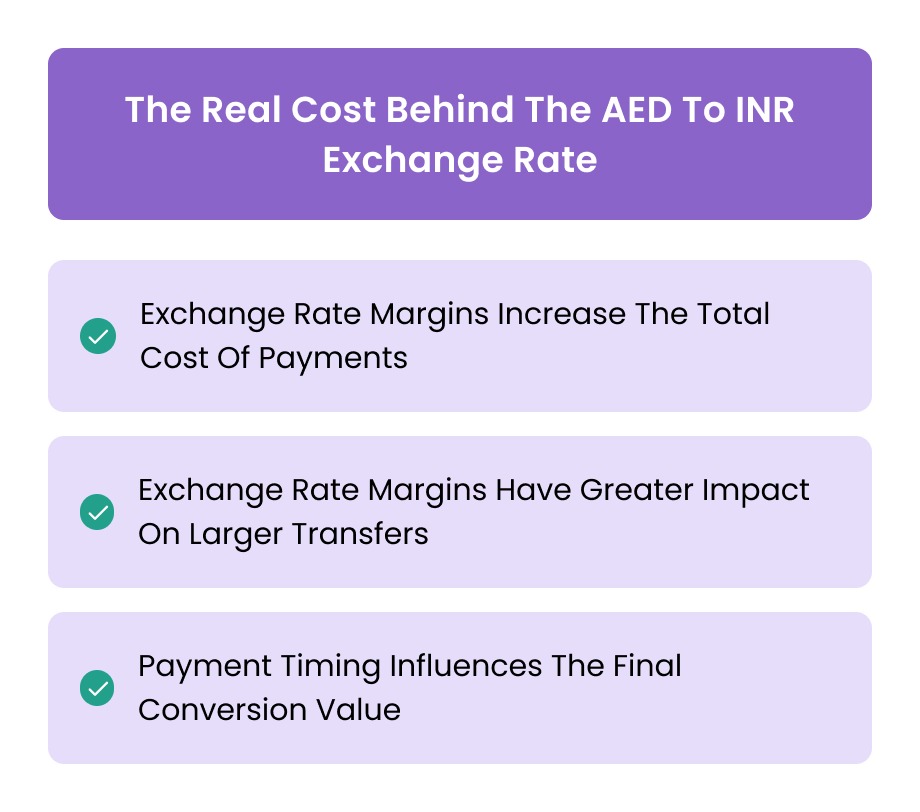
Exchange Rate Margins Increase The Total Cost Of Payments
When UAE businesses convert AED to INR, payment providers usually apply several charges as part of the transaction.
These may include:
- Exchange rate margin: A small adjustment added to the exchange rate offered to the customer.
- Transfer fee: A fixed or percentage-based fee for processing the payment.
- Receiving or intermediary fees: Charges applied by correspondent banks or the beneficiary bank in India.
Among these, the exchange rate margin often has the greatest financial impact because it applies to the entire transfer amount.
For example, a transfer fee may remain fixed regardless of whether the business sends AED 5,000 or AED 50,000. However, an exchange rate margin affects every dirham converted. As the transfer amount increases, the total cost created by the margin increases proportionally.
This makes the exchange rate one of the most important factors influencing the actual cost of AED to INR business payments.
Exchange Rate Margins Have Greater Impact On Larger Transfers
The financial impact of exchange rate margins becomes more significant as payment size increases.
For smaller payments, the difference may appear minimal. However, for larger supplier payments, contractor fees, or payroll transfers, even a small exchange rate difference can result in a noticeable increase in total cost.
Over time, repeated AED to INR payments with unfavourable exchange margins can increase operating expenses and affect overall budget accuracy.
This is why finance teams often review exchange rates carefully before making high-value international payments.
Payment Timing Influences The Final Conversion Value
The AED to INR exchange rate changes frequently due to currency demand, economic conditions, and financial market activity. These fluctuations can occur daily and may affect the final INR amount received.
As a result, the timing of a payment can influence the effective cost.
A payment made when the exchange rate is more favourable will convert into a higher INR amount. In contrast, a less favourable rate increases the AED cost required to meet the same payment obligation.
For finance teams, this creates an important planning consideration. Monitoring exchange rates and aligning payment timing with operational needs helps maintain predictable expenses and accurate financial reporting.
Understanding these cost factors helps UAE businesses manage AED to INR payments more efficiently and maintain better financial control over international expenses.
Also Read: Types of Expenses Every Business Should Know
How UAE Finance Teams Should Manage AED To INR Payments
Completing an AED to INR transfer is only part of the financial process. Finance teams must also ensure the AED value, exchange rate, and supporting documents are recorded correctly in their accounting systems.
Without structured expense management, foreign currency payments can lead to reconciliation delays, reporting errors, and reduced financial visibility.
Every AED To INR Payment Requires Proper Accounting Records
Each payment made in Indian Rupees creates a full accounting workflow that finance teams must complete to maintain accurate records.
This typically includes:
- Recording the transaction: Entering the AED amount, applied exchange rate, and converted INR value.
- Collecting the supplier invoice or receipt: Ensuring supporting documents are available for verification.
- Categorising the expense: Assigning the correct expense account and cost centre.
- Reconciling the payment: Matching the transaction with bank or corporate card statements.
In many organisations, these steps are still handled manually. Payment confirmations, invoices, and exchange rate details may be stored across different systems, which slows reconciliation. When businesses make frequent AED to INR payments, this manual effort increases finance workload and extends month-end closing timelines.
Exchange Rate Differences Create Accounting Adjustments
Exchange rate changes can create differences between the expected expense value and the final recorded cost.
An exchange gain or loss occurs when the exchange rate changes between the time the expense is recorded and when the payment is settled. Finance teams must identify and record this adjustment to reflect the true AED cost.
This process usually involves:
- Calculating the exchange difference
- Recording the adjustment in the accounting system
- Ensuring financial statements reflect the accurate expense value
Without proper tracking, exchange differences can be difficult to calculate and may affect financial accuracy.
Limited Visibility Creates Financial Control Challenges
When AED to INR payments are not tracked clearly, finance teams may face several operational risks.
These include:
- Incorrect financial reporting: Expenses may be recorded using inaccurate values.
- Missing invoices or documentation: Incomplete records create gaps in financial statements.
- Delayed financial closing: Additional time is required to locate information and correct discrepancies.
These challenges reduce financial transparency and make it harder for finance leaders to maintain reliable and audit-ready records. Maintaining clear visibility into foreign currency expenses helps ensure accurate reporting and efficient financial operations.
Also Read: Guide to Preparing Financial Statements Efficiently
How To Manage AED To INR Exchange Rate Risk
Managing AED to INR payments effectively requires more than completing the currency conversion. Finance teams must also manage exchange rate fluctuations, select appropriate payment methods, and maintain accurate expense records.
A structured approach helps UAE businesses reduce unexpected costs and maintain efficient financial operations as payment volumes increase.
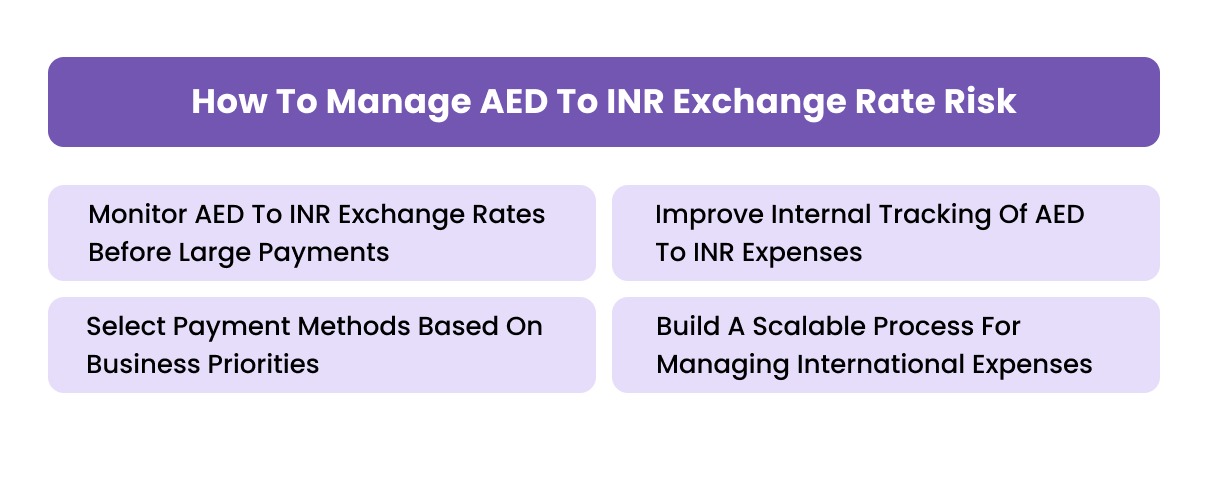
Monitor AED To INR Exchange Rates Before Large Payments
The AED to INR exchange rate changes regularly, which can directly affect the cost of supplier, contractor, and payroll payments. Finance teams often monitor exchange rate trends before making high-value transfers to avoid unfavourable conversions.
This helps businesses:
- Identify more favourable exchange rate periods
- Avoid unnecessary currency conversion losses
- Maintain more predictable international payment costs
Even small improvements in exchange rate timing can create meaningful savings when payments are large or recurring.
Select Payment Methods Based On Business Priorities
Different payment methods offer varying benefits depending on operational and financial needs. Finance teams typically evaluate options based on overall efficiency, not just the visible transfer cost.
Key decision factors include:
- Cost: Including transfer fees and exchange rate margins
- Speed: How quickly the payment reaches the recipient in India
- Operational efficiency: How easily the payment can be tracked, recorded, and reconciled
For example, urgent payments may prioritise faster processing, while planned payments may focus on cost efficiency and accurate documentation.
Choosing the right payment method helps businesses balance cost control with operational reliability.
Improve Internal Tracking Of AED To INR Expenses
Accurate tracking of foreign currency payments improves financial accuracy and strengthens internal control. When finance teams have complete visibility into AED to INR expenses, they can manage records more efficiently.
Effective tracking helps finance teams:
- Record the correct AED expense value
- Reduce time spent on reconciliation
- Maintain accurate and audit-ready financial records
- Improve overall financial control
We at Alaan help businesses improve visibility and simplify financial workflows by connecting corporate cards, cross-border transfers, approvals, and reconciliation in a single platform. By automatically capturing payment data, approvals, and supporting documents, we help finance teams maintain organised, reconciliation-ready records for international payments and expenses.
Build A Scalable Process For Managing International Expenses
As UAE businesses grow, the number and value of AED to INR payments typically increase. This creates additional complexity in expense tracking, reconciliation, and financial reporting.
Without a scalable process, businesses may experience:
- Increased manual accounting effort
- Higher risk of reporting errors
- Reduced visibility into international spending
Establishing a structured expense management process helps ensure foreign currency payments remain properly recorded and easy to reconcile.
This supports accurate financial reporting and allows finance teams to manage international operations efficiently as the business expands.
How Alaan Helps UAE Businesses Manage AED To INR Payment Records
Converting AED to INR for supplier, contractor, and service payments creates accounting responsibilities beyond the currency conversion itself. Finance teams must track the AED amount paid, the exchange rate applied, the final INR value, and the supporting invoice.
At Alaan, we provide an expense management platform with corporate cards and cross-border transfers through Super Pay. Businesses can pay international suppliers and service providers, including AED to INR payments, while maintaining complete visibility, control, and organised documentation. This allows finance teams to manage global expenses, track foreign currency transactions, and reconcile payments accurately within a single platform.
We support AED to INR expense management in several practical ways:
- Clear visibility into foreign currency expenses: Each transaction is recorded instantly, allowing finance teams to see the AED amount, payment details, and supporting information in one place.
- Centralised invoice and receipt storage: Supplier invoices and payment documents can be attached directly to each transaction, ensuring records remain complete and easy to access.
- Accurate, exportable expense reports: Finance teams can generate detailed reports showing international expense values, helping ensure financial statements reflect the correct AED cost.
- Faster reconciliation and month-end closing: Because expense data is captured at the time of payment, finance teams do not need to manually reconstruct AED to INR transactions later.
By helping businesses maintain organised, reconciliation-ready records, we at Alaan improve financial visibility, reduce manual accounting effort, and support accurate management of AED to INR business expenses.
Also Read: Accounts Payable Automation and Invoice Management Software
Conclusion
The AED to INR exchange rate directly affects how much UAE businesses pay Indian suppliers and how those expenses are recorded in their financial statements. Exchange rate margins, timing differences, and incomplete documentation can all change the final AED cost and increase reconciliation effort. Without proper tracking, foreign currency payments can reduce cost visibility and delay month-end closing.
The key is to monitor exchange rates, maintain complete payment records, and ensure every AED to INR expense is accurately captured. At Alaan, we help finance teams manage international payments and expenses with real-time visibility, structured approvals, and reconciliation-ready documentation. Schedule a free demo to see how Alaan helps UAE businesses manage AED to INR payments with greater visibility and control.
If India is one of several countries you pay, our guide to cross-border payments in the UAE explains how routing, FX margins and CBUAE rules work across corridors, and the AED to EGP rate guide covers the same questions for payments to Egypt. You can also run your next rupee transfer through the SuperPay FX calculator to see what your supplier receives before you send it.
FAQs
1. How Often Does The AED To INR Exchange Rate Change?
The AED to INR exchange rate can change multiple times during the day due to market activity, currency demand, and economic conditions. These fluctuations affect the INR amount received and the AED cost recorded. Finance teams should check the applied rate at the time of each transaction.
2. Should Businesses Record AED Or INR Values In Their Accounting?
UAE businesses should record the expense in AED, which is the base currency for financial reporting. The INR value can be recorded for reference, but the AED amount reflects the actual business cost. This ensures consistency in financial statements.
3. What Causes Differences Between The Expected And Actual INR Received?
Differences can occur due to exchange rate margins, intermediary bank charges, or timing delays. These factors may reduce the final INR amount credited to the recipient. Finance teams must verify the final settled amount for accurate records.
4. How Can Businesses Ensure Accurate INR Expense Reporting?
Businesses should retain the supplier invoice, payment confirmation, and exchange rate used for the conversion. This ensures the AED value recorded matches the actual transaction. Proper documentation supports accurate reconciliation and audit readiness.
5. How Do Frequent AED To INR Payments Affect Financial Operations?
Frequent foreign currency payments increase the need for accurate tracking and reconciliation. Without proper processes, finance teams may face delays and reporting errors. Structured expense management helps maintain efficiency and financial accuracy.
Gain control over business expenses with Alaan corporate cards
Invygo earned AED 100,000 in cashback using Alaan cards
Personalise approval workflows to align with your business needs with Alaan's Spend Management platform
Discover the power of automated expense tracking and smarter spend control with Alaan
Turn data into actionable insights with Alaan's spend management tools
Stay Tax Compliant with UAE's #1 Corporate Card and Spend Management Platform
Customisable corporate card policy template
Know how much Corporate Tax you have to pay this fiscal year
Easily integrate Alaan with your ERP for accurate, real-time expense tracking
Close books faster with Alaan's AI-powered accounting automation
Reconcile your books in minutes instead of hours, every single month.
Keep petty cash organized with Alaan corporate cards and automated expense management