.avif)

A practical look at how project budget management works during execution, what a usable budget includes, and how tighter spend control protects margin.
- With UAE cost increases running at 2 to 3% last year and the wider Middle East seeing 4.0% growth in 2024, project budgeting has become a margin-control discipline rather than a one-off planning task.
- A budget only stays useful if it lives through execution, so committed cost, actual cost, and scope change all need watching together, not just paid invoices.
- Most overruns start in approvals, procurement, and late cost capture rather than in the budget model itself, which is why they feel sudden even when the signs were there early.
- Reforecasting is part of managing a budget well, not proof the original one failed, and it keeps decisions grounded in where the project actually stands now.
- Alaan supports this operating layer with corporate cards, spend limits, approval workflows, real-time visibility into project spend, receipt capture, and accounting integrations for cleaner reconciliation.
Project budgets rarely fail because nobody created a spreadsheet. They usually fail because cost assumptions move, approvals slow down, scope changes slip through informally, or actual spend becomes visible too late to correct. For project-based businesses, budget management is less about producing a number at the start and more about keeping that number useful while the project is moving.
That matters even more when input costs are not static. In the UAE, cost pressure has stayed elevated across project-heavy sectors, with the UAE recording 2–3% cost increases last year and the wider Middle East seeing 4.0% cost growth in 2024. In that environment, project budget management becomes a margin-control discipline, not just a planning exercise.
In this article, we explain how budget management in project management works in practice, what a usable project budget should include, where cost control usually breaks down, and how stronger spend visibility helps teams protect margin and forecast more reliably.
TL;DR / Key Takeaways
- Budget management in project management works best when it stays active throughout execution, not only at the planning stage.
- A credible project budget needs a clear scope, cost assumptions, ownership, and a control baseline that the team can actually track.
- Better project budget control depends on monitoring committed cost, actual cost, and scope change together.
- Most budget problems begin in approvals, procurement, and delayed cost capture rather than in the budget model itself.
- Reforecasting is part of good budget management, not proof that the original budget failed.
- Alaan helps businesses strengthen project-related spend control through approvals, real-time visibility, and cleaner reconciliation.
Why Budget Management Matters In Project Management
Project budget management matters because projects do not consume cost evenly or neatly. Spend tends to move in phases, vendor commitments often arrive before final invoices, and scope changes can affect cost long before they appear in a formal report. If budget control is weak, the project team usually discovers the problem after too much money has already been committed.
It also matters because the budget does more than cap spend. A good budget helps the business decide whether the project is commercially viable, whether execution is tracking as expected, and whether emerging variance needs action now rather than explanation later. That is why budget management in project management sits as much with finance and control as it does with delivery.
Where Budget Pressure Usually Starts
- Scope Begins Moving Before Cost Is Updated
A small scope change rarely looks dangerous on its own. The issue is that repeated small changes can alter labour, procurement, subcontractor, and timeline costs before anyone fully reworks the budget. - Approvals Arrive After Spend Decisions Are Already In Motion
In many businesses, the budget looks controlled on paper but purchasing decisions move faster than the approval trail. By the time finance sees the full picture, the commercial commitment has often already been made. - Actual Cost Is Captured Too Late
Budget control weakens quickly when receipts, invoices, card spend, or supplier charges sit outside the main workflow for too long. The budget then becomes a historical record instead of a decision tool.
Why Finance Teams Care About It
- Margin Protection
Poor budget control does not only create overruns. It also weakens confidence in project profitability and makes it harder to separate execution issues from planning issues. - Forecast Accuracy
A project budget is one of the inputs that supports wider business forecasting. If project costs are unreliable, cash planning and management reporting become less dependable as well. - Variance Explanation
Senior stakeholders rarely want to hear only that the project spent more than planned. They want to know where the variance started, whether it was approved, and whether the rest of the budget is still credible.
Also Read: Cash Management Control System UAE
What A Project Budget Actually Includes
A project budget is not just a total approved amount. It is the planned distribution of money across the work that the project is expected to deliver, along with the assumptions behind that spend. That distinction matters because a project can stay close to its headline budget and still lose control at line-item, phase, or commitment level if the structure underneath is weak.
A usable budget therefore needs enough detail to support planning, approval, tracking, and reforecasting. If the budget only exists as a high-level estimate, it may help secure approval at the start but will not help much once execution begins.
The Core Components Of A Project Budget
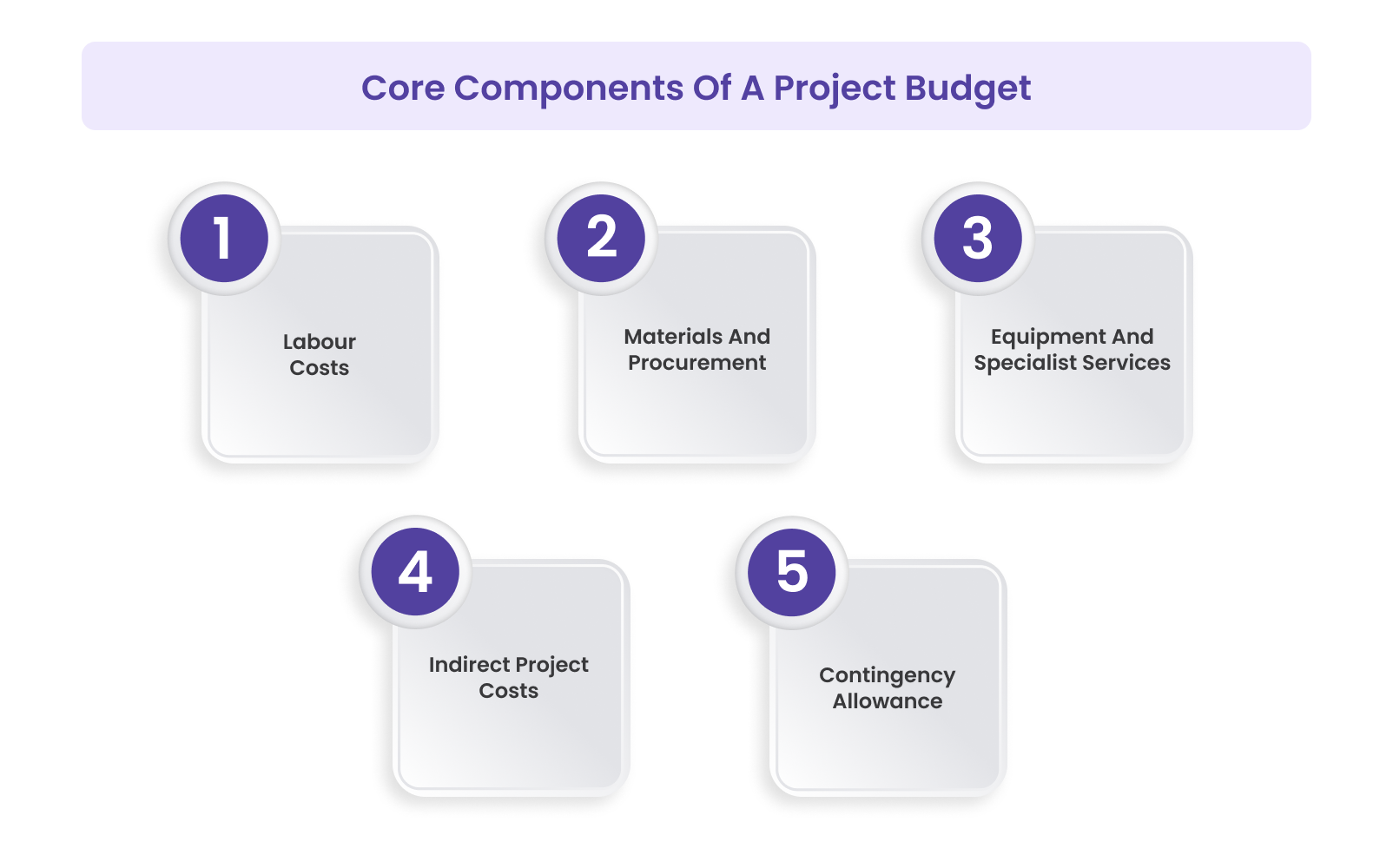
- Labour Costs
Internal team cost, contractor cost, and any role-based or time-based effort assumptions that affect delivery. - Materials And Procurement
Direct project purchases, supply inputs, and category-level costs that may move with quantity, availability, or supplier pricing. - Equipment And Specialist Services
Leased equipment, subcontractor support, implementation partners, consultants, or any external capability required to complete the work. - Indirect Project Costs
Site-related overheads, admin support, travel, project management overhead, compliance costs, or other indirect charges linked to project delivery. - Contingency Allowance
A defined reserve for identifiable uncertainty, where the business knows risk exists even if the exact outcome is not yet certain.
The Difference Between A Budget Estimate And A Cost Baseline
A budget estimate is part of the planning process. A cost baseline is the approved version of projected cost that the business uses to measure performance during execution. That difference matters because teams often speak about “the budget” as if every early estimate should function as the control number, which is rarely true in practice.
A baseline becomes the reference point for comparing planned work against actual cost and progress. It is also central to earned value style tracking, where the business needs an approved basis for judging whether cost performance is genuinely on track.
Related: Financial Planning Analysis FPA
How Project Management Budget Planning Should Work
Project management budget planning works best when it moves in sequence. If the project tries to jump straight to final numbers before scope, assumptions, and ownership are clear, the budget may still get approved, but it will be difficult to control later.
The goal is not to make the planning process more bureaucratic. The goal is to create a budget structure that can survive execution, support decisions, and still be useful once vendor spend, timeline changes, and reporting pressure begin to build.
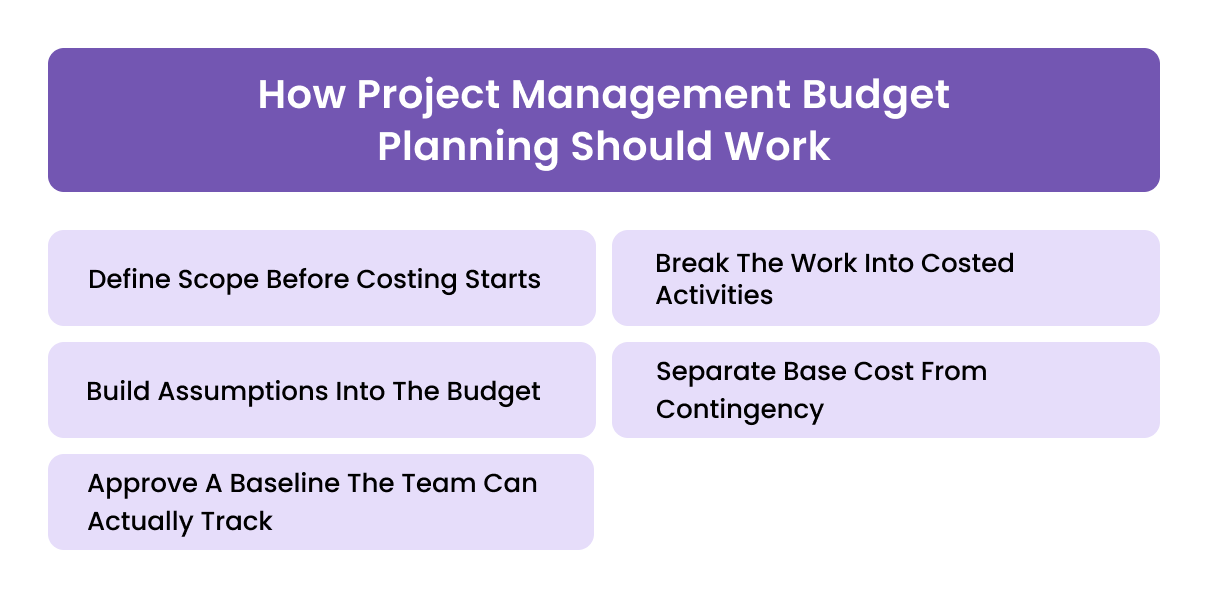
1. Define Scope Before Costing Starts
If the scope is vague, the budget will carry hidden instability from the start. A team may still produce a figure, but that figure will rely on too many unstated assumptions to remain dependable once execution begins.
Scope clarity does not mean every detail must be final. It means the business should know what the project is expected to deliver, what is excluded, and where major commercial dependencies sit before building the main cost view.
2. Break The Work Into Costed Activities
A project budget is easier to manage when cost is linked to phases, work packages, deliverables, or accountable owners. That makes it easier to see where pressure is building and which part of the project is responsible for it.
This also improves control later. If the budget only exists as a top-line number, the team may know the project is drifting but still struggle to identify which activity, supplier, or phase is causing it.
3. Build Assumptions Into The Budget
Every serious project budget rests on assumptions, whether they are written down properly or not. Quantities, rates, supplier timing, duration, exchange-rate exposure, resource availability, and dependency risk all shape the final number.
The stronger approach is to state those assumptions clearly during planning. That way, when the budget begins to move, the business can identify whether the issue came from execution quality, commercial change, or a planning assumption that did not hold.
4. Separate Base Cost From Contingency
This is one of the cleaner ways to keep the budget more credible. The base cost should represent the expected cost of delivering the planned work under the stated assumptions. Contingency should reflect known areas of uncertainty that may or may not materialise.
When those two are mixed carelessly, the budget becomes harder to read and even harder to control. The team may think it still has room left, while finance may be unclear whether that room reflects genuine plan cost or unused risk allowance.
5. Approve A Baseline The Team Can Actually Track
Budget approval should result in more than a signed document. It should produce a control baseline that the business can track against during execution, review in reporting, and use when explaining variance.
If the approved number cannot be mapped back to real project activity, the team may still call it the budget, but it will not function as one in any meaningful control sense.
Also Read: Difference Budgeting Financial Forecasting
How To Manage Budget In Project Management During Execution
Budget planning gives the project a starting point. Execution is where that budget either stays useful or starts falling apart. Once suppliers are engaged, scope begins moving, and costs start hitting the business, the project needs a live control rhythm rather than occasional budget reviews.
A common mistake is to treat budget monitoring as a reporting exercise only. In practice, budget management during execution works better when the business is reviewing cost movement early enough to act on it, not just explain it later.
1. Track Actual Cost Against The Baseline Frequently
A project budget becomes harder to control when actual cost is reviewed too late or at too high a level. If the team only checks performance after invoices have piled up or after a project phase is already complete, the budget has less value as a decision tool.
Frequent tracking does not mean overcomplicating the process. It means creating a review cadence where actual spend is compared with the approved baseline often enough to identify pressure while corrective action is still possible.
2. Review Committed Cost As Well As Paid Cost
One of the biggest gaps in project budget control is that teams focus too much on paid cost and not enough on committed cost. The budget risk often appears earlier through approved purchase orders, supplier confirmations, subcontractor commitments, or pending invoices that have not yet reached the final payment stage.
That is why project budget reviews should look beyond cash already spent. A budget can appear healthy on a paid-cost basis while still carrying a large exposure through obligations that are already commercially locked in.
3. Watch Variance Before It Becomes A Problem
Variance management works best when the business does not wait for a dramatic overrun. Smaller signals usually appear first, such as unit cost moving above estimate, quantities increasing faster than expected, or one workstream consuming budget too quickly relative to progress.
The more useful question is not just whether the project is over budget today. It is whether the current pattern of cost movement suggests that the project is likely to stay within its remaining budget if nothing changes.
4. Escalate Scope Changes Properly
Informal scope movement is one of the easiest ways for a project budget to lose credibility. Small changes often get treated as operational adjustments, but those adjustments can still affect labour, procurement, timelines, or specialist support in ways that eventually push the project off course.
A better approach is to price and approve material scope changes explicitly. That keeps the budget aligned with the actual project rather than forcing finance and delivery teams to keep working from different versions of reality.
5. Reforecast Before The Budget Breaks
Reforecasting should not be treated as an admission that the budget failed. It is part of keeping the budget relevant as conditions change. If assumptions move, supplier cost changes, or execution patterns shift, the forecast should move as well so that management decisions stay grounded in the latest picture.
That updated view helps the business answer a more commercially useful question: what is the most likely final cost from here, based on the project as it now stands, rather than the project as it looked at the start.

How To Control Project Budget More Effectively
Project budget control improves when the business puts governance around how spend gets approved, recorded, and challenged. Without that layer, teams may still track costs, but they are often reacting to spend after it has already happened.
This is why budget control is not only about monitoring numbers. It is also about controlling the workflow around those numbers so that the budget remains linked to real decisions.
The Most Useful Control Levers
- Approval Discipline
Budget control weakens when purchase decisions move ahead of formal review. A clearer approval structure helps ensure spend is challenged before it becomes a committed cost. - Vendor Validation
Supplier pricing, commercial terms, and procurement choices can change the shape of a project budget quickly. Better vendor validation reduces the risk of cost drift entering through the purchasing side. - Change Order Control
Scope change is not always avoidable, but uncontrolled change is. A formal process for pricing and approving change orders helps keep the budget aligned with the actual delivery plan. - Forecast Refreshes
A project budget should not be treated as fixed simply because it was approved. Forecast refreshes help management keep control over where the project is heading, not only where it started. - Clear Cost Ownership
Budget control is stronger when each phase, workstream, or major cost area has identifiable ownership. That makes variance discussion more useful and prevents cost movement from becoming everyone’s issue but nobody’s responsibility. - Documented Audit Trail
Spend becomes easier to challenge, reconcile, and explain when the business can see what was approved, what was purchased, and what documentation supports the cost.
Also Read: Improving Internal Control Financial Reporting ICFR
The Metrics That Matter In Project Budget Management
Not every project needs a highly technical cost-control dashboard. What it does need is a set of measures that help the business understand whether cost performance is stable, whether the remaining budget is still credible, and where action may be needed next.
The best project budget metrics are the ones that connect financial reality with project execution. They help the business see both what has happened and what is likely to happen if the current pattern continues.
The Core Measures To Track
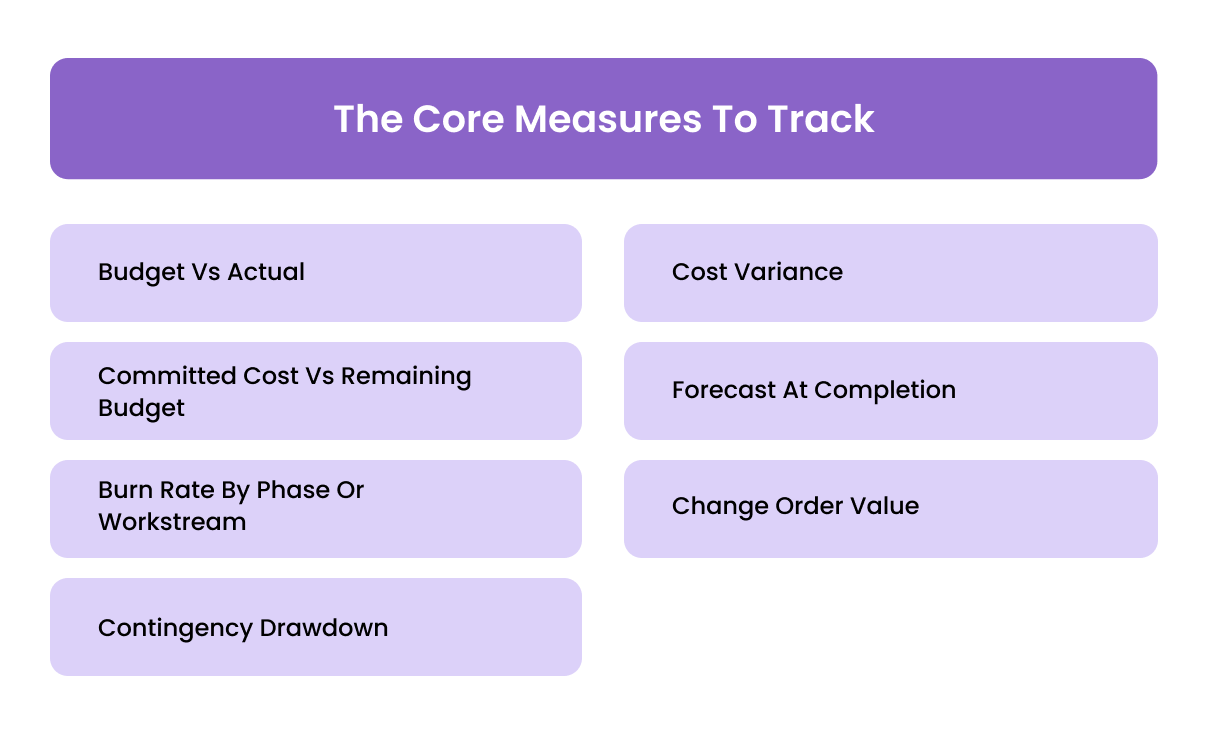
- Budget Vs Actual
This remains the most direct comparison. It shows whether spend is staying within the approved baseline at project, phase, or cost-category level. - Cost Variance
Variance helps the team move beyond the headline number by showing the size and direction of deviation from plan. - Committed Cost Vs Remaining Budget
This is often one of the most useful control views because it reveals exposure that has not yet turned into final payment. - Forecast At Completion
This shows the expected final cost based on the latest view of performance rather than the original plan alone. - Burn Rate By Phase Or Workstream
Burn rate helps management see whether spending is moving in line with project progress or consuming budget too quickly in certain areas. - Change Order Value
This helps quantify how much budget movement is being driven by approved scope change rather than delivery inefficiency. - Contingency Drawdown
This shows whether risk allowance is being consumed at a reasonable pace or whether the project is using contingency too early.
Where Earned Value Fits
Earned value can be useful where the organisation has the discipline to track both cost and progress consistently against an approved baseline. It is especially relevant when the business wants a more structured view of whether the project value delivered is keeping pace with the money spent.
For many businesses, though, the priority is not adopting every formal method at once. It is building a project budget process that captures actuals on time, tracks commitments properly, and produces a forecast the business can trust.
Related: Understanding Cost Management Key Steps Benefits
The Most Common Reasons Project Budgets Go Off Track
Most project budget problems do not come from one dramatic event. They usually come from a series of smaller gaps in planning, control, and execution that compound over time. That is why budget overruns often feel sudden, even when the warning signs were present much earlier.
Understanding those failure points makes budget control more practical. It helps the business strengthen the areas where projects usually lose financial discipline, rather than focusing only on the final overrun.
The Usual Failure Points
- Under-Scoped Budgets
The project starts with an incomplete picture of what delivery actually requires, which means cost pressure is built in from the beginning. - Weak Assumptions
The budget relies on rates, quantities, timelines, or supplier conditions that do not hold once execution begins. - Late Cost Capture
Invoices, receipts, reimbursements, or site-level spend arrive too late for the budget to function as a live control tool. - Unapproved Changes
Scope adjustments happen operationally but do not move through a formal pricing and approval process. - Supplier Cost Drift
Procurement cost moves gradually due to pricing changes, substitutions, delays, or revised terms. - Fragmented Approvals
Purchasing decisions happen across emails, chats, spreadsheets, and verbal sign-offs rather than inside one controlled workflow. - Spend Outside The Main Process
Card spend, urgent buying, site purchases, or employee-paid project expenses sit outside the core project control structure.
Also Read: Track And Manage Business Expenses
Why Project Budget Management Often Breaks Outside The Project Plan
Project budgets often look workable in the planning file, but lose strength in the operating process around them. The issue is rarely only the budget logic itself. It is usually the fact that approvals, procurement, invoices, receipts, and accounting records live across too many disconnected tools.
Once that happens, the project budget stops reflecting the full picture. Finance may see only posted cost, project teams may track separate commitments locally, and management may get budget views that are technically updated but commercially incomplete.
Where Visibility Usually Gets Lost
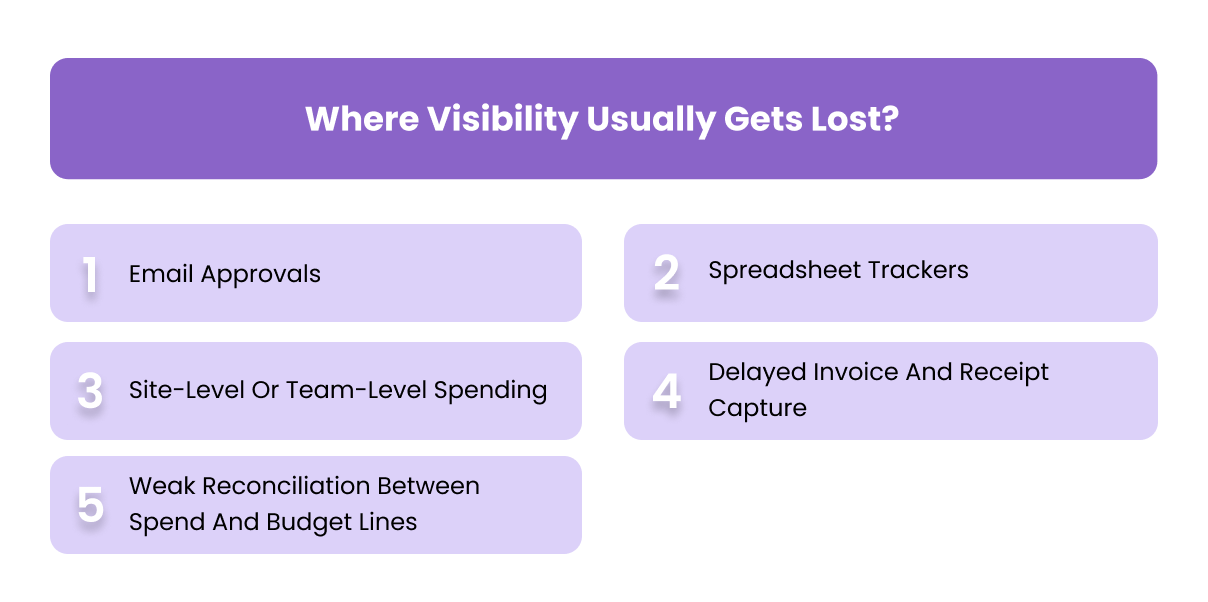
- Email Approvals
Approval trails become harder to verify and easier to bypass when spend decisions are scattered across inboxes. - Spreadsheet Trackers
Local trackers may help teams move quickly, but they often create version issues and delay consolidated visibility. - Site-Level Or Team-Level Spending
Smaller project purchases can escape the main budget view if they are raised outside the usual procurement and finance flow. - Delayed Invoice And Receipt Capture
Costs become harder to match and explain when supporting documentation arrives after the budget review window has passed. - Weak Reconciliation Between Spend And Budget Lines
Even when transactions are recorded, they may not map cleanly back to the project budget structure, which weakens control and reporting quality.
Related: Receipt Scanning Methods Efficiency
How Better Spend Control Supports Project Budget Management
Project budget control usually weakens before the budget review meeting. It breaks when purchases are approved informally, site-level spend is captured late, and finance sees cost only after it has already turned into a reporting problem. That is where Alaan is relevant. It helps businesses manage project-related spend through corporate cards, spend controls, approval workflows, receipt capture, AI verification, and accounting integrations, so cost visibility improves while the project is still moving.
- Corporate Cards With Spend Limits And Vendor Controls
Alaan lets businesses issue corporate cards with spending limits and vendor restrictions. That helps project teams control urgent purchases, site spend, and operational buying within clearer rules instead of relying on loosely governed card use. - Approval Workflows Before Spend Becomes Committed Cost
Alaan supports custom approval workflows, so project-related purchases can be reviewed before money is committed. This helps businesses apply stronger control across teams, functions, and locations where project spend is being raised. - Real-Time Visibility Into Project-Related Spend
Finance teams can see transactions as they happen across employees, vendors, and categories. That makes it easier to spot faster-than-expected burn, unusual supplier activity, or spend building outside the expected project pattern. - Receipt Capture And Supporting Documentation
Employees can upload receipts and invoices through the mobile app, Chrome extension, or email, so supporting documents stay attached to transactions from the start. That reduces lag between project activity and finance validation. - AI Verification And Duplicate Detection
Alaan extracts receipt data, matches it to transactions, and flags inconsistencies or duplicates. That helps finance teams review project-related spend more efficiently and reduces manual checking pressure. - Accounting Integration For Cleaner Reconciliation
Alaan integrates with Xero, QuickBooks, NetSuite, and Microsoft Dynamics, allowing expense data to sync in real time. That makes project spend easier to reconcile back to finance records and reduces manual re-entry later.

In practice, that gives businesses a stronger control layer around project spend, making the budget easier to trust while execution is still in progress.
Also Read: Expense Management Software Business Spend Tracking
Conclusion
Budget management in project management works best when the budget is treated as a live control system rather than a static planning document. The businesses that manage project budgets well are usually not the ones with the most complex templates. They are the ones that keep approvals, commitments, actuals, and forecast updates close enough to the work that variance can be acted on early.
That is also why project budget control depends on more than the budget file itself. It depends on how spend is approved, captured, documented, and reconciled while the project is running.
Alaan helps businesses strengthen that operating layer with corporate cards, spend limits, approval workflows, real-time visibility, cleaner documentation, and faster reconciliation. That makes project-related spend easier to control, easier to explain, and easier to connect back to the budget while the work is still live. Book a Demo Today!
FAQs
1. What is the difference between a project budget and a project forecast?
A project budget is the approved cost plan used as the main control reference. A forecast is the updated view of where the project is now expected to land based on current performance, commitments, and scope movement.
2. How often should a project budget be reviewed?
That depends on project size and spend intensity, but monthly is usually the minimum. For faster-moving projects or procurement-heavy work, more frequent reviews are often needed so cost pressure is visible before corrective action becomes too late.
3. Why is committed cost important in project budget management?
Because budget risk often appears before payment happens. Purchase orders, supplier confirmations, subcontractor commitments, and pending invoices can all reduce the real flexibility left in the budget, even if cash has not yet gone out.
4. Should contingency be included inside the main project cost lines?
It is usually better to keep contingency visible as a separate layer. That makes it easier to see how much of the base project cost is expected to be spent and how much is there to absorb known uncertainty.
5. What usually causes project budgets to drift without immediate notice?
The most common causes are small scope changes, delayed invoice capture, supplier cost movement, and fragmented approvals. These issues often build gradually before they show up as a clear overrun in the main report.
6. Does every business need formal earned value analysis?
No. Earned value can be useful, but many businesses get more benefit first from stronger basics: timely cost capture, cleaner approval workflows, proper commitment tracking, and a forecast they can actually trust.
Gain control over business expenses with Alaan corporate cards
Invygo earned AED 100,000 in cashback using Alaan cards
Personalise approval workflows to align with your business needs with Alaan's Spend Management platform
Discover the power of automated expense tracking and smarter spend control with Alaan
Turn data into actionable insights with Alaan's spend management tools
Stay Tax Compliant with UAE's #1 Corporate Card and Spend Management Platform
Customisable corporate card policy template
Know how much Corporate Tax you have to pay this fiscal year
Easily integrate Alaan with your ERP for accurate, real-time expense tracking
Close books faster with Alaan's AI-powered accounting automation
Reconcile your books in minutes instead of hours, every single month.
Keep petty cash organized with Alaan corporate cards and automated expense management