.avif)


How UAE finance teams can build a compliant, automated corporate spend framework that links policy, cards, AI validation, and ERP integration.
- In most UAE enterprises, a handful of indirect categories account for over 70% of unmanaged spend variance, mostly because that spending is scattered across teams and vendors.
- Seeing the totals is not the same as controlling them, and real control comes from connecting policies, cards, and accounting systems so approvals and limits enforce themselves in real time.
- UAE compliance raises the stakes, since missing TRNs, wrong VAT rates, or unmatched invoices can cost you penalties or lost recovery unless the checks happen early in the spend cycle.
- Alaan pulls card payments, invoices, and reimbursements into one dashboard, reads receipts to extract VAT details and TRNs, and posts compliant transactions straight into ERPs like Xero, QuickBooks, and NetSuite.
For most UAE finance leaders, the term corporate spend has moved far beyond expense reports and approvals. It now sits at the intersection of finance control, compliance, and operational agility.
As payment channels expand — from traditional procurement invoices to SaaS subscriptions, digital wallets, and virtual cards — corporate spending has become continuous, decentralised, and increasingly data-heavy. Without structured visibility, even small, routine purchases can create serious blind spots: duplicate payments, missed VAT recovery, and inaccurate cash-flow projections.
That’s why forward-looking organisations are rethinking spend management as a strategic finance function — one that balances policy control with automation, integrates directly with ERP systems, and delivers real-time insights on every dirham spent.
In this article, we explore how UAE companies can build a scalable, compliant, and intelligent framework for managing corporate spend.
Key Takeaways
- Corporate spend is strategic. It represents not just transactions but the financial discipline behind every operational decision.
- Visibility without automation fails. True control comes from linking policies, cards, and accounting systems in real time.
- UAE-specific compliance demands precision. TRN validation and VAT automation must be built into every spend process.
- Data centralisation drives savings. Consolidated dashboards expose inefficiencies, duplicate vendors, and missed credits.
What Corporate Spend Really Means
Corporate spend covers every payment an organisation makes to operate — not just procurement costs, but all business outflows tied to day-to-day activities.
It extends across both direct and indirect categories:
- Direct spend: raw materials, logistics, or goods that directly contribute to revenue generation.
- Indirect spend: marketing, IT subscriptions, utilities, travel, and professional services that support daily operations.
While direct spend typically follows a formal procurement process with negotiated contracts, indirect spend is often dispersed across teams and vendors. Marketing pays its agencies, IT manages SaaS subscriptions, and operations handles facility costs — each using different workflows and approval hierarchies.
This decentralisation creates visibility gaps. Finance departments see the total expense, but not the transaction-level insight — who spent, where, and why. Over time, this leads to inefficiencies such as unmonitored renewals, fragmented vendor lists, and VAT non-compliance.
Modern corporate spend management brings all these payments — cards, invoices, and reimbursements — under one unified structure. It’s not just about tracking; it’s about governing the flow of company money through policies, digital controls, and system integrations that ensure accuracy, accountability, and agility.
Also read: Business Spend Management Tools and Their Importance
Why Corporate Spend Management Matters More Than Ever
Over the past few years, the way organisations spend has changed more than the way they earn. Traditional expense cycles built around invoices, purchase orders, and manual reconciliations no longer reflect the pace at which today’s businesses operate.
In the UAE, where digital payments, cloud subscriptions, and regional expansion have become standard, the scale and frequency of corporate transactions have grown exponentially. A single marketing team may use 20 SaaS tools, while multiple departments run recurring vendor contracts that renew automatically. Without integrated oversight, this creates two fundamental risks: rising operational costs and compliance exposure.
1. Fragmented Spending Erodes Financial Accuracy
When each department uses its own payment method or card, finance teams struggle to match transactions to budget lines or VAT-compliant invoices. What starts as convenience quickly turns into reconciliation delays, incomplete reporting, and unclaimed tax credits.
A fragmented spend environment also weakens cash visibility — making it harder for finance teams to forecast liquidity or allocate working capital effectively.
2. Real-Time Payments Demand Real-Time Control
Corporate spending is no longer linear. Digital wallets, instant transfers, and prepaid cards have made payments faster — but policy enforcement hasn’t always kept up.
Without automated controls in place, employees can easily bypass budgets or vendor policies in seconds, often unintentionally.
This makes real-time spend visibility not a convenience, but a compliance necessity.
3. Data Volume Has Outpaced Manual Governance
Finance leaders today oversee hundreds of micro-transactions across cards, ERPs, and vendor systems. Relying solely on manual reconciliations or spreadsheets is no longer sustainable.
As spending becomes more distributed, automation is the only scalable way to maintain accuracy. Machine learning and rules-based governance can now match receipts, extract VAT details, and flag anomalies far more reliably than manual reviews ever could.
4. UAE Compliance Adds a Layer of Complexity
Corporate spend control in the UAE isn’t only about internal governance — it’s about meeting FTA VAT documentation standards and ensuring all spend complies with local audit requirements.
Unmatched invoices, missing TRNs, or incorrect VAT rates can lead to penalties or lost recovery opportunities.
Automating these checks early in the spend cycle prevents end-of-month fire drills and gives finance leaders confidence that their books are audit-ready.
In short, corporate spend management has evolved from bookkeeping to a real-time intelligence layer. It now defines how efficiently a business can convert cost into value, and how confidently finance can report compliance to regulators and leadership alike.
Building the Corporate Spend Control Stack

A company’s ability to control spend doesn’t depend on how many approvals it sets — it depends on how seamlessly those approvals work in practice. The most successful finance teams don’t manage expenses manually; they design control stacks that embed policy, automation, and data integrity into every transaction.
A modern corporate spend control stack typically includes four interconnected layers: policy, payments, automation, and integration.
1. Policy and Governance Framework
At the foundation is a clear, enforceable spend policy.
It defines:
- Who can spend: roles and levels of approval (e.g., department heads, project leads).
- What can be spent: expense categories, vendor lists, and per-transaction limits.
- When to spend: timing rules for travel, procurement, and reimbursements.
- How to report: documentation standards, VAT-compliant receipts, and audit records.
However, in most UAE organisations, policies remain static PDFs — visible but rarely followed. The key is to translate those written policies into live controls through digital systems.
When policy logic is embedded directly into a spend platform, approvals and category limits enforce themselves. This reduces errors and makes compliance frictionless.
2. Smart Corporate and Virtual Cards
Corporate cards have evolved from static payment tools into programmable control instruments.
With virtual cards, finance teams can now issue department-specific or even transaction-specific cards that expire automatically after use.
Smart card platforms, such as Alaan, allow admins to:
- Set spending caps per transaction, per vendor, or per employee.
- Restrict merchant categories (e.g., travel, SaaS, or logistics).
- Enable instant blocking or freezing in case of misuse or vendor termination.
- Offer integration with mobile wallets (Apple Pay, Google Pay) for convenience without compromising control.
These cards remove the dependency on reimbursements and manual reconciliations while providing real-time visibility into how and where company funds are spent.
[cta-1]
3. Real-Time Expense Capture and AI Validation
Once transactions occur, they must be verified — not at month-end, but instantly.
Modern expense management tools use AI to validate receipts, extract VAT details, and flag mismatches between invoices and transaction data.
For instance, when an employee uploads a receipt through Alaan’s app or Chrome extension, the system automatically reads vendor names, dates, and TRNs, checks them against spend policies, and posts compliant transactions directly into the ERP.
This reduces the administrative burden on finance teams and ensures compliance by design.
4. ERP and Accounting System Integration
The final layer in the control stack is integration — connecting expense data with accounting systems like Xero, QuickBooks, Oracle NetSuite, or Microsoft Dynamics.
When spend data flows automatically into the general ledger, finance teams eliminate manual entry errors, shorten closing cycles, and maintain up-to-date ledgers at all times.
It also enables cross-departmental reporting — procurement can view budget utilisation, and finance can assess category-level efficiency without relying on static spreadsheets.
ERP integration transforms spend control from a reactive process into a continuous financial workflow.
When these layers — policy, payment, automation, and integration — operate in sync, they create a system of real-time financial governance.
Every transaction becomes traceable, every approval auditable, and every expense compliant — without slowing down business operations.
Designing a Spend Framework That Reflects UAE Financial Realities
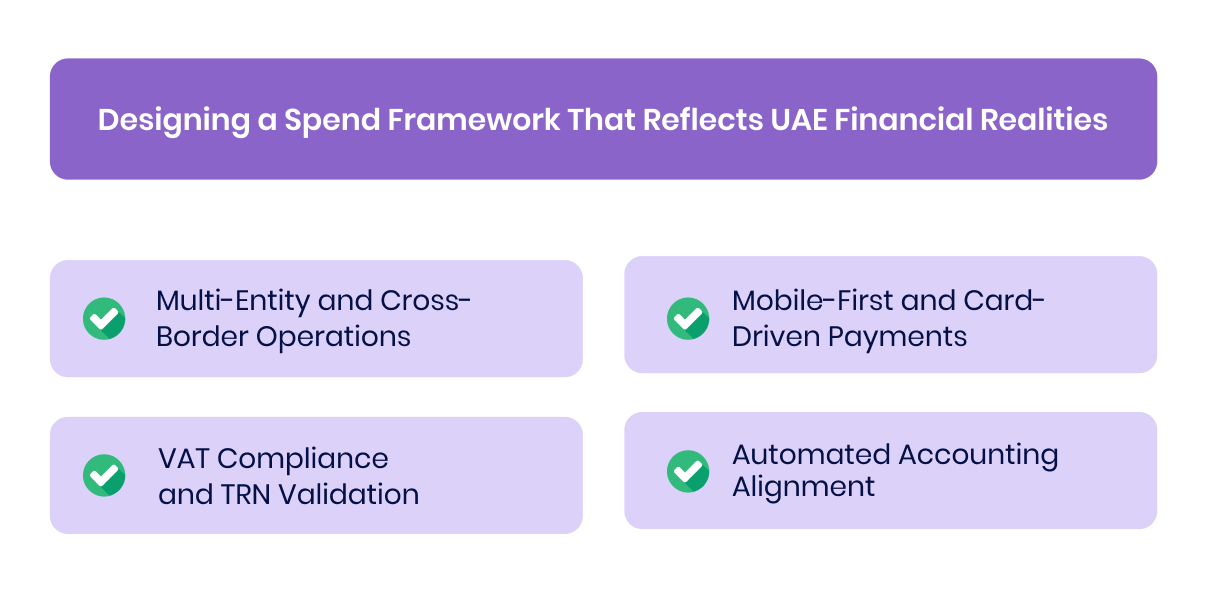
For finance leaders in the UAE, designing a spend framework isn’t just about efficiency — it’s about compliance, traceability, and adaptability to a rapidly evolving financial landscape.
Unlike many Western markets, UAE businesses operate within a mix of multi-entity structures, dynamic VAT regulations, and hybrid payment environments — each of which demands tighter alignment between spend policy and accounting control.
Here’s how these realities shape the way corporate spend frameworks must be designed:
1. Multi-Entity and Cross-Border Operations
Many UAE-based organisations operate across multiple jurisdictions — free zones, mainland entities, and regional branches. Each may have different cost centres, currencies, and tax obligations.
A centralised spend framework must therefore allow:
- Entity-level visibility: spend data tagged to specific branches or legal entities.
- Cross-currency management: automatic conversion and consolidation for reporting.
- Segregated controls: each entity follows its own policy limits and approval chain while reporting to a unified dashboard.
This ensures both compliance and transparency when reconciling inter-company expenses or regional budgets.
2. VAT Compliance and TRN Validation
Since the UAE introduced VAT, accurate documentation has become non-negotiable for expense approval. Finance teams must ensure that every transaction includes:
- Valid Tax Registration Numbers (TRN) for suppliers.
- Proper tax invoice formats per Federal Tax Authority (FTA) standards.
- Accurate VAT classification for claimable vs. non-claimable categories.
Manual validation at scale is almost impossible — which is why many finance teams now embed AI-driven VAT validation within their spend systems.
Platforms like Alaan automatically extract VAT data from uploaded receipts, verify TRNs, and flag incomplete or non-compliant invoices before they enter the ledger.
This transforms compliance from a post-transaction correction into a real-time assurance mechanism.
[cta-6]
3. Mobile-First and Card-Driven Payments
Corporate payments in the UAE are increasingly digital. Apple Pay, Google Pay, and Visa Commercial Pay are replacing manual transfers and cash reimbursements — creating faster, more transparent transaction trails.
A resilient spend framework must support:
- Virtual and mobile-enabled corporate cards for travel and departmental expenses.
- Real-time spending notifications for finance managers.
- Merchant category restrictions to prevent policy breaches.
By linking these payments to an automated spend management platform, companies ensure that every tap, transfer, or subscription aligns with corporate budgets and compliance rules.
Also read: Corporate Cards for Startups in the UAE
4. Automated Accounting Alignment
Local accounting teams often juggle multiple ledgers for different subsidiaries or regions. Without automated data flow, month-end closes can stretch into weeks.
A UAE-aligned spend framework integrates directly with accounting systems — posting transactions, categorising expenses, and matching them against approved budgets instantly.
This not only eliminates manual errors but also simplifies FTA audit preparation, since every record is already categorised, timestamped, and traceable.
Designing for UAE realities means balancing regulatory precision with operational flexibility. Finance leaders who succeed in this space don’t just manage costs — they build a compliant financial infrastructure that scales confidently with growth.
High-Impact Spend Categories That Demand Continuous Oversight

Not all spending is created equal. While some costs are predictable and tightly controlled, others fluctuate based on seasonality, team activity, or vendor dependency.
In most UAE enterprises, a handful of indirect categories account for over 70% of unmanaged spend variance — not because they’re unnecessary, but because they’re decentralised.
Below are the categories that deserve the most continuous monitoring and policy integration.
1. SaaS and Technology Subscriptions
The rise of cloud-based tools has brought convenience — and hidden duplication.
Teams across departments often subscribe to the same SaaS products separately, using individual credit cards or untracked renewals.
Common issues include:
- Auto-renewals of underused software.
- Unaligned license counts across departments.
- Currency conversion losses on USD-denominated subscriptions.
How finance teams should manage it:
- Maintain a central SaaS registry that lists all tools, owners, and renewal dates.
- Link corporate card usage to approval workflows for any new subscription.
- Use automated alerts (via tools like Alaan Intelligence) to detect duplicate vendors or renewal overlaps.
2. Travel and Entertainment (T&E)
Travel and entertainment remain a major corporate cost driver — especially for UAE businesses with regional operations.
The complexity arises not from the scale of spend, but from the frequency and variability of transactions.
Challenges include:
- Out-of-policy bookings or upgrades.
- Non-VAT-compliant receipts from international vendors.
- Manual reconciliation delays between travel systems and ERP.
Best practices:
- Issue dedicated T&E corporate cards with category restrictions.
- Enforce automated policy rules: e.g., hotel limits or per diem caps.
- Digitise receipts in real time through expense apps or Chrome extensions.
By embedding real-time tracking, finance leaders can ensure every dirham spent on travel is visible and accounted for.
Also read: Effective Workplace Travel Policy
3. Marketing and Vendor Services
Marketing often escapes traditional procurement controls. Agencies, consultants, and freelancers operate on flexible scopes — leading to invoice mismatches or contract drift.
Without a spend analysis process, companies end up with multiple vendors delivering similar services under inconsistent terms.
To fix this:
- Tag all marketing vendors within a central spend dashboard.
- Benchmark spend by campaign type or department to spot overinvestment.
- Use periodic vendor rationalisation reviews to consolidate supplier lists and improve negotiation leverage.
This not only streamlines costs but also increases transparency across marketing ROI and budget accountability.
4. Office and Administrative Expenses
Facilities, utilities, courier services, and consumables collectively form a large portion of indirect spend — yet often remain unmonitored.
Since these expenses are handled by admin or HR teams, they rarely undergo detailed financial analysis.
Finance leaders should:
- Set budget ceilings per department or project.
- Automate recurring payments (e.g., rent, utilities) with smart categorisation.
- Apply AI-based anomaly detection to identify unexpected fluctuations (e.g., a sudden spike in courier fees).
5. Professional Services and Outsourced Support
Consultants, auditors, and outsourced vendors provide crucial expertise, but their billing models can be opaque.
Lack of central documentation or inconsistent contract renewals can inflate this category significantly.
Governance recommendations:
- Maintain a service contract repository tied to expense entries.
- Enforce PO-linked invoicing and approval chains for all service-based payments.
- Periodically benchmark consulting rates across the market to ensure value alignment.
Tracking these categories continuously doesn’t just reduce leakage — it builds a predictive understanding of spending behaviour.
With AI-based spend analysis and ERP-linked reconciliation, companies can transition from reactive reviews to proactive financial control.
Also read: Understanding Spend Visibility and Its Business Benefits
Conclusion
Corporate spend management is no longer a back-office accounting task — it’s a strategic lever that determines how efficiently a business operates.
In the UAE, where enterprises deal with high transaction volumes, diverse vendors, and evolving VAT regulations, the real differentiator isn’t spend visibility alone — it’s control.
Finance leaders who invest in unified, automated systems can do more than prevent overspending. They can forecast with accuracy, recover every claimable dirham, and build a governance structure that scales with growth.
At Alaan, we believe control should never come at the cost of speed.
Our platform helps finance and procurement teams align on one goal — every transaction visible, every policy enforceable, and every expense compliant.
If your organisation is ready to modernise how it manages spend, start with visibility — and let automation do the rest.
Book a demo to see how Alaan can help you gain complete control over your corporate spend — from expense automation to VAT compliance and ERP integration.
Also read: ERP Integration Challenges and Solutions
If you want the fundamentals behind these strategies, start with what a spend management system is and how it differs from expense management. Alaan's expense management software handles the receipt capture, approval flows and card controls described above. To put a number on it, the Alaan savings calculator estimates the time and money you'd get back each year. CEOs who want the short version can read about spend management for CEOs, which covers real-time spend analytics and corporate tax readiness.
Frequently Asked Questions
1. What does corporate spend include?
Corporate spend includes all financial outflows made by an organisation — from direct procurement and travel to SaaS subscriptions, marketing, utilities, and professional services. It covers both operational and discretionary expenses required to run day-to-day business activities.
2. How is corporate spend different from business expenses?
While “business expenses” often refer to reimbursable costs incurred by employees, corporate spend is broader — it includes vendor payments, card-based transactions, and all purchases made across departments using company funds or accounts.
3. What’s the best way to manage corporate spend in UAE companies?
For UAE enterprises, the best approach combines AI-powered expense automation, corporate cards with controls, and ERP integration. This ensures all transactions are VAT-compliant, reconciled, and visible in real time.
4. Why is visibility important in spend management?
Without visibility, finance teams can’t track spending patterns, identify leakage, or forecast accurately. A unified spend dashboard like Alaan’s provides instant insights across departments, helping finance prevent errors before they escalate.
5. What are the most common challenges in corporate spend control?
The biggest challenges include fragmented data, off-policy purchases, delayed reconciliation, and manual VAT validation. Automation and integrated card systems directly address each of these pain points.
6. How does Alaan help organisations optimise corporate spend?
Alaan consolidates all corporate transactions — from card payments to invoices — into one dashboard. It validates every expense against VAT and company policy, automates categorisation, syncs data with ERPs, and offers real-time analytics for smarter financial decisions.
Gain control over business expenses with Alaan corporate cards
Invygo earned AED 100,000 in cashback using Alaan cards
Personalise approval workflows to align with your business needs with Alaan's Spend Management platform
Discover the power of automated expense tracking and smarter spend control with Alaan
Turn data into actionable insights with Alaan's spend management tools
Stay Tax Compliant with UAE's #1 Corporate Card and Spend Management Platform
Customisable corporate card policy template
Know how much Corporate Tax you have to pay this fiscal year
Easily integrate Alaan with your ERP for accurate, real-time expense tracking
Close books faster with Alaan's AI-powered accounting automation
Reconcile your books in minutes instead of hours, every single month.
Keep petty cash organized with Alaan corporate cards and automated expense management