.avif)


A finance department usually gets judged on accuracy first. That makes sense, but accuracy on its own is no longer enough. A strong finance function is also expected to protect controls, improve visibility, support decisions, and keep pace as the business becomes more complex.
That shift matters because finance teams are being pushed towards more data-led, automated, and decision-support work rather than staying limited to reporting alone. Recent survey data shows many finance leaders are prioritising data, AI, and technology, while a large majority of financial controllers expect their roles to change significantly by 2030.
In this article, we explain the finance department best practices that help businesses build a stronger function, including structure, reporting discipline, internal controls, cash visibility, and the right operating model as the business grows.
TL;DR
- Finance Department Best Practices Are About Accuracy, Control, Visibility, And Decision Support
- A Strong Finance Function Needs Clear Ownership Across Reporting, Controls, Cash, Planning, And Compliance
- The Right Finance Department Organisation Structure Depends On Business Size, Complexity, And Transaction Volume
- Automation Helps, But Weak Process Design And Unclear Ownership Still Create Finance Problems
- Alaan Helps Finance Teams Improve Spend Control, Approvals, Visibility, And Reconciliation Across Day-To-Day Operations
Related: Improving Internal Control Financial Reporting ICFR
What Good Finance Department Best Practices Actually Mean
Finance department best practices are not about building a function that looks impressive on paper. They are about building one that can report reliably, maintain control, support the business with useful information, and scale without becoming chaotic. That usually comes down to process design, role clarity, and the quality of financial discipline across routine work.
A weak finance department often shows its problems indirectly. Reporting arrives late, approvals happen informally, reconciliations fall behind, and too much depends on one or two people knowing how things work. Stronger practice reduces those points of friction before they start affecting wider business decisions.
- Finance Should Protect Accuracy And Support Decisions
Good finance work is not limited to getting the numbers right. It should also help the business understand what those numbers mean, where pressure is building, and what action may be needed next. - Best Practice Is About Process, Not Just People
A capable team still struggles when ownership is unclear or workflows are weak. Strong finance departments rely on repeatable processes, clear approval logic, and consistent documentation rather than individual heroics. - A Strong Finance Function Reduces Surprises
Better reporting, stronger controls, and cleaner visibility help the business spot issues earlier. That includes rising spend, weak collections, delayed reconciliations, policy exceptions, and month-end bottlenecks.
Also Read: Account Reconciliation Importance Steps
Core Finance Department Best Practices
Strong finance departments usually do a few things consistently well. They close reliably, maintain tighter control over routine activity, produce usable reporting, and make ownership clearer as the business grows. Those are the practices that help finance stay dependable under pressure rather than becoming a bottleneck.
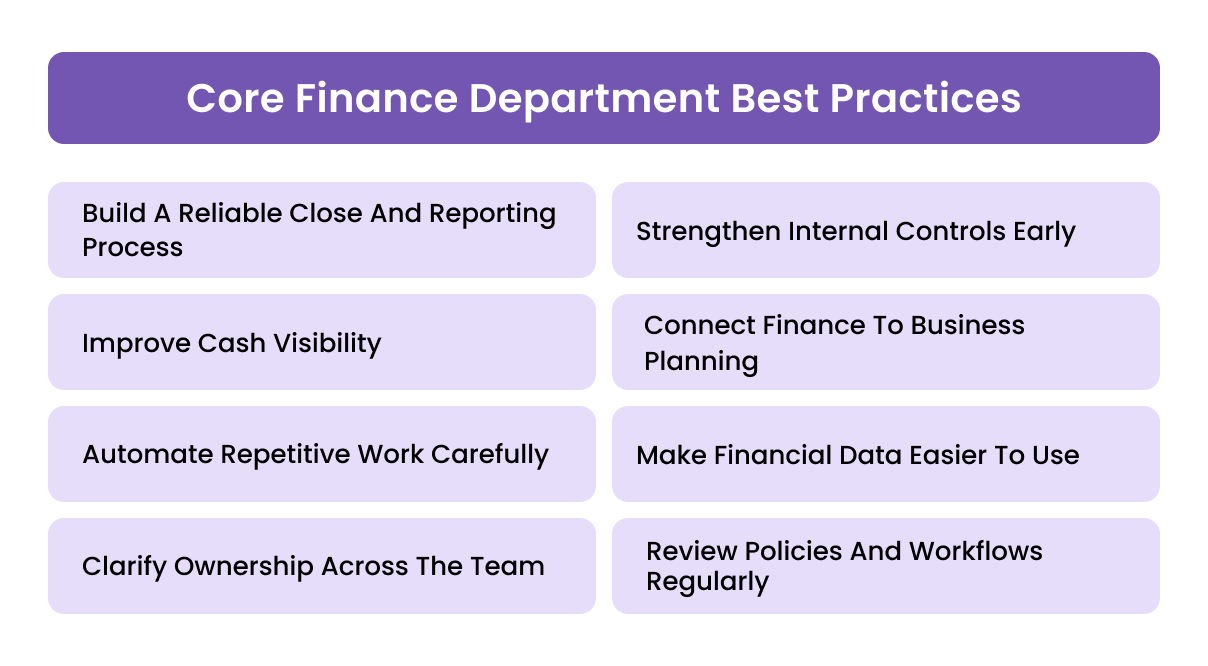
1. Build A Reliable Close And Reporting Process
A month-end close should not feel like a recurring rescue exercise. The stronger approach is to define ownership in advance, keep reconciliations current through the month, and standardise the close process enough that reporting does not depend on last-minute corrections.
Reliable reporting starts there. If the close is inconsistent, management reporting becomes slower, decision-making gets delayed, and confidence in the numbers starts weakening even when the team is working hard.
2. Strengthen Internal Controls Early
Controls usually become painful when they are added too late. A better approach is to build approval logic, documentation requirements, and segregation of duties into the finance workflow before transaction volume becomes harder to manage.
That matters because weak controls do not stay confined to finance. They spill into policy exceptions, avoidable spend, poor audit trails, and a higher risk of errors being discovered only after the fact.
3. Improve Cash Visibility
Cash visibility is one of the most practical measures of finance quality. A finance team does not need to predict everything perfectly, but it should have a clear enough view of inflows, outflows, obligations, and timing to flag pressure before it becomes disruptive.
That means cash should not be reviewed in isolation. It needs to be connected to payment timing, collections, upcoming commitments, and operational decisions that may change short-term liquidity.
4. Connect Finance To Business Planning
Finance works better when it is linked to the business rather than sitting beside it. Budgeting, cash planning, hiring decisions, purchasing activity, and commercial changes all affect financial performance, so the finance function needs enough visibility and influence to support those choices properly.
Where that connection is weak, finance often becomes reactive. The team records what happened, but it has too little influence on what should happen next.
5. Automate Repetitive Work Carefully
Automation can improve finance productivity, but it works best when the underlying process is already defined clearly. Automating a weak workflow usually makes errors faster rather than making finance better.
The useful target is repetitive manual work such as data capture, approval routing, document collection, reconciliation support, and recurring reporting tasks. Those are the areas where automation usually creates the clearest operational benefit. Finance leaders’ current emphasis on data, AI, and technology supports this direction, but the gains depend heavily on the strength of the underlying process design. (EY)
6. Make Financial Data Easier To Use
Finance data should not only satisfy compliance or reporting needs. It should help management understand spending patterns, margin pressure, cash usage, category trends, and operational risk in a form that is actually useful.
When reporting is technically correct but too late, too fragmented, or too hard to interpret, finance loses some of its value to the business. Better practice means making the numbers usable, not just available.
7. Clarify Ownership Across The Team
A finance department becomes more reliable when responsibilities are clearly assigned. That includes ownership for accounts payable, receivables, payroll, reporting, budgeting, tax, treasury, reconciliations, and policy enforcement where relevant.
Without that clarity, tasks start slipping between roles. Work gets duplicated in some areas, ignored in others, and escalated too late when something goes wrong.
8. Review Policies And Workflows Regularly
Good finance process design should not stay fixed forever. As the business grows, transaction volume rises, approval needs change, and the level of risk usually becomes more complex. Policies and workflows should evolve with that reality.
That does not mean redesigning everything constantly. It means checking whether the current finance operating model still fits the scale, risk profile, and reporting needs of the business.
Also Read: Automated Account Reconciliation Benefits Steps
Corporate Finance Organisational Structure
A good corporate finance organisational structure is not just an org chart. It is a way of assigning responsibility across reporting, controls, planning, cash management, and operational finance so the function can work consistently as the business grows. The more complexity a business carries, the more important that structure becomes.
A practical corporate finance organisational structure often includes:
- Leadership Layer
CFO, Head Of Finance, Or Finance Director Responsible For Direction, Oversight, And Decision Support - Controllership Layer
Financial Reporting, Close, Reconciliations, Controls, And Accounting Governance - Planning Layer
Budgeting, Forecasting, Management Reporting, And FP&A Support - Cash And Funding Layer
Liquidity Oversight, Banking Relationships, Payment Timing, And Treasury Activity Where Relevant - Transactional Finance Layer
Accounts Payable, Accounts Receivable, Payroll, Expense Processing, And Routine Financial Operations - Tax And Compliance Layer
VAT, Corporate Tax, Statutory Filings, Audit Coordination, And Policy Compliance
This structure does not need to exist as separate teams in every business. In smaller companies, one person may cover multiple areas. What matters is that the responsibilities are still defined clearly enough for the function to remain dependable.
Related: Understanding Chart Of Accounts Guide
Finance Department Organisation Structure By Business Stage
The right finance department organisation structure depends on how large the business is, how complex its operations have become, and how much transaction volume the team is expected to manage. A structure that works for an early-stage company often becomes too informal once the business adds more entities, more approvals, more reporting needs, or more regulatory exposure.
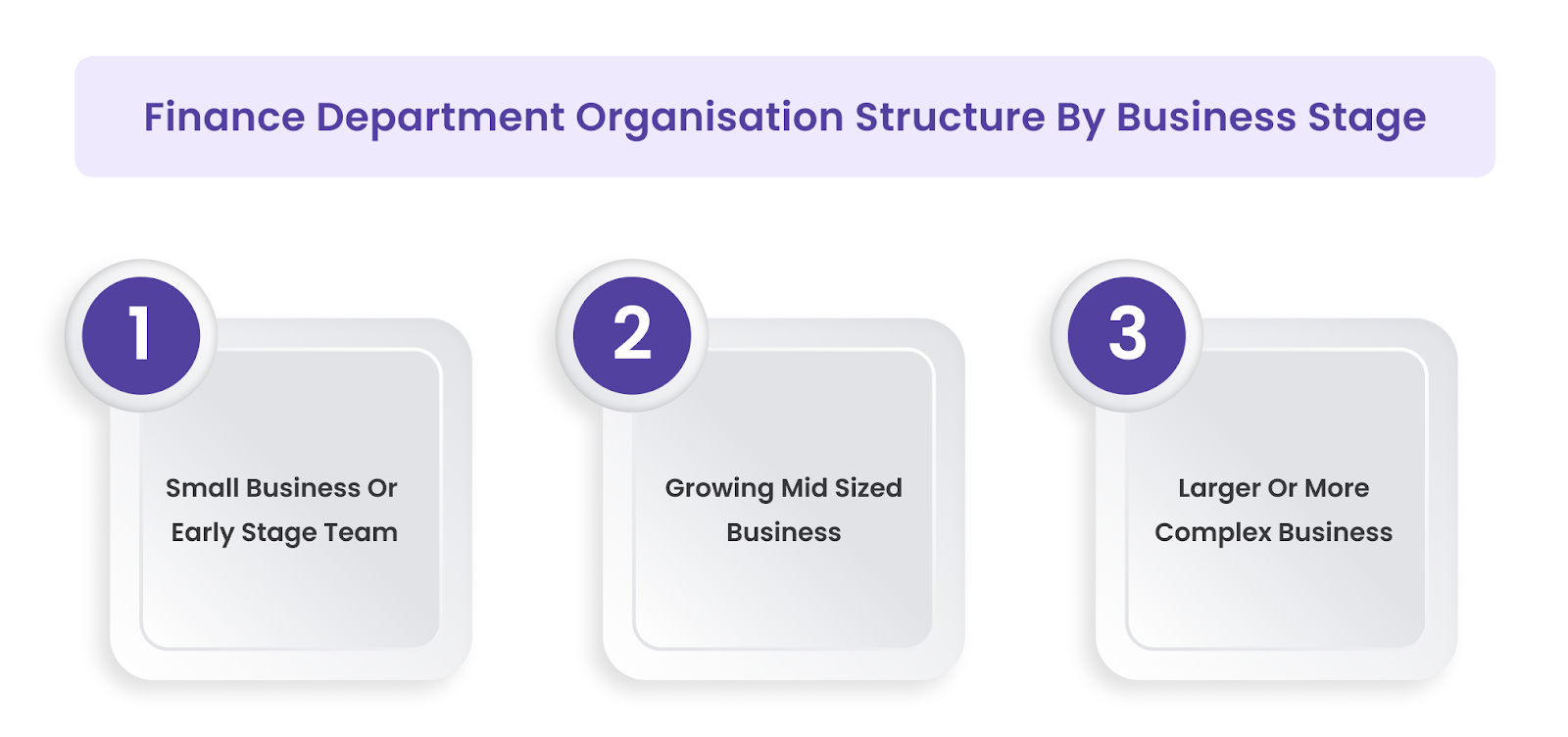
That is why finance structure should be viewed as something that evolves with the business. The goal is not to create layers for the sake of it. The goal is to make sure ownership, control, and reporting quality keep improving as complexity rises.
- Small Business Or Early Stage Team
In a smaller business, the finance structure is usually lean. One finance lead may oversee budgeting, reporting, payments, and controls, with bookkeeping or external support covering part of the transactional work. This can work well if processes are clear and the volume is still manageable. - Growing Mid Sized Business
As the business grows, finance usually needs clearer separation between transactional work and higher-value finance responsibilities. Reporting, budgeting, reconciliations, payable operations, receivables, and spend control start needing more distinct ownership so that the function does not become overly dependent on one person. - Larger Or More Complex Business
In a more developed structure, the finance department often becomes more specialised. Controllership, FP&A, treasury, tax, compliance, and transactional finance may sit as clearer lanes within the function. That makes it easier to maintain control without slowing down the wider business.
Also Read: Business Budget Startups UAE
The Processes That Usually Break First In Weak Finance Departments
Weak finance departments rarely fail all at once. Problems usually begin in the routine processes that depend on consistency, ownership, and timely follow-through. When those foundations weaken, the wider finance function starts becoming slower, noisier, and less reliable.
These are usually the first areas where strain becomes visible:
- Month End Close Becomes Unreliable
Close timelines start slipping, journal entries increase late in the process, and reporting quality begins depending on last-minute correction rather than routine discipline. - Approvals Happen Informally
Spend decisions move through messages, verbal confirmations, or unclear escalation paths, which weakens control and makes audit trails harder to follow later. - Cash Visibility Is Too Delayed
Finance no longer has a strong enough view of upcoming obligations, payment timing, or short-term liquidity to spot pressure early. - Reporting Arrives Too Late To Support Decisions
The numbers may still be accurate eventually, but by the time they reach management, they are less useful for active decision-making. - Reconciliations Fall Behind
When reconciliations stop keeping pace, the risk of unresolved differences, reporting errors, and weaker confidence in balances starts rising quickly. - Too Much Depends On One Person
One individual often becomes the informal control point for too many tasks, which creates operational risk and makes the function harder to scale.

Related: Understanding Recording Business Expenses Efficiency Strategies
Common Mistakes In Finance Department Design
Finance departments often become inefficient not because the team lacks technical ability, but because the design of the function does not match the reality of the business. In many cases, the problems come from unclear ownership, weak process design, or an overreliance on tools without enough operating discipline behind them.
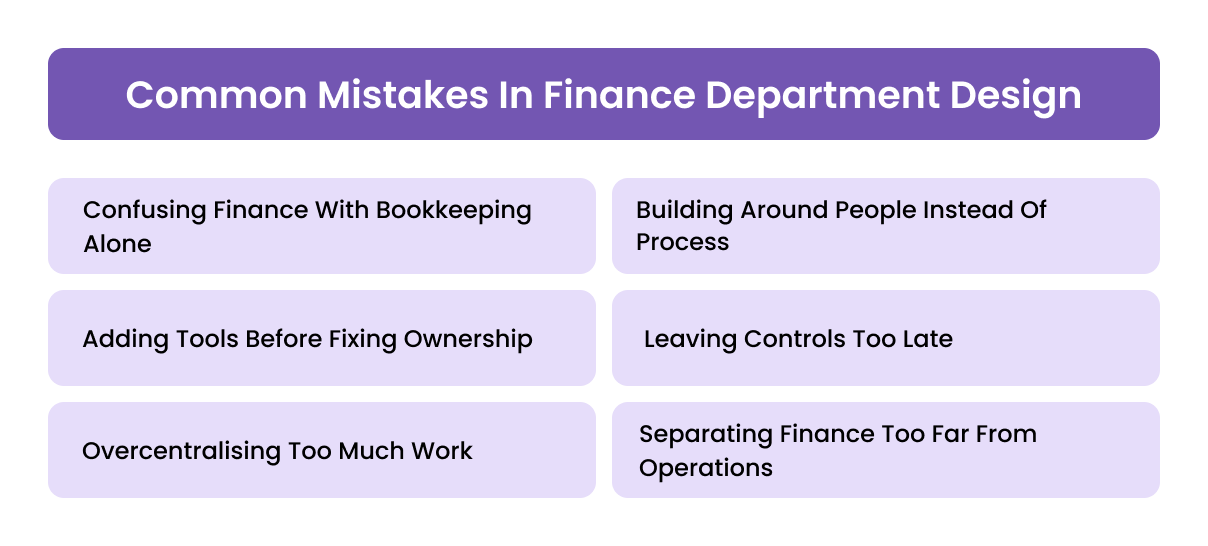
Some of the most common design mistakes include:
- Confusing Finance With Bookkeeping Alone
Bookkeeping is essential, but finance has a broader role. A strong function should also support controls, planning, reporting, and decision-making. - Building Around People Instead Of Process
When the function depends too heavily on how one person works, it becomes fragile. Good process should survive role changes, leave cover, growth, and handovers. - Adding Tools Before Fixing Ownership
New systems do not automatically solve weak finance design. If responsibility is unclear, the business often ends up with more software but not better outcomes. - Leaving Controls Too Late
Controls become harder to introduce once informal habits are already embedded. It is easier to build approval logic and documentation discipline early than to retrofit them later. - Overcentralising Too Much Work
When too many tasks sit with one central finance bottleneck, response times slow down and operational teams begin working around the process instead of through it. - Separating Finance Too Far From Operations
Finance works better when it understands what is happening commercially and operationally. If the function becomes too isolated, reporting may stay technically correct while becoming less useful.
Also Read: Guide To Manage Overall Spending
How Alaan Supports Stronger Finance Department Workflows
Many finance issues do not begin at month-end. They begin earlier, when spend happens without proper controls, approvals, or supporting records. That is where Alaan is relevant. It helps finance teams manage day-to-day spend through corporate cards, spend controls, approval workflows, receipt capture, AI verification, and accounting integrations, so finance gets better visibility before problems reach reporting.
- Corporate Cards With Spend Limits And Vendor Controls
Alaan lets businesses issue corporate cards with spending limits and vendor restrictions. That gives finance teams tighter control over who can spend, how much can be spent, and where that spend can happen. - Approval Workflows Before Spend Is Finalised
Alaan supports custom approval workflows, so purchases and expenses can follow the right approval path before they become part of the month’s spend. That reduces informal approvals and improves policy consistency. - Real-Time Visibility Into Company Spend
Finance teams can see transactions as they happen across employees, teams, vendors, and categories. That makes it easier to spot category spikes, policy exceptions, and unusual spend patterns before month-end. - Receipt Capture And Supporting Documentation
Employees can upload receipts and invoices through the mobile app, Chrome extension, or email, so finance has cleaner supporting records attached to each transaction instead of chasing documents later. - AI Verification And Duplicate Detection
Alaan extracts receipt data, matches it to transactions, and flags inconsistencies or duplicates. That reduces manual checking and helps finance review expenses more efficiently. - Accounting Integration For Faster Reconciliation
Alaan integrates with Xero, QuickBooks, NetSuite, and Microsoft Dynamics, allowing expense data to sync in real time. That makes reconciliation cleaner and reduces manual re-entry during close.

In practice, this helps finance teams spend less time cleaning up fragmented spend data and more time focusing on control, reporting, and decision support.
Conclusion
Finance department best practices are not only about technical accuracy. They are about building a finance function that closes reliably, controls risk, supports decisions, and scales without losing visibility. The right structure matters because unclear ownership eventually turns into delayed reporting, weaker controls, and avoidable operational friction.
The stronger finance departments are usually not the ones with the most complicated setup. They are the ones with clearer process design, better role clarity, stronger workflow discipline, and more reliable visibility into what is happening across the business.
Alaan helps finance teams strengthen that day-to-day operating layer with corporate cards, spend controls, approval workflows, real-time visibility, cleaner documentation, and faster reconciliation. That gives finance a better grip on the workflows that shape reporting quality in the first place. Book a Demo Today!
For finance leaders
- Financial controller vs CFO and other roles explains who does what, and when it's time to hire a controller.
- Setting a vision for the finance department includes example statements and a 12 to 36 month roadmap.
- Building internal financial controls is a short guide to segregation of duties and monitoring.
- Opportunity cost is worth a read before the next budget meeting, since it gives you a way to compare options that all sound important.
If you want an honest read on where your own finance function sits today, the CFO self-assessment takes a few minutes and costs less than a consultant. Once you know the gaps, our piece on defining a finance department vision helps turn them into goals and KPIs the team can actually be measured against.
FAQs
1. What is the biggest sign that a finance department needs a process reset?
One of the clearest signs is when the team is constantly fixing issues late rather than preventing them early. That often shows up through delayed close, weak approval trails, reconciliation backlogs, or too much dependence on one person.
2. How should a finance department balance control with business speed?
The goal is not to slow everything down. It is to build controls into the workflow early enough that routine activity can move quickly without creating risk later. Good finance design makes compliant activity easier, not heavier.
3. When should a growing business separate finance roles more clearly?
Usually, when transaction volume, reporting needs, or operational complexity start making one-person oversight too risky. That is often the point where accounts payable, reporting, reconciliations, budgeting, and control work need clearer ownership.
4. Does automation fix weak finance processes automatically?
No. Automation helps only when the underlying process is already clear enough to automate properly. If ownership is weak or approvals are inconsistent, automation usually just makes the confusion move faster.
5. What should a finance team review monthly even in a smaller business?
At minimum, teams should review cash position, payables, receivables, budget versus actual, unusual spend movement, and key reconciliations. The point is to catch pressure early, not wait for year-end reporting to expose it.
6. What is the difference between a finance function and basic bookkeeping?
Bookkeeping focuses on recording transactions accurately. A broader finance function also covers controls, cash visibility, budgeting, reporting, planning, and decision support. A business needs both, but they are not the same job.
Gain control over business expenses with Alaan corporate cards
Invygo earned AED 100,000 in cashback using Alaan cards
Personalise approval workflows to align with your business needs with Alaan's Spend Management platform
Discover the power of automated expense tracking and smarter spend control with Alaan
Turn data into actionable insights with Alaan's spend management tools
Stay Tax Compliant with UAE's #1 Corporate Card and Spend Management Platform
Customisable corporate card policy template
Know how much Corporate Tax you have to pay this fiscal year
Easily integrate Alaan with your ERP for accurate, real-time expense tracking
Close books faster with Alaan's AI-powered accounting automation
Reconcile your books in minutes instead of hours, every single month.
Keep petty cash organized with Alaan corporate cards and automated expense management