.avif)


In a hospital, procurement decisions affect much more than ordering speed or negotiated price. They influence whether clinical teams get the right equipment on time, whether suppliers can support maintenance and servicing, and whether the organisation can keep operations running without avoidable disruption. That is why the hospital procurement process should be treated as a control and continuity function, not just a purchasing workflow.
This matters because healthcare procurement sits closer to service delivery than procurement in many other industries. Global health guidance stresses that medical devices and health technologies need to be safe, effective, high-quality, and appropriate for the intended environment, while research on healthcare equipment procurement consistently points to lifecycle cost, maintenance, and usability as core decision factors rather than optional extras.
In this blog, you’ll understand how the hospital procurement process works, why healthcare procurement is more complex than standard purchasing, and how hospitals can improve control, supplier evaluation, and long-term value.
TL;DR / Key Takeaways
- Hospital Procurement Is Not Only About Buying Supplies; It Supports Clinical Continuity, Compliance, And Cost Control
- A Strong Healthcare Procurement Process Starts With Need Assessment And Ends With Delivery, Acceptance, Documentation, And Supplier Review
- In Procurement In Healthcare, The Lowest Upfront Price Is Often Less Useful Than Lifecycle Value
- Most Hospital Procurement Problems Come From Weak Specifications, Fragmented Approvals, Limited Spend Visibility, And Poor Supplier Evaluation
- At Alaan, We Help Finance And Procurement Teams Strengthen Approvals, Documentation, Spend Visibility, And Payment Control Across Operational Purchasing
Related: Hospital Spend Optimisation Strategies
What Is The Hospital Procurement Process
The hospital procurement process is the structured method hospitals use to identify need, define specifications, evaluate suppliers, obtain approvals, place orders, receive goods, verify delivery quality, and maintain the documentation needed for financial and operational control. In healthcare, that process has to balance commercial discipline with clinical suitability, supplier reliability, and ongoing service requirements.

This is what makes procurement in healthcare different from routine enterprise purchasing. Public healthcare procurement systems in the UAE already reflect that structure through formal electronic tendering, separate technical and financial offers, and controlled vendor participation rules. That alone shows that hospital procurement is not an informal buying activity. It is a governed process with operational consequences.
- Why Procurement In Healthcare Is Different
Hospitals buy categories where quality, uptime, compatibility, and service support matter alongside price. A weak purchase decision can create operational issues long after the invoice has been approved. - What Hospitals Usually Procure
Hospital procurement can cover medical equipment, diagnostic systems, consumables, laboratory items, pharmaceuticals, facilities-related supplies, IT-linked health technology, maintenance services, and other operational categories tied to patient care. - Why Procurement Quality Matters In Clinical Settings
In healthcare, a poor procurement decision can affect delivery timelines, maintenance quality, equipment usability, and clinical readiness. That is why procurement quality needs to be judged more broadly than simple purchase cost.
Also Read: Hospital Operating Expenses Breakdown
Why Procurement In Healthcare Industry Is More Complex
Healthcare procurement is more complex because hospitals do not only buy products. They buy reliability, technical fit, service continuity, and documentation quality. Research on medical equipment procurement makes this clear by linking procurement quality to needs assessment, technical specifications, maintenance planning, and the broader operating environment in which the equipment will actually be used.
That complexity increases further because procurement decisions often involve more than one stakeholder group. Clinical users may define functional need, biomedical or technical teams may assess compatibility and serviceability, procurement may manage vendor comparison, and finance may assess budget and payment control. If those inputs stay disconnected, hospitals can end up buying equipment that looks commercially acceptable but performs poorly in practice.
- Clinical Impact Of Procurement Decisions
Equipment and supply decisions can affect diagnostic quality, treatment continuity, and staff workflow. That makes procurement more operationally sensitive than standard indirect purchasing. - Regulatory And Documentation Requirements
Healthcare purchases often require stronger documentation, clearer specifications, and more formal supplier evaluation because the products may be linked to safety, quality, or regulated use. - Supplier Qualification And Reliability
Hospitals need more than a quotation. They need confidence in service capability, installation readiness, after-sales support, and delivery consistency. - Maintenance And Uptime Dependencies
A product that is difficult to maintain or poorly supported may create higher long-term cost and operational risk even if its purchase price looks attractive. - Inventory Sensitivity For Critical Items
Delays or procurement errors can create more serious consequences in healthcare categories where continuity of supply matters directly to care delivery.
Related: Guide Logistics Spend Analysis
The Main Steps In A Healthcare Procurement Process
A strong healthcare procurement process usually follows a defined sequence. The exact workflow may differ across private hospitals, public systems, and specialist facilities, but the underlying logic is consistent: identify the need clearly, specify it properly, compare suppliers on more than price, control approvals, verify delivery, and monitor supplier performance after award.

1. Identify The Clinical Or Operational Need
The process should begin with a real and properly defined requirement. That may come from a clinical department, biomedical engineering, laboratory operations, pharmacy, facilities, or administration. The important point is that the request should reflect an actual operational need rather than a vague purchasing preference.
If this stage is weak, the rest of the process becomes less reliable. Supplier comparison does not work well when the business itself has not yet defined what it needs clearly enough to evaluate properly.
2. Define Specifications Clearly
Technical and operational specifications are central to hospital procurement. Hospitals need clarity on functionality, compatibility, installation requirements, servicing expectations, training needs, and documentation requirements before they compare suppliers. Guidance and research on healthcare equipment procurement repeatedly show that appropriate specification design is one of the strongest predictors of better purchasing outcomes.
A weak specification usually creates problems later in the process. Suppliers may quote against different assumptions, evaluation becomes inconsistent, and the final purchase may not match the environment in which the equipment or product will actually be used.
3. Assess Budget And Total Cost
Hospitals should look beyond purchase price alone. The real cost of a procurement decision can include installation, maintenance, consumables, servicing, training, spare parts, downtime exposure, and replacement implications. Research on healthcare procurement and lifecycle costing supports this broader approach because siloed purchasing decisions often reduce overall cost-effectiveness rather than improve it.
That is why healthcare procurement should evaluate budget in two layers: whether the organisation can afford the acquisition now, and whether it can support the asset or supply category properly over time.
4. Source And Evaluate Suppliers
Once the requirement is clear, procurement can compare suppliers more meaningfully. In hospital procurement, that comparison should include product quality, certifications, service support, delivery capability, maintenance readiness, and vendor reliability rather than focusing only on headline price.
The supplier decision matters because hospitals often depend on post-purchase support long after delivery. A cheaper supplier that cannot support installation, training, spare parts, or response times may become more expensive in operational terms later.
5. Run Tender Or Quotation Review
Formal tendering or structured quotation comparison helps hospitals evaluate suppliers more consistently. In UAE public healthcare procurement, electronic tender submission, formal bid conditions, and separate technical and financial offers already show how structured this stage can be in practice.
This matters because the hospital procurement process works better when technical fit is assessed properly before price becomes the deciding factor. Otherwise, commercial comparison can overpower operational suitability too early.
6. Approve And Place The Order
Hospital procurement often requires approval across more than one function. Procurement, finance, operations, and user departments may all need visibility depending on the size or sensitivity of the purchase. A good approval process should therefore be clear enough to control risk without becoming so fragmented that it slows essential procurement unnecessarily.
7. Receive Inspect And Accept
Procurement does not end when the goods arrive. Hospitals should verify that delivery matches the specification, that condition and documentation are complete, and that installation or usability requirements are properly addressed where relevant. This is especially important for higher-value or clinically significant items because acceptance errors can create operational issues that are harder to unwind later.
8. Monitor Supplier Performance
A strong hospital procurement process includes review after purchase. That means tracking delivery performance, support quality, maintenance responsiveness, documentation standards, and whether the supplier met the expectations used in the award decision.
This final stage matters because supplier performance is one of the most useful inputs for future procurement decisions. Without that feedback loop, hospitals risk repeating the same procurement weaknesses in the next cycle.
Also Read: Procurement Automation Software Solution
What Hospitals Should Evaluate Before Buying
Hospitals usually make better procurement decisions when evaluation starts before quotations are compared. By the time pricing discussions begin, the organisation should already be clear on whether the product is clinically appropriate, technically suitable, supportable, and financially sensible over time.
That matters because healthcare procurement quality is shaped by more than the purchase event itself. Research on medical equipment procurement repeatedly shows that need definition, technical appropriateness, maintenance planning, and lifecycle suitability all influence whether a purchase performs well after delivery.
- Clinical Suitability
The product or equipment should match the actual use case, patient environment, and service requirement rather than looking broadly acceptable on paper. - Technical Specifications
Hospitals need clarity on performance, compatibility, installation conditions, and any supporting infrastructure needed to use the item properly. - Supplier Reliability
A quotation is only one part of supplier assessment. Delivery performance, support quality, response time, and service capability matter just as much in hospital procurement. - Maintenance And Service Support
In many healthcare categories, the real procurement risk appears after the item is delivered. If maintenance support is weak, the hospital may face higher downtime and more operational disruption later. - Warranty Terms
Warranty coverage should be reviewed for scope, exclusions, duration, and how support is actually delivered in practice. - Training Requirements
Some products only create value if users are trained properly. That makes training part of procurement quality, not a separate issue to be addressed later. - Installation Readiness
Hospitals should confirm whether site preparation, utilities, integration requirements, or technical setup conditions are already in place before the order moves forward. - Consumables And Ongoing Usage Cost
Some purchases create long-term spend commitments through consumables, replacement parts, or service dependencies. Those costs should be evaluated early. - Regulatory And Documentation Fit
Supporting documentation, certifications, and any relevant compliance records should be part of the evaluation, especially where the category has stronger quality or regulatory sensitivity. - Total Cost Of Ownership
A good hospital procurement decision looks beyond the quoted price and asks what the item will really cost to run, support, maintain, and replace over its useful life.
Related: Guide Logistics Spend Analysis
Why Lowest Price Is Not Enough In Hospital Procurement
The lowest quoted price can look attractive during supplier comparison, but in hospital procurement that is often too narrow a basis for decision-making. A cheaper product may still become the more expensive choice once servicing, maintenance, downtime, consumables, and usability are taken into account.
That is why healthcare procurement benefits from a lifecycle view rather than a purchase-price view. Research on value-based procurement and medical-device acquisition supports this broader logic: the better decision is often the one that improves quality, suitability, and long-term value rather than simply reducing the initial transaction cost.
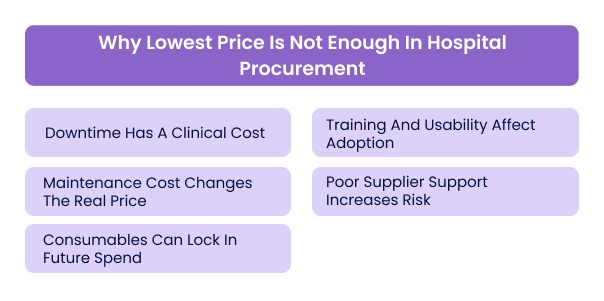
- Downtime Has A Clinical Cost
If a critical item becomes unavailable because support is weak or service is slow, the effect is not only financial. It can also disrupt clinical workflow and care continuity. - Maintenance Cost Changes The Real Price
A lower purchase price can be offset quickly by higher maintenance frequency, expensive spare parts, or weaker support coverage. - Consumables Can Lock In Future Spend
Some equipment decisions create ongoing dependence on a specific consumables ecosystem, which changes the true long-term cost of the purchase. - Training And Usability Affect Adoption
If the product is difficult to use or poorly supported, the hospital may not realise the value it expected from the purchase. - Poor Supplier Support Increases Risk
Procurement quality includes what happens after delivery. A supplier that cannot support installation, troubleshooting, or follow-up effectively may create more operational pressure later.
Also Read: Understanding Cost Management Key Steps Benefits
Common Problems In The Hospital Procurement Process
Hospital procurement problems usually begin before purchase orders are issued. In many cases, the issue is not that teams fail to buy at all, but that specifications are unclear, approvals are fragmented, supplier evaluation is too commercial, or documentation quality weakens as the process moves across departments.
That pattern is common in healthcare procurement because the workflow sits across clinical users, procurement, finance, technical teams, and suppliers. When those handoffs are weak, hospitals often end up with delay, rework, cost leakage, or products that do not perform as expected in the real operating environment.
- Weak Initial Specifications
If the requirement is vague, supplier comparison becomes unreliable from the beginning. - Too Much Focus On Unit Price
Price-only comparison can hide longer-term cost and operational risk. - Supplier Evaluation That Stops At Commercial Terms
Hospitals need stronger review of service capability, support, and reliability, not just quotation differences. - Fragmented Approval Chains
If too many approvals happen informally or late, the process slows down and accountability becomes harder to track. - Missing Documentation
Poor documentation weakens audit trail quality and makes later review more difficult. - Poor Visibility Into Category Spend
Without clearer spend visibility, it becomes harder to identify overbuying, duplicate purchasing, or inconsistent vendor usage. - Delayed Delivery Or Installation
Procurement success depends on operational readiness after award, not just contract issuance. - Weak Post Purchase Review
If supplier performance is not assessed after delivery, the hospital loses one of its best inputs for improving future procurement decisions.

Related: Business Spend Management Tools Importance
How To Improve Healthcare Procurement
Improving healthcare procurement usually starts with better structure, not more complexity. Hospitals tend to get better results when requests are standardised, approvals are clearer, supplier evaluation is more complete, and procurement decisions are linked more closely to finance and operational follow-through.
The aim is not simply to buy faster. It is to buy with better control, better documentation, and better long-term outcomes. In healthcare settings, that usually means improving the quality of the workflow around procurement, not only the negotiation stage itself.
1. Standardise Request And Approval Workflows
Hospitals should make it easier for departments to raise requests in a consistent format with clear specifications, budget context, and approval routing. That reduces ambiguity and improves review quality.
2. Involve Clinical And Technical Teams Earlier
Clinical and technical input should appear before supplier comparison is finalised, not after. That helps procurement assess suitability more accurately and reduces the risk of buying a technically acceptable but operationally weak solution.
3. Compare Suppliers On Lifecycle Value, Not Only Quoted Price
A better evaluation framework should include support quality, maintenance, reliability, consumables, training, and service responsiveness alongside the initial quote.
4. Improve Documentation And Audit Trail Quality
Hospitals benefit when supporting documents, approvals, vendor records, and procurement decisions are easier to trace. That improves control and reduces friction later in finance and compliance review.
5. Track Supplier Performance After Award
Post-purchase review should become part of the procurement process rather than an optional extra. Delivery quality, support quality, and operational performance are too important to ignore once the order is complete.
6. Build Better Visibility Into Procurement Spend
Clearer category and supplier-level visibility helps hospitals identify spend concentration, recurring cost pressure, and inconsistent procurement behaviour across departments.
7. Reduce Manual Handoffs Between Procurement And Finance
A smoother workflow between procurement and finance improves payment readiness, supporting-document quality, and the speed with which transactions move into accounting review.
Also Read: Automated Procurement Processes Workflows
Where Alaan Fits In The Hospital Procurement Process
At Alaan, we fit into hospital procurement at the financial workflow layer rather than the clinical sourcing layer. The value is in helping hospitals and healthcare operators manage procurement-related spend through corporate cards, spend controls, approval workflows, receipt capture, AI verification, and accounting integrations, so operational purchasing becomes easier to review, document, and control.

- Corporate Cards With Spend Limits And Vendor Controls
Alaan lets businesses issue corporate cards with spending limits and vendor restrictions. That helps hospitals apply clearer control to operational purchases and reduces ad hoc buying outside approved boundaries. - Approval Workflows Before Spend Is Finalised
Alaan supports custom approval workflows, so procurement-related purchases can be reviewed before money is committed. That helps hospitals strengthen control across departments, sites, and operational teams. - Real-Time Visibility Into Procurement Spend
Finance teams can see transactions as they happen across employees, vendors, and categories. That makes it easier to track purchasing patterns, identify unusual supplier activity, and spot spend building outside expected behaviour. - Receipt Capture And Supporting Documentation
Employees can upload receipts and invoices through the mobile app, Chrome extension, or email, so procurement-related transactions carry cleaner supporting records from the start. - AI Verification And Duplicate Detection
Alaan extracts receipt data, matches it to transactions, and flags inconsistencies or duplicates. That reduces manual checking and helps finance teams review procurement-related spend more efficiently. - Accounting Integration For Cleaner Reconciliation
Alaan integrates with Xero, QuickBooks, NetSuite, and Microsoft Dynamics, allowing expense data to sync in real time. That makes operational purchasing easier to reconcile and improves the audit trail between procurement activity and finance records.

In practice, that gives hospitals a stronger control layer around operational purchasing, with better visibility before the transaction turns into a month-end finance issue.
Related: Control Employee Expenses Improve Spending Management
Conclusion
The hospital procurement process is not just a purchasing routine. It is a control process that affects supplier reliability, documentation quality, budget discipline, and continuity of care. The stronger hospital procurement models are usually the ones that combine clear specifications, better supplier evaluation, lifecycle thinking, and cleaner workflow discipline around approvals and follow-through.
For hospitals and healthcare operators, the more useful goal is not simply to buy faster or at the lowest upfront cost. It is to procure in a way that supports service continuity, financial control, and long-term value.
Alaan helps strengthen that operating layer with corporate cards, spend limits, approval workflows, real-time visibility, cleaner documentation, and faster reconciliation. That makes procurement-related spend easier to control, easier to review, and easier to connect back to finance. Book a Demo Today!
Once the award is made and the goods arrive, the invoices still need checking and paying, and our guide to AP automation explains how busy finance teams take the manual matching out of that step.
FAQs
1. What makes hospital procurement different from general procurement?
Hospital procurement is more operationally sensitive because purchases can affect clinical readiness, maintenance continuity, regulatory fit, and service delivery, not just cost and timing.
2. Why is lowest price often a weak basis for hospital procurement decisions?
Because the real cost of a healthcare purchase may include installation, servicing, downtime, consumables, training, and support quality. A lower upfront price can still produce a worse long-term outcome.
3. Who should usually be involved in hospital procurement decisions?
That depends on the category, but hospitals often need input from clinical users, procurement, finance, technical or biomedical teams, and sometimes facilities or IT, depending on the purchase.
4. Why do hospital procurement processes often become slow or fragmented?
Usually, because specifications are unclear, approvals are spread across too many handoffs, or supplier evaluation and documentation are not structured well enough from the start.
5. What is one of the most common mistakes hospitals make when buying equipment?
Focusing too narrowly on the purchase event instead of the full operating reality. Equipment value depends on fit, support, servicing, training, and long-term usability after delivery.
6. How should hospitals review supplier performance after a purchase?
They should look beyond whether delivery happened. Useful review points usually include support quality, maintenance responsiveness, documentation quality, installation readiness, and whether the supplier met the expectations used during award.
Gain control over business expenses with Alaan corporate cards
Invygo earned AED 100,000 in cashback using Alaan cards
Personalise approval workflows to align with your business needs with Alaan's Spend Management platform
Discover the power of automated expense tracking and smarter spend control with Alaan
Turn data into actionable insights with Alaan's spend management tools
Stay Tax Compliant with UAE's #1 Corporate Card and Spend Management Platform
Customisable corporate card policy template
Know how much Corporate Tax you have to pay this fiscal year
Easily integrate Alaan with your ERP for accurate, real-time expense tracking
Close books faster with Alaan's AI-powered accounting automation
Reconcile your books in minutes instead of hours, every single month.
Keep petty cash organized with Alaan corporate cards and automated expense management