.avif)

A practical look at how UAE businesses can tighten procurement to stop spend leakage and keep control as they scale in 2026.
- Control spend before it slips away by putting approvals, supplier payments, and VAT checks on one system, instead of untangling them during a two-day month-end firefight.
- Most spend leakage starts inside the business, with approvals scattered across email, spreadsheets, and chat apps and off-contract buying that finance only catches weeks later.
- The UAE recently announced AED 180 billion in industrial procurement opportunities, so speed, compliance, and supplier visibility matter more as businesses grow.
- Alaan connects supplier payments through SuperPay, corporate cards with vendor-specific controls, automated invoice and VAT capture, and accounting syncs so procurement stops springing surprises on finance later.
Your finance team should not discover a procurement mistake only after the supplier has already been paid, the invoice is missing, and month-end reconciliation turns into a two-day firefight.
Yet that is exactly how procurement still works in many growing UAE businesses: scattered approvals, duplicate vendor payments, uncontrolled departmental spending, and zero real-time visibility until cash flow starts to tighten.
That pressure is only increasing. The UAE recently announced AED 180 billion in new industrial procurement opportunities as part of its long-term supply chain expansion plans, making procurement speed and control more important than ever for businesses scaling in the region.
For businesses operating in the UAE, strategic procurement is no longer just about negotiating better vendor rates. It is becoming the system that determines how efficiently a company controls spending, manages suppliers, protects margins, and scales operations in 2026.
Key Takeaways:
- Procurement Is Becoming Infrastructure: The UAE recently announced AED 180 billion in industrial procurement opportunities, making procurement speed, compliance, and supplier visibility increasingly critical for scaling businesses.
- Spend Leakage Often Starts Internally: Many UAE businesses still manage procurement through emails, spreadsheets, and messaging apps, creating weak audit trails, delayed approvals, and uncontrolled off-contract spending.
- Strategic Procurement Goes Beyond Cost-Cutting: Modern procurement frameworks now evaluate supplier risk, VAT compliance, FX exposure, payment terms, and long-term operational value instead of simply choosing the cheapest vendor.
- E-Invoicing Will Reshape Procurement Workflows: As the UAE moves toward mandatory e-invoicing, procurement teams will increasingly need automated invoice validation, TRN verification, and structured digital audit trails.
- How Alaan Modernises Procurement: Alaan helps UAE businesses centralise supplier payments, automate approvals, sync procurement with accounting systems, enforce spend controls through corporate cards, and improve real-time procurement visibility.
What Is Strategic Procurement Exactly?
Strategic procurement is the process of managing purchasing decisions to support a company’s long-term financial, operational, and growth goals, not just its immediate buying needs.
Unlike traditional procurement, which focuses mainly on getting the lowest price quickly, strategic procurement looks at the bigger picture: supplier reliability, payment terms, operational risk, cash flow impact, compliance, and long-term business value.
The shift is fundamental: modern procurement has transitioned from a back-office cost-cutting exercise to a live business control system that ensures every dirham creates measurable operational value.
But once procurement starts influencing cash flow, compliance, approvals, and operational speed simultaneously, the weaknesses in traditional systems become much harder to ignore.
Also Read: How UAE Businesses Can Reduce Procurement Costs with These 20 Strategies
What starts as a procurement problem often ends up becoming a finance visibility problem.
Biggest Procurement Challenges UAE Businesses Still Face
Businesses still relying on spreadsheets, scattered approvals, and manual invoice matching are increasingly finding procurement delays turning into cash-flow and compliance problems.
Some of the biggest procurement challenges UAE businesses still face include:
- Approvals spread across disconnected channels
Purchase requests still move through emails, Excel sheets, ERP comments, and messaging apps, creating delays and weak audit trails. - Poor visibility into supplier spend
Finance teams often cannot track committed spend, recurring vendor costs, or department-wise procurement exposure in real time. - VAT and invoice compliance slowing procurement cycles
Missing TRNs, non-compliant invoices, and delayed VAT verification increasingly create payment bottlenecks and reconciliation pressure. - Cross-border supplier payment inefficiencies
Businesses managing regional and international vendors frequently deal with FX markups, delayed settlements, fragmented banking workflows, and inconsistent payment visibility. - Manual procurement reconciliation
Procurement and finance teams still spend hours matching invoices, approvals, vendor records, and payment confirmations manually across disconnected systems. - Off-contract and uncontrolled spend leakage
Smaller operational purchases often bypass procurement controls entirely, creating “maverick spend” categories that become difficult to track centrally. - Disconnected procurement and finance operations
Procurement decisions happen first while finance teams only see the financial impact later during cash-flow reviews, reconciliation, or VAT filing cycles. - Difficulty scaling procurement across entities and regions
As businesses expand across the GCC, maintaining consistent supplier controls, approval hierarchies, and procurement governance becomes significantly more complex. - Procurement systems struggling to keep up with digital transformation
Many organisations still operate procurement processes designed for slower supplier ecosystems and lower transaction volumes, despite increasing pressure for automation and real-time visibility.
The challenge is that most UAE businesses are still trying to manage this entire procurement cycle across disconnected systems.
The Strategic Procurement Process: How It Actually Works
Moving beyond theory, the strategic procurement process is a continuous cycle designed to ensure that every dirham spent is an intentional investment. In the UAE's high-velocity market, this process transforms purchasing from a reactive need-and-buy habit into a proactive financial strategy.
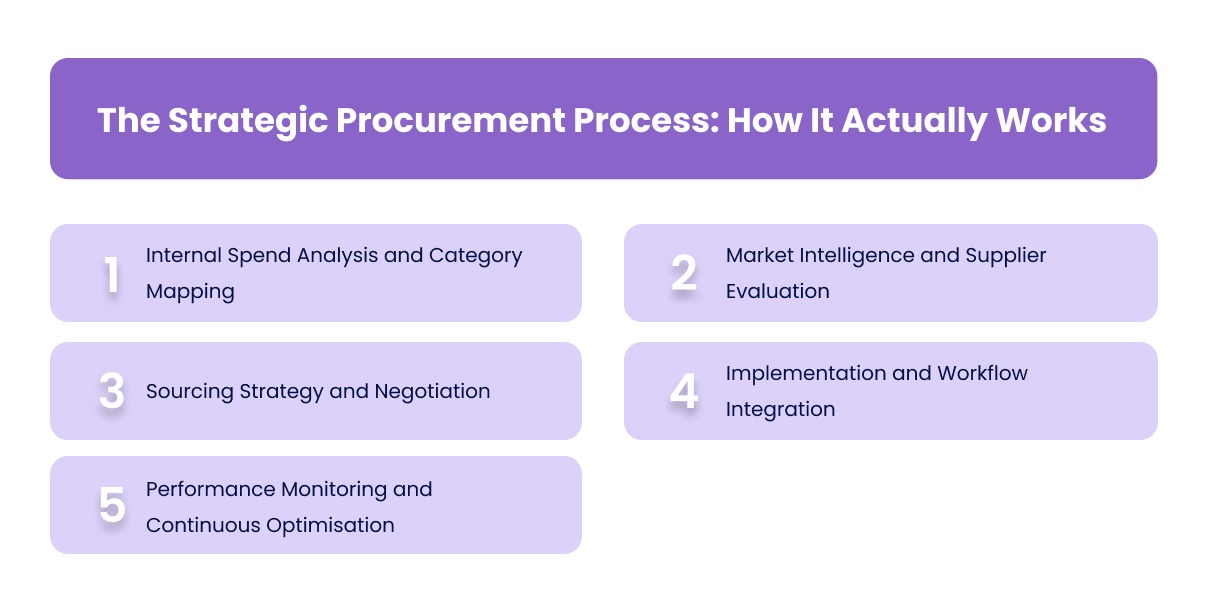
1. Internal Spend Analysis and Category Mapping
The process begins with a deep dive into historical data. The finance team audits previous spending to categorise costs into buckets such as raw materials, office overheads, and third-party services.
By identifying which departments are spending the most and with which vendors, the business can spot fragmentation: where multiple teams are buying the same service from different providers at varying rates and consolidate that volume to gain leverage.
2. Market Intelligence and Supplier Evaluation
Once the business knows what it spends, it looks outward. This stage focuses on identifying suppliers that match operational, financial, and compliance requirements for long-term scalability. Strategic procurement looks past the lowest bidder and evaluates vendors based on:
- Financial Stability: Can the supplier scale with your business?
- Geographic Risk: How do regional shipping lanes or FX fluctuations affect their reliability?
- Technical Capability: Do they support digital invoicing and automated reconciliation?
3. Sourcing Strategy and Negotiation
Armed with data, the procurement team develops a sourcing plan. This isn't always about a standard tender; it might involve long-term partnership agreements, just-in-time delivery contracts to reduce storage costs, or diversifying suppliers to mitigate risk.
Negotiations increasingly focus on payment flexibility, supply reliability, and long-term operational value instead of unit pricing alone.
4. Implementation and Workflow Integration
This is where the strategy meets the shop floor. The agreed contracts are loaded into the company’s spend management system, and automated approval workflows are established.
By digitising the Purchase-to-Pay (P2P) cycle, the business ensures that staff can only buy from approved vendors at the negotiated prices, effectively closing the door on unauthorised spend leakage.
Also Read: Procure-to-Pay Systems: Defining Process and Steps
5. Performance Monitoring and Continuous Optimisation
The process does not end when a contract is signed. Strategic procurement requires ongoing Scorecarding of suppliers. Are they delivering on time? Is the quality consistent?
By reviewing these KPIs (Key Performance Indicators) quarterly, UAE businesses can decide whether to renew, renegotiate, or replace a vendor, ensuring the supply chain remains lean and competitive as the market evolves.
Once procurement decisions start affecting cash flow directly, reactive purchasing becomes significantly more expensive.
Example of Strategic Procurement in Action
To illustrate how these theoretical frameworks function in the high-pressure UAE market, consider this scenario of a quickly scaling multi-entity hospitality group based in Dubai.
Scenario: The Invisible Spend Leakage
A hospitality group with five premium restaurant concepts and a central commissary kitchen was facing a common 2026 challenge: uncontrolled departmental spend.
Despite having negotiated best-price contracts for bulk ingredients and equipment, the month-end reconciliation revealed that nearly 12% of total procurement was happening off-contract.
Individual restaurant managers were buying emergency supplies from local retail outlets at a 30% markup, and the finance team only discovered these leaks weeks later when the petty cash claims arrived.
The Strategic Procurement Intervention
The group moved from a reactive buying model to a Strategic Procurement Framework by implementing three specific shifts:
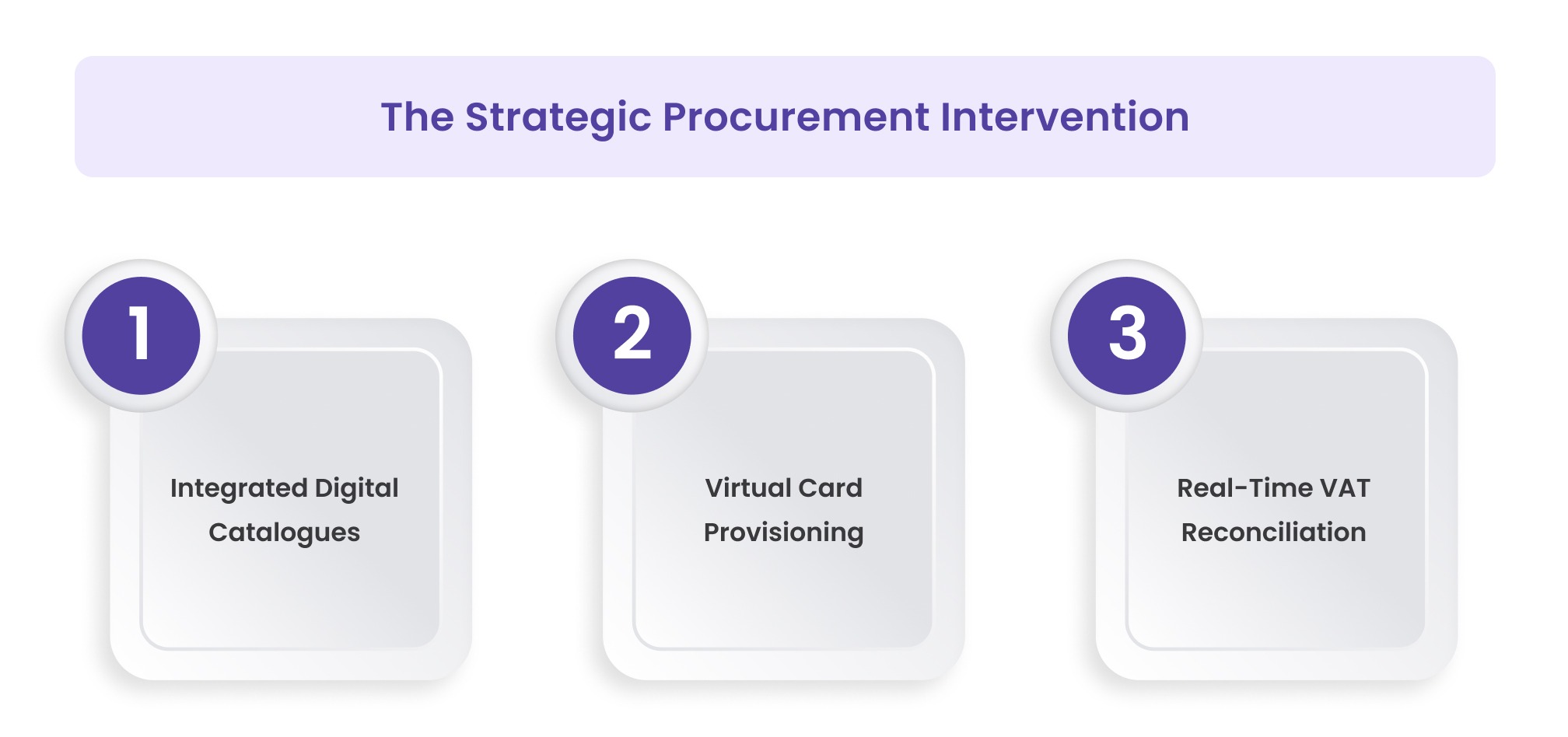
- Integrated Digital Catalogues: They moved all approved suppliers into a single digital procurement platform. Instead of calling a vendor, managers selected items from a pre-negotiated Virtual Storefront. This ensured that every dirham spent was automatically aligned with the pre-agreed contract rates.
- Virtual Card Provisioning: To eliminate the emergency retail run problem, the procurement team issued specific virtual cards to each head chef with hard spending limits and merchant category restrictions. These cards only worked at approved food and beverage wholesalers, making it physically impossible to spend company funds on unvetted or non-compliant vendors.
- Real-Time VAT Reconciliation: Every time a purchase was made via the virtual card, the manager was prompted to upload a photo of the invoice immediately. The system used OCR (Optical Character Recognition) to verify the supplier’s TRN (Tax Registration Number) against the UAE Federal Tax Authority database in real time, ensuring 100% VAT compliance before the goods even reached the kitchen.
The Strategic Result
By the end of the first quarter, the business saw a measurable shift in their operational efficiency:
| Metric | Before Strategic Framework | After Strategic Framework |
|---|---|---|
| Off-Contract Spend | 12% of total spend | < 1% of total spend |
| Reconciliation Time | 4 days per month | Real-time / 2 hours total |
| Average Margin Improvement | Base level | +4.5% through contract adherence |
| VAT Recovery | 85% (due to lost receipts) | 100% |
In this example, strategic procurement wasn't just about buying cheaper lettuce. It was about building a control system that ensured the finance team had total visibility over cash flow, while the operational teams had the speed they needed to keep the restaurants running without breaking the rules.
Similar operational friction is what pushed companies like Al Barari to centralise spend management workflows after managing procurement, reimbursements, and accounting across multiple entities became increasingly difficult to control manually.
The businesses seeing the biggest procurement gains today are not necessarily buying less; they are controlling spend earlier.
Strategic Procurement vs Procurement Automation
While these two terms are often used interchangeably in the UAE tech scene, they represent two different layers of business operations. Procurement Automation provides the speed and the tools, but Strategic Procurement provides the brain and the long-term vision.
The Critical Distinction
Think of procurement automation as the high-speed engine, while strategic procurement is the navigation system. You can automate a bad process and simply end up making mistakes faster; strategic procurement ensures that the process itself is designed to protect your margins and scale your business.
| Feature | Procurement Automation | Strategic Procurement |
|---|---|---|
| Primary Goal | To eliminate manual tasks and increase transaction speed. | To align spending with long-term business and financial goals. |
| Focus Area | The "How": Invoices, approvals, and data entry. | The "Why": Supplier risk, cash flow impact, and value creation. |
| Data Usage | Moves data from point A to point B (e.g., syncing an invoice to an ERP). | Analyses data to find patterns, renegotiate contracts, and stop leakage. |
| Supplier Role | Focuses on the efficiency of the transaction (e.g., automated payments). | Focuses on the health of the relationship and supply chain resilience. |
| Typical Outcome | Reduced administrative hours and fewer human errors. | Improved profit margins, better VAT compliance, and controlled scaling. |
| 2026 Context | Using AI to read receipts and auto-route approvals. | Deciding which global or local suppliers to partner with to avoid FX risk. |
Which is exactly why procurement automation alone is no longer enough without strategic oversight behind it.
Also Read: How to Budget for FX Risk Management in 2026
Strategic Procurement Trends UAE Businesses Should Watch
Procurement in the UAE is moving far beyond vendor negotiations and purchase approvals. As the country accelerates AI adoption, digital government infrastructure, and e-invoicing readiness, procurement is increasingly becoming a real-time operational control layer tied directly to finance, compliance, and business visibility.
Some of the biggest strategic procurement trends UAE businesses should watch include:
- AI-led procurement operations
The UAE government recently announced plans to move 50% of government operations and services toward AI-powered systems within two years, signalling how automation and AI-driven workflows are becoming central to procurement and operational decision-making. - Procurement automation replacing manual workflows
Businesses are now shifting away from spreadsheet-based procurement toward automated approval routing, supplier onboarding, invoice validation, and sourcing systems powered by AI. - E-invoicing readiness becoming a procurement priority
With the UAE moving toward mandatory e-invoicing frameworks, procurement teams will increasingly need structured digital invoice capture, supplier validation, and real-time compliance workflows integrated directly into purchasing systems. - Supplier risk intelligence becoming operationally critical
Procurement teams are placing greater focus on supplier financial health, compliance status, operational resilience, and geopolitical risk as part of procurement decision-making instead of evaluating vendors on pricing alone. - Procurement and finance systems becoming more connected
UAE businesses are increasingly integrating procurement workflows with accounting, payments, ERP systems, and spend management platforms to improve cash-flow visibility and reconciliation speed. - Real-time procurement visibility replacing retrospective reporting
Businesses increasingly want live dashboards showing committed spend, supplier exposure, pending approvals, and procurement performance instead of waiting for month-end reporting cycles. - Cross-border procurement infrastructure improving
As UAE businesses continue expanding globally, procurement systems are evolving to support international supplier payments, FX visibility, and centralised vendor management across multiple regions. - Responsible AI and governance controls entering procurement
Procurement automation is increasingly being paired with governance frameworks focused on auditability, compliance visibility, risk monitoring, and accountable AI deployment.
Also Read: Smart Business Travel Procurement: Reducing Leakage and Regaining Spend Control
And as procurement becomes more digitised across the UAE, the expectations around speed, compliance, and visibility are rising together.
How Alaan Helps UAE Businesses Modernise Strategic Procurement
For many UAE businesses, procurement still breaks down at the exact point where speed and control are supposed to work together. Vendor approvals sit in email chains, invoices arrive through multiple channels, finance teams manually verify VAT details, and supplier payments happen separately from procurement visibility.
Alaan helps businesses modernise strategic procurement by connecting purchasing, approvals, supplier payments, spend controls, and accounting workflows into one unified system built for UAE finance operations.
Here’s how Alaan supports modern procurement workflows:
- Centralised Spend Visibility
Procurement and finance teams can track supplier spend, department budgets, approvals, and payment activity in real time instead of waiting for month-end reconciliation cycles. - SuperPay for Supplier Payments
Alaan’s SuperPay helps businesses manage domestic and international supplier payments, FX visibility, invoice approvals, and payment tracking within a single workflow. - Corporate Cards with Procurement Controls
Businesses can issue smart corporate cards with vendor-specific controls, spending limits, and approval rules that automatically enforce procurement policies during transactions. - Automated Invoice Capture and VAT Validation
Invoice data, supplier details, TRNs, and VAT information can be captured automatically to reduce manual verification work and improve procurement compliance readiness. - Approval Workflows Built for UAE Finance Structures
Alaan supports configurable approval chains that reflect how procurement and finance teams actually operate in UAE organisations, including layered and role-based approvals. - Accounting and ERP Automation
Procurement transactions sync directly with accounting systems like Xero, QuickBooks, NetSuite, and Dynamics 365, helping businesses reduce reconciliation delays and maintain cleaner financial records. - Audit-Ready Procurement Trails
Invoices, approvals, payment records, and procurement activity remain centrally documented, helping businesses maintain stronger audit visibility and compliance readiness. - Built for Scaling UAE Businesses
With more than 3,000 businesses using the platform and growing regional investment into procurement and spend infrastructure, Alaan is increasingly positioning itself as part of the UAE’s modern finance and procurement ecosystem.
Conclusion
The businesses that gain the biggest advantage from strategic procurement are usually not the ones negotiating the cheapest supplier contracts. They are the ones building systems where procurement decisions stop creating operational surprises for finance teams later.
If approvals still depend on follow-up messages, invoices still arrive through scattered channels, or supplier visibility only appears during reconciliation week, the issue is no longer procurement volume. It is infrastructure.
Modern procurement should help your business move faster with more control, not force teams to choose between speed and compliance.
That is where Alaan fits in. By bringing together procurement visibility, supplier payments, automated approvals, VAT-ready tracking, and accounting automation into one platform, Alaan helps UAE businesses turn procurement into a scalable operational system instead of a manual finance burden.
Booking a personalised demo is one of the fastest ways to understand where procurement friction is slowing your business today and what a more connected procurement workflow could look like in 2026.
Procurement and payables run into each other at the invoice stage, so the guide to AP automation is a good next read on how invoices get captured, approved and paid without the usual spreadsheet relay.
FAQs
1. Why is strategic procurement becoming more important in the UAE?
Strategic procurement is becoming critical because UAE businesses are managing higher supplier volumes, tighter VAT compliance requirements, cross-border payments, and upcoming e-invoicing mandates simultaneously. With the UAE moving toward mandatory e-invoicing, procurement is increasingly tied to finance visibility, audit readiness, and operational control.
2. What is the difference between procurement automation and strategic procurement?
Procurement automation focuses on speeding up operational tasks like invoice approvals, payment routing, and data entry. Strategic procurement focuses on the larger business impact of spending decisions, including supplier risk, cash-flow management, compliance, contract optimisation, and long-term operational efficiency. Businesses increasingly need both working together instead of treating procurement as only an administrative function.
3. What are the biggest procurement risks UAE businesses face today?
Some of the biggest risks include fragmented approvals, poor supplier spend visibility, missing VAT-compliant invoices, delayed reconciliations, FX inefficiencies in international payments, and disconnected procurement and finance systems. Manual procurement processes are also becoming harder to sustain as UAE compliance requirements tighten.
4. How will UAE e-invoicing affect procurement workflows?
The UAE’s upcoming e-invoicing framework will require businesses to move toward structured digital invoicing formats with stronger supplier validation, invoice traceability, and real-time compliance processes. Procurement teams will increasingly need systems that support automated invoice capture, VAT verification, approval tracking, and audit-ready documentation.
5. How do modern UAE businesses manage procurement at scale?
Modern UAE businesses increasingly centralise procurement through integrated platforms that combine supplier payments, approval workflows, accounting syncs, VAT validation, procurement visibility, and spend controls into one system. This helps finance and procurement teams reduce manual reconciliation work while improving operational visibility and compliance readiness.
Gain control over business expenses with Alaan corporate cards
Invygo earned AED 100,000 in cashback using Alaan cards
Personalise approval workflows to align with your business needs with Alaan's Spend Management platform
Discover the power of automated expense tracking and smarter spend control with Alaan
Turn data into actionable insights with Alaan's spend management tools
Stay Tax Compliant with UAE's #1 Corporate Card and Spend Management Platform
Customisable corporate card policy template
Know how much Corporate Tax you have to pay this fiscal year
Easily integrate Alaan with your ERP for accurate, real-time expense tracking
Close books faster with Alaan's AI-powered accounting automation
Reconcile your books in minutes instead of hours, every single month.
Keep petty cash organized with Alaan corporate cards and automated expense management