.avif)

Most UAE founders wake up worried about their next big contract, but the real silent growth-killer is the admin-tax hiding in plain sight.
In 2026, business travel across the Middle East is expected to grow 1.5 times faster than the global average, yet many companies still manage travel expenses through spreadsheets, manual approvals, and reimbursement-heavy workflows.
You’ve been taught to treat an expenses policy in the UAE as a boring PDF, yet in a world of instant digital payments, expecting an employee to lend their company money and wait weeks for a reimbursement feels fundamentally broken.
With the Federal Tax Authority now digitising audits and tightening corporate tax scrutiny, that stack of unfiled receipts isn’t just a mess; it’s a drain on your culture and your compliance.
It’s time to stop policing dirhams and start empowering teams. This guide breaks down how to build a 2026-ready spend framework that protects your margins without slowing down your momentum.
Key Takeaways:
- Expense Policies in 2026: UAE expense policies now influence VAT recovery, Corporate Tax compliance, audit readiness, and cash-flow visibility, not just reimbursements.
- 50% Deductibility Rule: Client entertainment expenses under UAE Corporate Tax are only 50% deductible, making accurate categorisation and VAT-compliant invoices essential.
- Biggest Policy Mistakes: Delayed submissions, approvals over WhatsApp, missing supplier TRNs, and outdated global templates are among the biggest causes of compliance gaps.
- Spend Management vs Policies: Modern spend systems use smart corporate cards, AI invoice scanning, automated approvals, and live spend tracking to prevent policy violations before they happen.
- How Alaan Helps: Alaan helps UAE businesses automate expense controls through VAT-ready tracking, accounting automation, approval workflows, and real-time spend visibility.
What Is an Expense Policy?
An expense policy is a formal corporate framework that defines the criteria, limits, and procedures for how employees spend company funds on behalf of the business. Rather than just being a list of restricted items, it serves as a strategic roadmap that aligns individual spending habits with the broader financial health and tax obligations of the firm.
In the context of the UAE regulatory environment, this document serves three critical functions:

- Financial Guardrails: It establishes clear ceilings for daily allowances, travel tiers, and procurement categories to ensure cash flow remains predictable as a business scales.
- Legal Compliance: With the introduction of corporate tax and stringent VAT regulations, the policy acts as the primary defense during an audit by the Federal Tax Authority. It ensures that every dirham claimed as a business deduction is backed by a compliant tax invoice.
- Cultural Transparency: It removes the awkwardness of reimbursement negotiations by providing employees with a clear understanding of what the company will cover, from client dinners at the Dubai International Financial Centre to logistical costs in the Northern Emirates.
Documenting the specific categories of business spending ensures that teams know exactly what is permissible before a single dirham is ever committed.
Common Types of Business Expenses Covered in UAE Expense Policies
Establishing clear categories for business spending isn't just about tracking dirhams; it’s about ensuring that every claim aligns with the UAE’s increasingly rigorous tax framework.
Under the UAE Corporate Tax framework, certain business expenses are fully deductible, while others, such as entertainment expenses, are restricted to partial deductibility.
Commonly covered expenses in the UAE policy include:
- Travel and Mobility: Flights, hotel stays, and inter-city transport. Given the high volume of regional business, policies often specify tiers (e.g., Economy for regional flights under four hours) and cover Salik (toll) charges for company vehicles.
- Training & Professional Development: Employee training, professional development, and industry-related learning expenses are generally deductible when they are incurred wholly and exclusively for business purposes.
- Client Entertainment (The 50% Rule): Costs for client lunches, gala dinners, or hospitality events. Under the UAE Corporate Tax law, these are only 50% deductible, reflecting the personal enjoyment element.
- Employee Costs: Salaries, allowances, medical insurance, and other employee-related expenses incurred wholly for business purposes are generally deductible under UAE Corporate Tax rules.
- Remote Work and Technology: Stipends for home internet, SaaS subscriptions, and essential hardware (laptops/phones).
- Marketing and Advertising: Genuine costs for promoting the business, including digital ads and physical branding materials.
Also Read: Understanding UAE Business Entertainment Expenses and Deductions
Even with clearly defined categories, several common policy mistakes continue to drain the margins of growing Middle Eastern firms.
Biggest Expense Policy Mistakes UAE Businesses Make
As the Federal Tax Authority shifts to real-time oversight, the gap between a policy that looks good on a shelf and one that actually works in the field is where most companies lose their margins.
To keep your growth frictionless, steer clear of these common pitfalls that turn simple spending into a compliance headache:
- Treating expense policies like static PDFs instead of live financial controls
Many businesses create policies once and rarely update them as tax rules, approval structures, and spending patterns evolve. - Allowing approvals through WhatsApp, email chains, or verbal confirmations
Informal approvals create weak audit trails and make it difficult to verify accountability during audits or reconciliations. - Reimbursing expenses without checking VAT-compliant invoices
Missing TRNs, incorrect VAT breakdowns, or invalid invoices can result in blocked VAT recovery and reporting issues. - Allowing delayed expense submissions
Late claims slow down month-end closes, increase missing documentation risks, and reduce real-time financial visibility. - Using global expense templates without adapting them for UAE tax rules
Many policies fail to reflect UAE-specific VAT requirements, deductibility rules, and FTA documentation standards. - Ignoring small recurring spend leakage
Small recurring purchases across teams often become one of the largest uncontrolled expense categories over time. - Treating finance teams as cleanup departments instead of control systems
When employees spend first and documentation comes later, finance teams end up fixing preventable compliance and reporting problems.

Also Read: VAT Refunds in the UAE: What Businesses Need to Know in 2026?
Recognising the difference between a static policy and active spend management is what separates companies that merely record history from those that control it in real-time.
Expense Policy vs Spend Management
In the high-speed commercial hubs of Dubai and Abu Dhabi, the difference between a policy and management is the difference between a map and a GPS.
An Expense Policy is a static set of rules. It is the document that tells your team they should fly economy to Riyadh or that a client dinner at DIFC should not exceed AED 500 per head.
The problem? Policies are retrospective. By the time a finance manager sees a violation, the money has already left the company bank account, and the reimbursement battle begins.
Spend Management, however, is the live execution of those rules. In 2026, UAE businesses are moving toward integrated platforms that act as digital guardrails.
- Proactive vs. Reactive: While a policy asks for a receipt after the fact, spend management uses corporate cards with built-in limits that automatically decline a transaction if it violates the policy.
- VAT Automation: It goes far beyond reminding employees to get a tax invoice. Modern spend management platforms now use AI to scan invoices instantly, capture TRNs, validate VAT fields, and prepare records for FTA-ready reporting in real time.
- Real-time Visibility: Instead of waiting for month-end reconciliations, spend management gives UAE CFOs a dashboard view of every dirham spent across the Emirates in real-time, allowing for instant budget adjustments.
In short, a policy is what you hope will happen; spend management is what actually happens.
It is the same operational shift companies like Al Barari made when manual expense tracking started slowing finance visibility across the business.
Also Read: AR Aging Reports: Optimise Cash Flow & Ensure VAT Compliance
Constructing a comprehensive policy document requires a specific set of clauses that address everything from regional mobility to the latest Federal Tax Authority requirements.

What a Modern UAE Expense Policy Should Include
A well-structured policy should clearly define not just what employees can spend, but how expenses are approved, documented, verified, and tracked across the business.
A strong UAE-ready expense policy should typically include:
Seeing a policy-driven workflow in action reveals how these theoretical rules translate into frictionless operations during a standard business trip.
Also Read: Expense Policy Template With Best Practices for 2026
Example of an Expense Policy Workflow in Action
To understand how a modern policy actually functions, let’s look at a day in the life of a Sales Director traveling from Dubai to Abu Dhabi for a series of high-stakes client meetings in 2026.
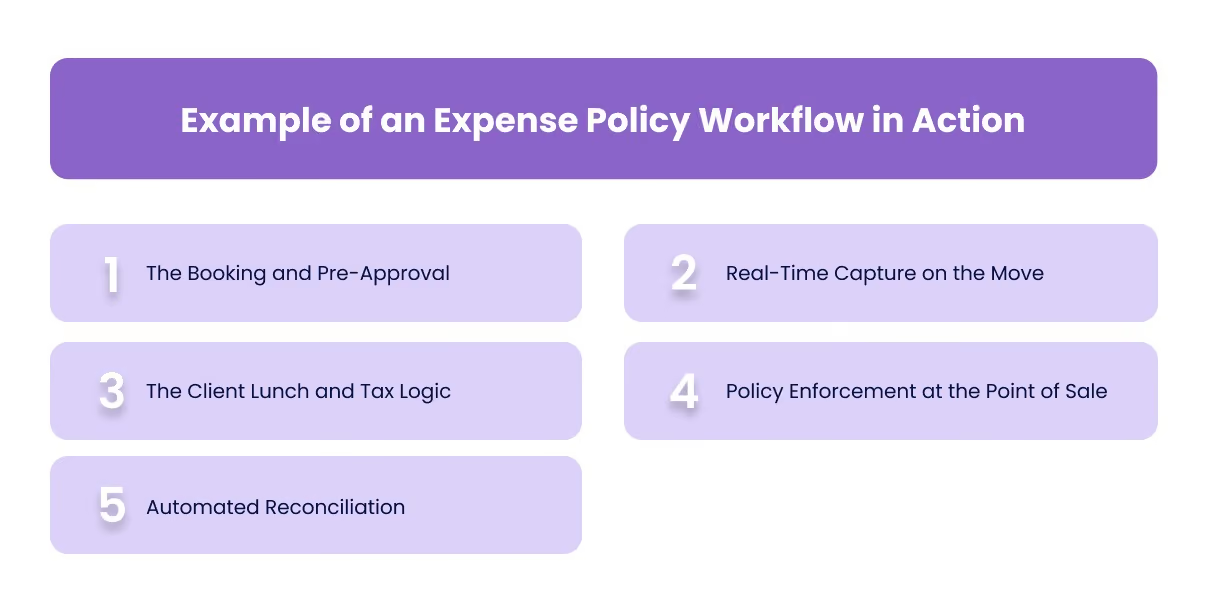
This is not a manual process; it is a live, automated sequence that protects the company’s capital and tax standing in real-time.
1. The Booking and Pre-Approval
Before the trip begins, the manager uses the company’s spend management platform to book a hotel. The system automatically cross-references the Senior Level tier in the policy. Since the booking falls under the AED 900 cap for Abu Dhabi, it is auto-approved instantly, removing the need for back-and-forth emails with the finance department.
2. Real-Time Capture on the Move
The manager drives through the Darb toll gate and pays for parking via the M-Parking SMS service. Instead of hoarding physical tickets, they pay with a virtual corporate card.
The transaction is instantly logged, and a mobile notification prompts them to snap a photo of the parking SMS. The AI immediately matches the image to the card transaction, creating a digital audit trail before they even reach the site.
3. The Client Lunch and Tax Logic
Lunch takes place at a restaurant on Al Maryah Island with a client. When the manager scans the AED 600 invoice, the system’s AI identifies the restaurant’s 15-digit TRN and verifies the 5% VAT.
Since the expense is tagged as Client Entertainment, the software automatically flags only AED 300 as deductible for the UAE Corporate Tax return, ensuring the company stays compliant without any manual accounting.
4. Policy Enforcement at the Point of Sale
On the return journey, the manager stops for fuel but attempts to buy personal electronics at the station’s convenience store. The transaction is declined at the counter. The company’s smart card has a Merchant Category Code lock that only permits fuel purchases at ADNOC or ENOC stations. The manager must use a personal card for non-business items to prevent accidental policy violations.
5. Automated Reconciliation
At the end of the month, the manager does not file an expense report. Because every transaction was captured, categorised, and tax-verified at the point of sale, the finance manager simply syncs the data with the company’s ERP. The VAT is reclaimed, the Corporate Tax audit trail is flawless, and the business maintains total visibility over its margins.

Closing the gap between a written document and daily spending habits requires a digital infrastructure that automates compliance at the point of sale.
How Alaan Helps UAE Businesses Manage Expense Policies
Alaan helps UAE businesses close that gap by turning expense policies into automated spend controls.
Built specifically for the UAE market, the platform combines corporate cards, expense automation, approval workflows, and VAT-ready tracking into a single spend management system designed for modern finance operations.
Here’s how Alaan helps businesses manage expense policies at scale:
- SuperPay for Global Vendor Payments
Alaan’s SuperPay helps UAE businesses manage international supplier payments, invoice approvals, FX handling, and payment tracking from a single platform, reducing manual banking workflows and improving visibility across global transactions - Spend Management
Finance teams get real-time visibility into company-wide spending across departments, employees, and vendors, making it easier to monitor budgets, enforce policies, and detect unusual transactions early. - Corporate Cards with Smart Controls
Alaan enables businesses to issue physical and virtual corporate cards with built-in spending limits, merchant restrictions, approval rules, and department-level controls that automatically enforce expense policies during the transaction itself. - Accounting Automation
The platform automates receipt capture, expense categorisation, reconciliation workflows, and accounting syncs, helping finance teams reduce manual work and close books faster every month. - VAT-Ready Expense Tracking
Alaan automatically captures invoice data, VAT amounts, and supplier TRNs to simplify UAE compliance workflows and maintain cleaner audit records. - Automated Approval Workflows
Expense approvals can be routed dynamically based on employee role, spend category, or transaction amount, removing dependency on fragmented approvals through chats or email chains. - Centralised Audit Trails
Transactions, invoices, approvals, and supporting documents remain digitally stored in one place, improving audit readiness and financial transparency across the organisation.
Conclusion
An expense policy should not slow your teams down just to keep finance comfortable. The real goal is creating a system where spending stays controlled without turning every transaction into manual admin work.
If your business still relies heavily on reimbursements, scattered approvals, and month-end cleanups, it may be time to rethink the process, not just rewrite the policy.
Alaan helps UAE businesses turn expense policies into real-time spend controls through smart corporate cards, automated approvals, VAT-ready tracking, and integrated finance workflows built for modern teams.
Booking a personalised demo is one of the fastest ways to understand where your current expense process is creating hidden friction and what a more scalable system could look like as your business grows.
FAQs
1. What should an expense policy include in the UAE?
A UAE expense policy should clearly define reimbursable expenses, approval workflows, VAT invoice requirements, submission timelines, spending limits, and audit documentation standards. It should also align with UAE Corporate Tax and FTA compliance requirements.
2. Are business entertainment expenses fully deductible in the UAE?
No. Under UAE Corporate Tax rules, many client entertainment expenses are only 50% deductible, especially where there is a personal enjoyment element involved. Proper categorisation and documentation are important for compliance.
3. What happens if employees submit expenses late?
Late expense submissions can delay reconciliations, create VAT reporting inconsistencies, increase missing documentation risks, and weaken audit trails. Many UAE businesses now enforce strict submission deadlines to improve financial visibility and compliance readiness.
4. Why are VAT-compliant invoices important for expense claims?
Without valid tax invoices containing correct supplier details, VAT amounts, and TRNs, businesses may lose the ability to recover input VAT during FTA filings. Invalid or incomplete invoices are one of the most common compliance issues flagged during audits.
5. How do modern UAE businesses automate expense management?
Many UAE businesses now use spend management platforms that combine corporate cards, automated approvals, receipt scanning, VAT tracking, and accounting integrations to reduce manual work and improve real-time spend visibility.
Gain control over business expenses with Alaan corporate cards
Invygo earned AED 100,000 in cashback using Alaan cards
Personalise approval workflows to align with your business needs with Alaan's Spend Management platform
Discover the power of automated expense tracking and smarter spend control with Alaan
Turn data into actionable insights with Alaan's spend management tools
Stay Tax Compliant with UAE's #1 Corporate Card and Spend Management Platform
Customisable corporate card policy template
Know how much Corporate Tax you have to pay this fiscal year
Easily integrate Alaan with your ERP for accurate, real-time expense tracking
Close books faster with Alaan's AI-powered accounting automation
Reconcile your books in minutes instead of hours, every single month.
Keep petty cash organized with Alaan corporate cards and automated expense management