.avif)


A step-by-step guide to calculating cost of sales accurately so UAE businesses can protect their margins and price with confidence.
- With SMEs contributing more than 63% to the UAE's non-oil economy, small gaps in cost tracking quickly turn into margin leaks that erode profitability.
- The core formula is Beginning Inventory plus Purchases minus Ending Inventory, which counts only the goods you actually sold rather than everything you bought.
- Only direct costs belong here, so raw materials, direct labour, and production overheads count while marketing, rent, and admin salaries stay out.
- As spend spreads across cards, invoices, and reimbursements, Alaan captures and categorises each expense in real time and syncs with Xero, QuickBooks, and NetSuite so cost data stays reliable at scale.
Many businesses track revenue closely, but far fewer have a clear, consistent view of what it actually costs to generate that revenue. Without this clarity, profitability becomes difficult to measure and even harder to improve.
In the UAE, where SMEs account for over 94% of all companies and contribute more than 63% to the non-oil economy, maintaining financial control is not optional; it’s essential. As the ecosystem grows more competitive, small gaps in cost tracking can quickly turn into margin leaks.
This is where the cost of sales plays a critical role. It directly feeds into gross profit (Revenue – Cost of Sales) and helps businesses understand how efficiently they are delivering their products or services.
If the cost of sales is miscalculated or inconsistently tracked, it doesn’t just affect reporting; it impacts pricing decisions, margins, and overall financial planning. Understanding how to find the cost of sales is, therefore, a foundational step toward better financial control.
Key Takeaways:
- Cost of sales drives margins: It directly determines gross profit (Revenue – Cost of Sales), making accuracy critical, especially in the UAE, where SMEs contribute over 63% to the non-oil economy.
- Formula ensures accuracy: Beginning Inventory + Purchases – Ending Inventory counts only sold goods, not total purchases.
- Process matters: A step-by-step approach, inventory, purchases, ending stock, and direct costs, keeps calculations consistent and reliable.
- Include only direct costs: Raw materials, direct labour, and production costs qualify; if the cost continues without sales, it should be excluded.
- Tracking needs structure: As businesses scale, real-time visibility and automated categorisation become essential. This is where Alaan supports accurate, decision-ready cost tracking.
What Is Cost of Sales?
Cost of sales refers to the total cost directly tied to producing or delivering a product or service. It includes all expenses required to bring what you sell to the customer, such as raw materials, direct labour, and production-related costs.
It does not include indirect expenses like administrative salaries, marketing spend, or general overheads, as these are not directly linked to production or service delivery.
Cost of Sales Formula
The standard way to calculate the cost of sales is to adjust inventory over a specific period. The formula ensures that only the cost of goods actually sold is included:
Cost of Sales = Beginning Inventory + Purchases – Ending Inventory
- Beginning inventory: Value of stock available at the start of the period
- Purchases: Additional inventory or production costs incurred during the period
- Ending inventory: Unsold stock that is excluded from current period costs
This structure ensures that costs are accurately matched to revenue, giving a clear view of gross profit.

Once you understand what cost of sales includes and how the formula works, the next step is applying it in practice, step by step, using your actual inventory and purchase data.
How to Find Cost of Sales (Step-by-Step)
Calculating the cost of sales becomes straightforward when you follow a structured approach. Instead of treating it as a single formula, breaking it into steps ensures accuracy and consistency, especially when dealing with inventory, purchases, and direct production costs.
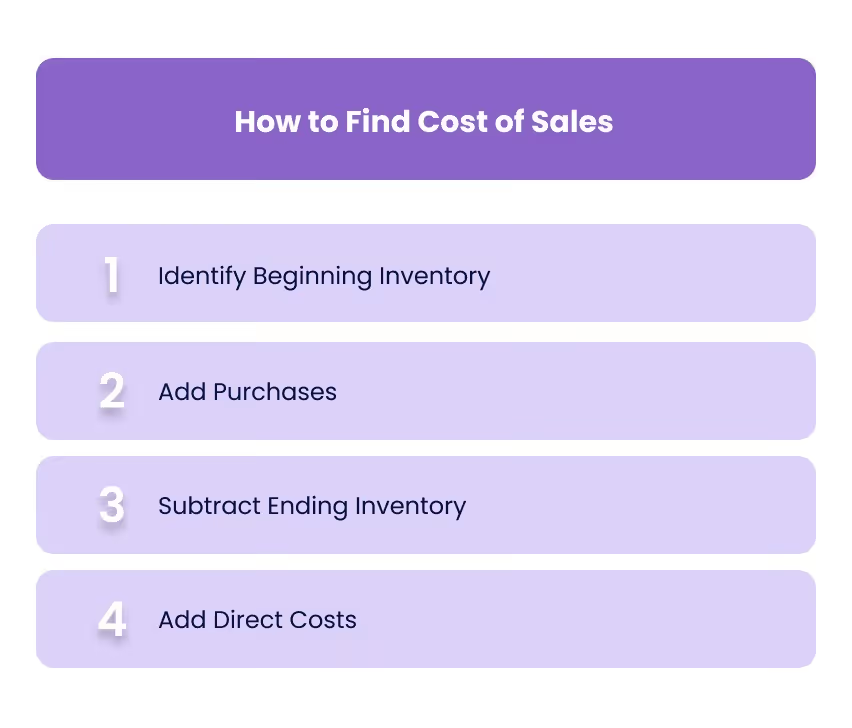
This step-by-step method helps match costs to actual sales and avoid margin errors.
Step 1: Identify Beginning Inventory
Beginning inventory is the value of stock available at the start of the accounting period. This includes unsold goods carried forward from the previous period.
How:
- Use the closing inventory value from the previous period
- Ensure it reflects accurate valuation (FIFO, weighted average, etc.)
- Pull this directly from your balance sheet or inventory system
This forms the starting point of your cost calculation.
Also Read: What Is Direct Cost? How It Differs from Other Expenses in Your Business
Step 2: Add Purchases
Purchases include all inventory or production-related costs incurred during the period. This covers raw materials, finished goods bought for resale, and any costs directly tied to acquiring inventory.
How:
- Sum all inventory purchases within the period
- Include freight, shipping, and import duties if applicable
- For manufacturers, include raw materials and production inputs
This step ensures all additional stock or production costs are accounted for.
Step 3: Subtract Ending Inventory
Ending inventory is the value of unsold stock remaining at the end of the period. Since these goods have not yet been sold, their cost should not be included in the current cost of sales.
How:
- Conduct a physical stock count or use inventory software
- Assign an accurate valuation to the remaining inventory
- Subtract this value from the total
This adjustment ensures you only account for goods that were actually sold.
Also Read: Effective Procurement Risk Management: Proven Strategies For UAE Businesses
Step 4: Add Direct Costs (if applicable)
Direct costs include expenses directly tied to production or service delivery, such as labour and manufacturing overhead. These are essential to reflect the true cost of generating revenue.
How:
- Include wages of employees directly involved in production or delivery
- Add factory or production overheads (utilities, equipment usage)
- Exclude indirect costs like admin or marketing
In some cases, the extended formula becomes:
Cost of Sales = Beginning Inventory + Purchases + Direct Costs – Ending Inventory

Also Read: Mastering Overhead Expenses: The Key to Controlling Business Costs
With the process in place, it helps to see how these numbers come together in a real scenario, so you can apply the same approach to your own books with clarity.
Cost of Sales Example
To see how this works in practice, let’s walk through a simple, realistic scenario using the standard formula.
Scenario:
A retail business is calculating its cost of sales for the quarter:
- Beginning Inventory: AED 50,000
- Purchases during the period: AED 20,000
- Ending Inventory: AED 15,000
Calculation:
Cost of Sales = Beginning Inventory + Purchases – Ending Inventory
Cost of Sales = 50,000 + 20,000 – 15,000 = AED 55,000
In this case, AED 55,000 represents the actual cost of the goods sold during the period—not just the cost of what was purchased.
With Direct Costs:
If the business also incurs direct labour or production costs (say AED 10,000), these are added to reflect the true cost of delivering the product:
Cost of Sales = 50,000 + 20,000 + 10,000 – 15,000 = AED 65,000
Before breaking down the components further, it’s important to understand exactly which costs should, and should not, be included in the cost of sales.
What Costs Are Included in Cost of Sales?
Understanding what goes into the cost of sales is critical for accurate reporting. At its core, the cost of sales includes only those costs that are directly tied to producing or delivering what you sell, nothing more, nothing less.
Costs Included:
These are expenses that move in direct proportion to your sales or production:
- Raw materials: Inputs used to create the product (e.g., components, ingredients, inventory for resale)
- Direct labour: Wages of employees directly involved in production or service delivery
- Manufacturing/production costs: Factory overheads like utilities, equipment usage, and packaging are tied to production
Costs Excluded:
These are indirect expenses that do not change directly with production or sales:
- Marketing and advertising
- Office rent and utilities (non-production)
- Administrative salaries and management costs
Such expenses fall under operating costs, not the cost of sales, because they are incurred regardless of how much you sell.

Also Read: Streamlined Expense Management: A Practical Guide for UAE Finance Teams
With the definitions in place, the real challenge lies in execution: capturing these costs accurately, consistently, and without delays as your business scales.
How Alaan Helps Finance Teams Track Costs Accurately
Once you understand what should be included in the cost of sales, the real challenge is execution. Costs are often scattered across invoices, cards, reimbursements, and spreadsheets, making it difficult to track them accurately or in real time.
This is exactly where finance teams start losing visibility. Delayed data, missing receipts, and manual reconciliation create gaps that directly impact how reliably you can calculate the cost of sales.
Alaan is built to solve this at the source, by ensuring every expense is captured, categorised, and controlled the moment it happens. Instead of chasing data at month-end, finance teams get real-time visibility into every dirham spent, across employees, vendors, and categories.
Key Features That Support Accurate Cost Tracking:
1. Real-time visibility and unified spend tracking:
Track all expenses—cards, vendor payments, subscriptions, and reimbursements—in one place with live dashboards. This eliminates data silos and gives a clear view of where money is going.
2. Smart corporate cards with built-in controls:
Issue physical and virtual cards with spend limits, vendor restrictions, and usage rules. This prevents out-of-policy spend before it happens, rather than fixing it later.
3. Automated expense capture and categorisation:
Receipts are scanned, and key details like amount, VAT, and vendor are extracted automatically. Transactions are categorised in real time, helping teams correctly allocate costs to cost of sales vs operating expenses.
4. Approval workflows and spend governance:
Set up multi-level approvals to ensure every expense is reviewed and aligned with company policy, without slowing down operations.
5. Seamless accounting integrations:
Sync directly with accounting systems like Xero, QuickBooks, and NetSuite to eliminate manual data entry and speed up reconciliation.
6. Built-in compliance, validation, and controls:
Automatically flag duplicates, missing receipts, and unusual transactions, while capturing VAT data for compliance, ensuring cleaner, audit-ready books.
7. Reduced manual work and employee reimbursements:
With corporate cards and automated workflows, finance teams spend less time chasing receipts and more time analysing costs and improving margins.
8.SuperPay for supplier payments:
Manage invoice uploads, approvals, and global supplier payments in one workflow to ensure better visibility and control over supplier costs, a key component of cost of sales.
How This Works in Practice
For example, the marketing agency Markathon struggled to track spend accurately as operations scaled. With expenses spread across campaigns and clients, the team lacked clear visibility into where money was being spent, making it harder to categorise costs and maintain control.
By switching to Alaan, they were able to assign dedicated cards to each client or project and track every transaction in real time through a central dashboard. This made it significantly easier to monitor spend, categorise expenses correctly, and maintain clarity across financial data.
As a result, the team moved from reactive tracking to structured, real-time cost visibility, improving both accuracy and financial control.
If your numbers deserve more than guesswork, it might be time to see how they look with clarity, explore Alaan with a personalised demo.
Conclusion
Cost of sales is not just an accounting metric; it’s a reflection of how well a business understands its own operations. When this number is clear and reliable, decisions around pricing, profitability, and growth become far more grounded. When it isn’t, even strong revenue can hide underlying inefficiencies.
As businesses scale, the challenge is no longer knowing the formula; it’s maintaining consistency in how costs are captured, classified, and reviewed over time. Small gaps in this process can compound quickly, especially when data is spread across multiple systems and teams.
This is where having the right financial infrastructure in place makes a difference. With Alaan's better visibility and structured workflows, finance teams can move from reactive corrections to proactive control. This ensures that cost data supports decisions, rather than slowing them down.
If you’re exploring ways to improve visibility and control across business spend, you can book a personalised demo with Alaan to see how it works in practice.
FAQs
1. What is the formula to find the cost of sales?
The standard formula is: Cost of Sales = Beginning Inventory + Purchases – Ending Inventory. If applicable, direct costs like labour and production overhead may also be included.
2. Is the cost of sales the same as the cost of goods sold (COGS)?
They are similar but not always identical. Cost of goods sold is typically used for product-based businesses, while cost of sales is a broader term that can include service-related direct costs as well.
3. What costs are included in cost of sales?
Cost of sales includes direct costs such as raw materials, direct labour, and production expenses. It excludes indirect costs like marketing, administrative salaries, and office rent.
4. How does cost of sales affect profitability?
The cost of sales directly impacts gross profit. Higher costs reduce margins, while better cost control improves profitability and pricing decisions.
5. How can businesses track cost of sales accurately?
Businesses can improve accuracy by maintaining real-time records of inventory, purchases, and direct costs, using structured workflows and integrated financial systems to avoid manual errors.
Gain control over business expenses with Alaan corporate cards
Invygo earned AED 100,000 in cashback using Alaan cards
Personalise approval workflows to align with your business needs with Alaan's Spend Management platform
Discover the power of automated expense tracking and smarter spend control with Alaan
Turn data into actionable insights with Alaan's spend management tools
Stay Tax Compliant with UAE's #1 Corporate Card and Spend Management Platform
Customisable corporate card policy template
Know how much Corporate Tax you have to pay this fiscal year
Easily integrate Alaan with your ERP for accurate, real-time expense tracking
Close books faster with Alaan's AI-powered accounting automation
Reconcile your books in minutes instead of hours, every single month.
Keep petty cash organized with Alaan corporate cards and automated expense management