.avif)


A guide to setting and managing a marketing budget for a UAE small business, covering how much to spend, how to split it, and how to keep it aligned with revenue and tax relief.
- For UAE small businesses, marketing spend is a balancing act between investing enough to grow and not straining cash flow, and it now doubles as a compliance question.
- Under UAE Small Business Relief, companies with revenue below AED 3 million per tax period can qualify, so every expense including marketing has to be planned to protect both margins and eligibility.
- Most SMEs allocate 5% to 15% of revenue and split it across acquisition, content, retention, and tools, with paid ads often taking 20-40% and content and SEO a similar share.
- Studies show marketers waste up to 26% of their budget on poor allocation and tracking, so testing, measuring, and reallocating decide ROI far more than the initial split.
- Alaan brings spend, approvals, payments, and tracking into one workflow, as marketing agency Markathon did by assigning dedicated cards per client or campaign and tracking every transaction on a central dashboard.
For many small businesses in the UAE, budgeting for marketing often feels like a balancing act: invest enough to grow, but not so much that it strains cash flow. The challenge is not just deciding how much to spend, but knowing what the business can realistically afford while staying financially compliant.
This has become even more important under the UAE’s evolving corporate tax framework. Under the Ministerial Decision on Small Business Relief, businesses with revenue below AED 3 million per tax period can qualify for relief, but once this threshold is exceeded, the benefit is no longer available. This creates a clear shift in how small businesses need to think about spending.
Every expense, including marketing, must be planned with visibility and control, not just for growth, but to maintain eligibility, manage margins, and avoid unnecessary financial pressure. In this context, a marketing budget is no longer just a growth tool. It becomes a financial strategy, one that needs to align with revenue, compliance, and long-term sustainability.
This blog breaks down how to create a marketing budget for a small business in the UAE, including how much to allocate, where to spend, and how to manage it effectively.
Key Takeaways:
- Marketing spend must align with revenue thresholds: Under UAE Small Business Relief, businesses below AED 3 million in revenue must manage expenses carefully to maintain eligibility and protect margins.
- 5–15% of revenue is the typical benchmark: Most small businesses allocate this range to marketing, adjusting based on growth stage, competition, and acquisition strategy.
- Budget structure matters more than size: Splitting spend across acquisition, content, retention, and tools ensures both short-term results and long-term growth.
- Execution determines ROI, not allocation alone: Even well-planned budgets fail without tracking, testing, and continuous optimisation across channels.
- Real-time visibility is critical for control: As spend spreads across platforms and vendors, structured tracking and systems like Alaan help maintain accuracy, prevent overspending, and improve decision-making.
How Much Should a Small Business Spend on Marketing?
There’s no single number that works for every business, but there is a clear benchmark most SMEs follow. The most common approach is to allocate a percentage of revenue, ensuring marketing spend grows in line with the business.
For small businesses in the UAE and similar markets, the typical range falls between 5% and 15% of revenue, depending on growth stage and competition.
- Early-stage or conservative spend should be 5–10% of revenue.
- Growth-focused businesses can go 10–20% or higher.
- Highly competitive or scaling businesses can go beyond this range.
In many UAE-specific cases, businesses also translate this into monthly budgets, often starting from around AED 5,000–20,000, depending on channels and goals.
Also Read: Mastering Your Operating Budget: From Annual Planning to Real-Time Control
What Actually Determines Your Budget
While percentages provide a starting point, the right number depends on a few key factors:
- Business stage: New businesses spend more to gain visibility, while established ones optimise for efficiency
- Industry competition: Sectors like retail, F&B, and real estate require higher spending to stay visible
- Customer acquisition model: Businesses relying on paid ads need higher upfront budgets
- Revenue stability: Marketing budgets should scale with predictable income, not assumptions

Once these factors shape how much you can spend, the next step is to structure that budget effectively: break it down into the key components that actually drive results.
Key Components of a Small Business Marketing Budget
Most high-performing small businesses split their budgets across awareness, acquisition, conversion, and retention, ensuring both short-term results and long-term brand building.
In the UAE, where digital channels dominate and competition is high, this structure becomes even more important. With a $3.3 billion digital advertising market and near-total social media penetration, businesses must allocate budgets strategically across high-impact channels.
Key Components and How to Allocate Them:
Breaking down the budget into components is only the starting point; putting it into action requires a clear, step-by-step approach.
How to Create a Marketing Budget (Step-by-Step)
Creating a marketing budget is not about guessing a number; it’s about building a structured plan that connects spending to outcomes. The most effective budgets are built using data, clear goals, and continuous refinement rather than one-time estimates.
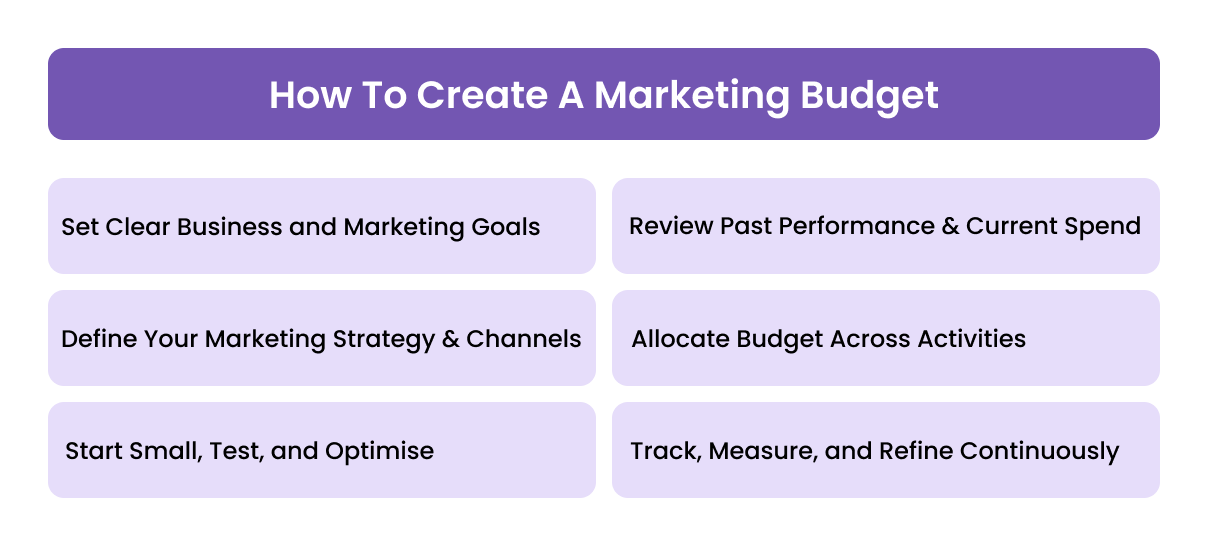
Here’s a practical step-by-step approach that small businesses can follow:
Step 1: Set Clear Business and Marketing Goals
Every marketing budget should start with clear, measurable goals; whether it’s increasing leads, driving sales, or expanding into a new market.
How:
- Define short-term and long-term goals (e.g., leads per month, revenue targets)
- Align marketing goals with overall business objectives
- Set measurable KPIs like cost per lead or conversion rate
Budgets work best when every dirham is tied to a specific outcome.
Also Read: How to Build a Business Budget for Your UAE Startup
Step 2: Review Past Performance and Current Spend
Understanding what has worked before helps avoid wasted spend and improves future allocation.
How:
- Audit previous campaigns and channels
- Identify high-performing vs underperforming activities
- Analyse ROI, cost per lead, and conversion data
Historical data provides a baseline for smarter, more predictable budgeting.
Step 3: Define Your Marketing Strategy and Channels
Your strategy determines where the budget should go: paid ads, content, SEO, events, or retention.
How:
- Map your customer journey (awareness to conversion to retention)
- Select channels that match your audience and goals
- Avoid spreading the budget too thin across too many platforms
A focused strategy prevents inefficient spending across low-impact channels.
Step 4: Allocate Budget Across Activities
Once the strategy is clear, distribute your budget among key components such as ads, content, tools, and retention.
How:
- Assign percentages to each channel or activity
- Prioritise high-impact areas (e.g., paid ads for growth, SEO for long-term)
- Ensure balance between short-term results and long-term growth
A structured allocation makes budgets easier to track and optimise.
Step 5: Start Small, Test, and Optimise
Marketing budgets should be dynamic, not fixed. Testing helps identify what works before scaling.
How:
- Run small pilot campaigns before committing large budgets
- Track performance in real time
- Reallocate budget toward high-performing channels
Start small and scale what works to maximise ROI.
Step 6: Track, Measure, and Refine Continuously
A marketing budget is not a one-time plan; it needs ongoing monitoring and adjustments.
How:
- Track KPIs like ROI, CAC (customer acquisition cost), and conversion rates
- Review performance regularly (monthly or quarterly)
- Adjust spend based on results and business priorities
Continuous tracking ensures your budget stays aligned with growth and efficiency.
Even with a clear process in place, mistakes in applying the budget can quickly limit its impact.
Common Marketing Budget Mistakes
Even with a clear budget and structure in place, many small businesses lose effectiveness not because of how much they spend, but how they spend it. In fact, studies show that marketers waste up to 26% of their budget due to poor allocation and tracking decisions.
These mistakes are rarely obvious. They show up as underperforming campaigns, unclear ROI, or budgets that feel “used” but not “effective.”
Common Mistakes and How to Fix Them:
| Mistake | What’s Happening | Workaround |
|---|---|---|
| Spreading the budget too thin | Businesses try to be on every platform with small spends, leading to weak performance across all channels | Focus on 1–2 high-impact channels first, then scale based on results |
| Relying on guesswork instead of data | Decisions are based on intuition rather than performance metrics, leading to wasted spend | Track KPIs like ROI, CAC, and conversions; review performance regularly |
| “Set it and forget it” budgeting | Budgets are fixed annually without adapting to performance or market changes | Reallocate budgets quarterly or monthly based on what’s working |
| Over-investing in unproven channels | Large budgets are allocated to new or trending platforms without testing | Start with small test budgets and scale only after proven results |
| Ignoring long-term channels like SEO or brand | Too much focus on short-term paid ads leads to unsustainable growth | Balance performance marketing with content, SEO, and brand-building |
| Not budgeting for tools and tracking | Lack of analytics and martech leads to poor visibility and inefficient spend | Invest in tools for tracking, attribution, and automation early |
| Cutting marketing during slow periods | Businesses reduce marketing spend when revenue drops, worsening growth | Optimise spend instead of cutting it; double down on high-performing channels |
| Focusing on vanity metrics | Tracking clicks or impressions instead of actual revenue or ROI | Measure success based on conversions, revenue, and ROI |

Also Read: Proven Ways to Cut Business Costs Now
Avoiding these mistakes is not just about better planning; it requires the right level of visibility and control over how marketing spend actually flows across the business.
How Alaan Helps Small Businesses Control Marketing Spend
Controlling marketing spend is not just about setting a budget, it’s about knowing where every dirham goes, in real time, and whether it’s delivering results.;
For most small businesses, this is where the gap appears. Marketing expenses are spread across ad platforms, subscriptions, vendor payments, and team spending; often tracked after the fact rather than during.
Alaan solves this by bringing spend, approvals, payments, and tracking into a single, connected workflow. This gives finance teams full visibility and control from the moment money is spent.
Key Features That Enable Marketing Spend Control:
1. Real-time visibility across all marketing spend:
Track ad spend, SaaS subscriptions, influencer payments, and vendor costs in one dashboard, with full visibility into where and how money is being spent.
2. Smart corporate cards with granular controls:
Issue cards for campaigns, teams, or channels with limits, vendor locks, and category restrictions to ensure budgets are controlled before spend occurs.
3. Automated expense capture and categorisation:
Receipts are captured and automatically matched to transactions, making it easier to categorise marketing costs accurately for reporting and analysis.
4. Centralised dashboard for spend tracking:
Finance teams can monitor all transactions in real time, eliminating the need to reconcile data across multiple tools or spreadsheets.
5. Seamless accounting automation:
All marketing expenses sync directly with accounting systems, reducing manual work and ensuring accurate financial records.
6. Built-in approvals and policy enforcement:
Every expense follows predefined approval workflows, ensuring marketing spend aligns with budgets and company policies.
7. SuperPay for vendor and campaign payments:
Manage supplier invoices, influencer payouts, and cross-border marketing payments in one place, with transparent FX rates, no hidden fees, and full tracking of every transaction.
How This Works in Practice
For example, marketing agency Markathon faced challenges tracking ad spend across multiple clients and campaigns. As spending increased, the team lacked visibility into where money was going, making it difficult to control budgets and allocate costs accurately.
By adopting Alaan, they were able to assign dedicated cards to each client or campaign and track every transaction in real time through a central dashboard. This gave them clear visibility into ad spend and made it easier to categorise and manage expenses across projects.
As a result, the team moved from fragmented tracking to structured, real-time control over marketing spend, improving both accuracy and efficiency.
If your marketing budget feels like a plan on paper but not in practice, it might be time to see how it performs with full visibility: experience it firsthand with a personalised demo from Alaan.
Conclusion
A marketing budget is not just a financial plan; it’s a reflection of how intentionally a business chooses to grow. When spend is aligned with clear goals, structured across the right channels, and continuously refined, it becomes a tool for consistency rather than guesswork.
The real shift happens when businesses move from tracking spend after the fact to understanding it as it happens. This is what enables better decisions, sharper allocation, and the ability to scale without losing control.
With a more connected approach to managing expenses, approvals, and payments, marketing budgets become easier to monitor, adjust, and optimise over time. That’s where solutions like Alaan fit in, bringing clarity and structure to how businesses manage spend across teams and channels.
If you’re looking to bring more visibility and control to your marketing budget, you can schedule a personalised demo with Alaan to see how it works in practice.
Marketing is usually among the first costs to go when cash gets tight, so it's worth reading our top steps for cash flow management alongside this. The cash flow stress test tool then shows how long your runway lasts if a campaign doesn't pay back as quickly as planned.
FAQs
1. What is the ideal marketing budget for a small business in the UAE?
Most small businesses allocate between 5% and 15% of their revenue to marketing. The exact percentage depends on factors like growth stage, industry competition, and customer acquisition strategy.
2. How do I decide how much to spend on each marketing channel?
Start by aligning channels with your business goals. Allocate more budget to high-impact channels, such as paid ads, for quick results, while investing in content and SEO for long-term growth.
3. Should small businesses focus more on digital or offline marketing in the UAE?
Digital marketing typically takes priority given the UAE's high internet and social media usage. However, offline channels such as events or partnerships can still be effective, depending on the industry.
4. What are the most common mistakes in marketing budgeting?
Common mistakes include spreading the budget too thin, relying on guesswork instead of data, ignoring long-term channels, and not tracking performance consistently.
5. How can small businesses track marketing spend effectively?
Businesses can track spend by using structured workflows, real-time dashboards, and integrated tools that capture expenses across channels, helping maintain visibility and control.
Gain control over business expenses with Alaan corporate cards
Invygo earned AED 100,000 in cashback using Alaan cards
Personalise approval workflows to align with your business needs with Alaan's Spend Management platform
Discover the power of automated expense tracking and smarter spend control with Alaan
Turn data into actionable insights with Alaan's spend management tools
Stay Tax Compliant with UAE's #1 Corporate Card and Spend Management Platform
Customisable corporate card policy template
Know how much Corporate Tax you have to pay this fiscal year
Easily integrate Alaan with your ERP for accurate, real-time expense tracking
Close books faster with Alaan's AI-powered accounting automation
Reconcile your books in minutes instead of hours, every single month.
Keep petty cash organized with Alaan corporate cards and automated expense management