.avif)


A rundown of 14 business budget types and budgeting methods, and how UAE finance teams pick the right mix and keep it accurate with real-time expense data.
- Picking one budget for everything is the real trap, since operational, financial, sales, cash flow, production, labour, CapEx, and project budgets each answer a different question about the business.
- Beyond the standard types there are methods like zero-based, flexible, incremental, activity-based, performance-based, and static budgeting, and the right one depends on your size, industry, and how predictable your revenue is.
- Most companies end up mixing methods, for example an operational budget for ongoing costs, a project budget for one-off initiatives, and a flexible overlay for reactive changes.
- Alaan links every corporate card transaction to its budget category, so finance teams see planned versus actual spending as it happens instead of waiting on manual reconciliation.
- For UAE businesses, accurate documentation and VAT-aligned processes keep budgeting both efficient and compliant.
Effective budgeting defines how a business manages growth, allocates resources, and measures performance. For finance leaders in the UAE and across the Middle East, choosing the right type of budget ensures that financial plans stay realistic and aligned with strategic goals.
Each budget serves a distinct purpose. Some guide daily operations, while others shape investment, sales, or project decisions. A clear understanding of these differences allows finance teams to plan accurately, anticipate challenges, and maintain control over company spending.
This article explores the main types of business budgets, their practical benefits, and how structured financial planning supports smarter decision-making and operational efficiency.
Key Takeaways:
- Every budget serves a distinct purpose. Operational, financial, and project budgets address different business needs — together they build a complete financial picture.
- Flexibility drives better control. Using hybrid or variable budgeting methods allows finance teams to adapt quickly to market or performance changes.
- Automation improves visibility. Linking real-time expense data with budgets helps finance leaders maintain accuracy, reduce errors, and act on current insights.
- Regional compliance matters. For UAE businesses, accurate documentation and VAT-aligned budgeting processes ensure both efficiency and regulatory confidence.
Budget Types That Form the Financial Foundation of Every Business

Budgets differ according to business objectives and the nature of spending. The following are the most widely used budget types in modern organisations.
1. Operational Budget
An operational budget sets out the income and expenses required to run daily business activities within a specific period. It focuses on recurring costs such as rent, utilities, salaries, and marketing, alongside expected revenue from operations.
A clear operational budget helps finance teams:
- Track performance against planned income and expenses.
- Identify overspending or inefficiencies early.
- Ensure every department remains within approved limits.
Example: A hospitality company in Dubai may use an operational budget to monitor staff wages, maintenance costs, and guest service expenses each quarter to maintain profitability.
At Alaan, we help businesses link real-time spending to operational budgets through our corporate cards and expense management platform, allowing finance teams to monitor actual versus planned spending without manual reconciliation.
[cta-4]
2. Financial Budget
A financial budget provides a complete picture of a company’s expected financial position. It covers projected income statements, balance sheets, and cash flows for a defined period.
This type of budget is essential for:
- Assessing overall financial health and liquidity.
- Planning capital allocation and funding requirements.
- Preparing for financial audits and compliance reporting.
For growing organisations, a financial budget ensures that strategic plans, such as expansion or hiring, remain achievable within available resources.
3. Sales Budget
A sales budget forecasts the revenue a company expects to generate during a specific time frame. It often serves as the foundation for other budgets, as most financial plans begin with revenue projections.
Finance and sales teams use this budget to:
- Estimate demand for products or services.
- Set achievable sales targets.
- Align marketing and inventory plans with expected revenue.
In competitive markets such as retail and e-commerce, accurate sales budgeting helps businesses adjust quickly to seasonal trends and consumer behaviour.
4. Cash Flow Budget
A cash flow budget focuses on the timing of cash inflows and outflows. It ensures that a company maintains sufficient liquidity to meet operational and financial commitments.
This budget type enables finance teams to:
- Forecast potential cash shortages or surpluses.
- Plan loan repayments and supplier payments efficiently.
- Avoid liquidity risks and maintain financial stability.
In the UAE, where payment cycles and working capital can vary across industries, a well-maintained cash flow budget supports consistent operations and compliance with financial obligations.
Also Read: Ground-Up Budgeting: Quick Guide for Finance Leaders
5. Production Budget
A production budget defines the quantity of goods a company plans to manufacture within a given period. It helps operations and finance teams coordinate production levels with sales forecasts and inventory targets.
Key components include:
- Forecasted sales volume
- Desired closing inventory
- Opening inventory levels
- Planned production quantity
By maintaining this balance, businesses ensure that production output meets customer demand without excessive stock or resource waste.
Example: A consumer goods company in Sharjah might use a production budget to plan monthly output, factoring in demand trends during Ramadan or peak retail seasons. This avoids overproduction and unnecessary holding costs.
When connected with spend management systems like Alaan, production-related purchases, such as raw materials or packaging costs, can be tracked instantly, helping finance teams maintain tighter cost control against the approved budget.
6. Labour Budget
A labour budget estimates the workforce requirements and related expenses needed to achieve business targets. It typically includes salary costs, benefits, training, and overtime forecasts.
This budget type helps:
- Align staffing levels with production or service goals.
- Prevent overstaffing or unplanned labour costs.
- Improve financial visibility into human resource spending.
For UAE organisations, where workforce planning must comply with local labour regulations and visa requirements, this budget ensures both compliance and financial discipline.
Example: A facilities management company could use a labour budget to allocate staff costs across multiple client contracts while ensuring overall profitability per project.
7. Capital Expenditure (CapEx) Budget
A capital expenditure budget covers long-term investments such as new equipment, technology upgrades, or property purchases. Unlike operational budgets, CapEx budgets focus on assets that provide value over several years.
CapEx budgeting enables finance leaders to:
- Prioritise large investments based on return potential.
- Plan funding through internal reserves or financing options.
- Evaluate depreciation and its impact on future cash flow.
Alaan supports this discipline by giving finance teams visibility into capital-related expenses as they occur, ensuring that actual spending remains within approved CapEx limits.
8. Project Budget
A project budget outlines the estimated costs, resources, and timelines associated with a specific initiative. It combines multiple cost elements, materials, labour, travel, and overheads into a single, trackable plan.
Effective project budgeting helps organisations:
- Prevent scope creep and uncontrolled spending.
- Maintain accountability for project costs and deliverables.
- Monitor progress through real-time expense tracking.
Example: A technology firm in Abu Dhabi implementing a new software rollout might maintain a dedicated project budget to track vendor payments and implementation costs, ensuring transparency and timely completion.
Smarter Budgeting Methods That Help You Plan With Precision

Beyond standard business budgets, many organisations adopt more advanced or alternative budgeting methods to achieve better control, flexibility, and financial insight. These approaches vary in structure and are often chosen based on company size, market conditions, and management style.
Below are six widely used budgeting methods that help finance teams adapt to different business needs.
1. Zero-Based Budgeting (ZBB)
Zero-based budgeting requires every expense to be justified from the ground up for each new budgeting period.
Unlike traditional methods that carry forward previous figures, ZBB assumes a zero starting point. This method ensures that every cost aligns directly with business goals and current priorities.
It is particularly effective for:
- Cost rationalisation and efficiency reviews.
- High-growth organisations that regularly adjust their spending.
- Companies are seeking to eliminate redundant expenses.
While it can be time-intensive, ZBB creates stronger accountability across departments and encourages value-driven decision-making.
2. Flexible or Variable Budgeting
A flexible budget adjusts automatically according to changes in revenue, output, or activity levels. Instead of being static, it evolves with actual performance data.
This approach benefits:
- Businesses with fluctuating demand or seasonal operations.
- Finance teams need quick visibility into how cost structures change.
Alaan supports this kind of flexibility by connecting live expense data from corporate cards and digital receipts, enabling finance leaders to view real-time variances between planned and actual spending.
3. Incremental Budgeting
Incremental budgeting builds on the previous year’s figures by making small adjustments for inflation, growth, or strategic shifts. It’s simple to implement but may overlook inefficiencies carried forward from prior budgets.
Best suited for:
- Stable organisations with consistent revenue streams.
- Companies prioritise ease and continuity over detailed cost analysis.
While straightforward, incremental budgeting should be complemented with periodic reviews to prevent cost drift or departmental complacency.
Also Read: How to Create a Financial Plan for Your UAE Business in 2026
4. Activity-Based Budgeting (ABB)
Activity-based budgeting allocates funds according to the activities that drive business operations. Instead of assigning costs by department, it identifies the key activities that generate value and allocates resources accordingly.
For example, a logistics company might base its budget on cost drivers such as delivery runs, fuel consumption, or warehouse handling volumes.
This method helps organisations:
- Understand cost behaviour more precisely.
- Improve operational efficiency by funding value-generating activities.
- Align budgets directly with performance outcomes.
5. Value- or Performance-Based Budgeting
Performance-based budgeting links financial planning with measurable business outcomes. It focuses on achieving defined results, such as reducing costs, improving customer satisfaction, or increasing revenue, rather than simply tracking inputs.
This approach works well for:
- Companies are adopting data-driven decision-making.
- Organisations operating across multiple projects or departments.
By tying spend to results, finance teams can demonstrate how each expenditure supports broader organisational goals.
6. Static or Fixed Budgeting
A static budget remains unchanged throughout the budgeting period, regardless of actual performance or market conditions. It’s most effective in predictable business environments where costs and demand remain stable.
This method provides:
- Clear financial boundaries.
- Straightforward variance analysis.
- High control over discretionary spending.
However, for companies operating in fast-changing markets, such as e-commerce or technology, static budgets may limit agility and responsiveness.
Also Read: Simple Steps to Track and Manage Business Expenses
Choosing the Right Budget Type for Your Company’s Goals
Selecting the right type of budget depends on how a business operates, its growth stage, and how predictable its revenues and costs are.
There’s no single model that suits every organisation; what matters is aligning the budgeting approach with business objectives and risk tolerance.
Below are key factors finance teams should consider before finalising a budgeting framework.
1. Business Model and Industry Dynamics
Different sectors demand different levels of flexibility.
- A retail business may rely on a flexible or sales budget to respond to seasonal fluctuations.
- A manufacturing company might prioritise a production or labour budget to align resources with output targets.
- A technology firm could favour project-based or zero-based budgeting for agile planning.
Understanding operational cycles and revenue patterns ensures the chosen budget mirrors actual business activity.
2. Size and Stage of the Organisation
A startup scaling rapidly may benefit from flexible or zero-based budgeting to control spend while staying adaptive. In contrast, mature enterprises often use a mix of operational and financial budgets for stability and long-term planning.
As a company grows, combining structured budgets with real-time expense tracking, as available through Alaan’s spend management platform, helps maintain transparency and control without adding complexity.
[cta-4]
3. Market Volatility and Risk Appetite
Businesses in dynamic industries should avoid rigid, static budgets that can quickly become outdated. In fluctuating markets, flexible or rolling budgets allow finance teams to adjust forecasts as conditions change.
This approach helps maintain agility while ensuring that decisions remain data-led and financially sound.
4. Data Maturity and Technology Adoption
The accuracy of any budget depends on the quality of data supporting it. Organisations using automated expense management tools can rely on up-to-date insights to inform budgeting decisions.
When real-time expense data is linked with forecasting tools, teams can instantly analyse budget variances, detect overspending, and make informed adjustments, all without manual reporting.
5. Stakeholder Involvement and Accountability
Budgeting is most effective when department heads and finance teams collaborate from the outset. Shared visibility fosters ownership and encourages departments to align individual spending with organisational priorities.
Transparent approval processes, supported by automation, also ensure that changes or reforecasts are tracked and authorised correctly.
6. Combining Methods for Hybrid Budgeting
Many successful organisations apply a mix of budget types. For instance:
- An operational budget for ongoing costs.
- A project budget for short-term initiatives.
- A flexible overlay for reactive adjustments.
This layered approach allows finance leaders to capture both strategic and operational priorities in one cohesive framework.
Alaan supports such hybrid budgeting environments by integrating corporate card data, expense records, and approvals into one platform, giving finance leaders a unified view of budgets, forecasts, and actual spending.
Also Read: How to Prepare a Business Budget for Startups in UAE
Role of Technology, Automation, and Expense Platforms in Managing Budgets
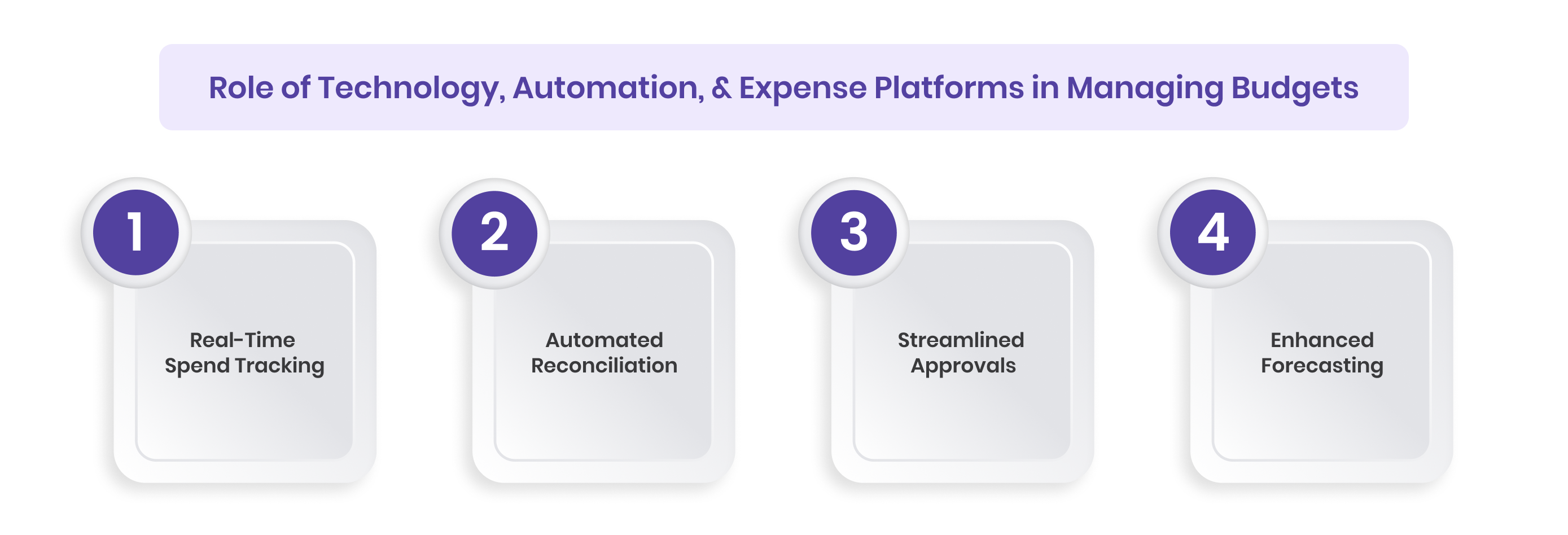
Modern finance teams increasingly rely on digital tools to manage complex budgeting cycles. Manual spreadsheets often create delays, version errors, and fragmented reporting.
Automation and expense management platforms simplify these processes by connecting data, improving accuracy, and enabling real-time decision-making.
1. Real-Time Spend Tracking
Traditional budgets rely on historical data, which may not reflect current performance. By linking expense systems directly to budgets, finance teams can monitor spending as it happens.
- This allows quick action on overspending or unused allocations.
- It strengthens control across departments without increasing administrative workload.
At Alaan, we make this visibility practical. Our platform links every corporate card transaction with the corresponding budget category, giving finance teams an immediate view of how actual expenses compare with planned allocations.
2. Automated Reconciliation and Error Reduction
Automation eliminates repetitive reconciliation work. Expense data flows directly into accounting systems, reducing manual entry and the risk of error. This keeps financial reports accurate and audit-ready throughout the budgeting period.
3. Streamlined Approvals and Policy Compliance
Automated workflows ensure that every purchase request and expense aligns with the relevant budget.
- Approval hierarchies can be customised based on amount, department, or vendor.
- This ensures compliance with internal controls and regional regulations, including UAE VAT standards.
4. Enhanced Forecasting and Analysis
Integrating automation and AI-powered analytics enables finance teams to evaluate trends and forecast outcomes more accurately. Real-time dashboards show how budgets perform against expectations, helping leaders adapt quickly to business changes.
These insights support better decisions on resource allocation, vendor management, and cost optimisation, all essential for fast-moving UAE and GCC businesses.
Also Read: Recording Business Expenses: A Practical Guide to Smarter Company Spending
Conclusion
A structured budgeting approach helps organisations maintain control, allocate resources efficiently, and plan for sustainable growth. Each budget type plays a specific role, from managing daily operations to guiding long-term investment decisions.
For finance leaders in the UAE, combining sound budgeting practices with technology offers the best results. Linking expense data, approvals, and budgets through a unified system improves visibility, accuracy, and compliance.
At Alaan, we help finance teams move beyond manual tracking by connecting real-time spending with budget planning.
This enables leaders to see how actual expenses align with financial goals, simplify approvals, and optimise resources across every department.
Bring accuracy, speed, and control to your budgeting process. Book a Demo with Alaan to see how real-time expense management supports smarter financial planning.
A budget only works if the cash is there when the bills arrive, so our steps to master cash flow management are a good next read. If you run projects, budget management in project management covers tracking spend once work starts, and the free cash flow stress test shows how your runway holds up under six preset scenarios.
FAQs
1. What is the main purpose of business budgeting?
Business budgeting helps organisations plan and control financial resources. It sets spending limits, forecasts revenue, and ensures that every decision supports long-term financial stability.
2. How do operational and financial budgets differ?
An operational budget covers day-to-day income and expenses, while a financial budget reflects the company’s full financial position, including cash flow, assets, and liabilities.
3. Which budgeting method suits small businesses best?
Small businesses often start with incremental or flexible budgeting. These approaches keep the process simple while allowing adjustments as the company grows or market conditions change.
4. Why should companies review budgets regularly?
Regular reviews ensure budgets stay accurate and relevant. They allow finance teams to adjust for unexpected changes, avoid overspending, and make data-driven decisions throughout the year.
5. How does automation support budgeting in modern finance teams?
Automation streamlines data entry, tracks spending in real time, and connects expenses with approved budgets. This improves accuracy, speeds up reporting, and provides instant visibility for finance leaders.
Gain control over business expenses with Alaan corporate cards
Invygo earned AED 100,000 in cashback using Alaan cards
Personalise approval workflows to align with your business needs with Alaan's Spend Management platform
Discover the power of automated expense tracking and smarter spend control with Alaan
Turn data into actionable insights with Alaan's spend management tools
Stay Tax Compliant with UAE's #1 Corporate Card and Spend Management Platform
Customisable corporate card policy template
Know how much Corporate Tax you have to pay this fiscal year
Easily integrate Alaan with your ERP for accurate, real-time expense tracking
Close books faster with Alaan's AI-powered accounting automation
Reconcile your books in minutes instead of hours, every single month.
Keep petty cash organized with Alaan corporate cards and automated expense management