.avif)

Which procurement KPIs actually help teams control spend and improve suppliers, and why tracking fewer, sharper metrics beats a crowded dashboard.
- Track a small set of KPIs that reflect real outcomes across cost control, compliance, supplier reliability, and workflow speed, rather than piling up activity counts.
- Counting purchase orders or processed invoices captures effort without showing whether procurement is effective, and savings figures can mislead when they come at the cost of supplier quality.
- For process efficiency, watch requisition-to-approval cycle time, approval bottlenecks, rework rates, and how many transactions run with little manual handling.
- Better numbers come from better processes, which is where Alaan helps, with corporate card spend controls, approval workflows before spend happens, centralised receipt capture, and accounting sync.
Procurement teams rarely struggle with a lack of data. The real problem is that they often track too many numbers without improving actual control, supplier performance, or process efficiency. Dashboards grow, reports expand, but decisions do not necessarily get better.
That is why defining the right procurement kpi matters. A useful KPI is not just something that can be measured. It is something that helps the business control spend, improve supplier outcomes, and run procurement processes more effectively.
For finance leaders, procurement heads, and operations teams, the focus should be on a small set of metrics that reflect real outcomes across cost, compliance, supplier reliability, and workflow efficiency.
TL;DR / Key Takeaways
- Procurement KPIs Should Measure Outcomes Like Cost Control, Supplier Performance, And Process Efficiency, Not Just Activity.
- The Most Useful Procurement Metrics Sit Across Spend Control, Compliance, Supplier Reliability, And Workflow Speed.
- A Strong Kpi For Procurement Process Efficiency Helps Reduce Delays, Rework, And Off-Contract Purchases.
- Operational Excellence KPIs for Efficiency Of Procurement Process: Focus On Cycle Time, Approval Quality, And Documentation Completeness.
- Better Procurement KPIs Require Better Underlying Processes, Not Just Better Reporting.
What A Procurement Kpi Should Actually Measure
A procurement KPI is a performance indicator used to evaluate how effectively procurement activities support business outcomes. This includes cost management, supplier performance, compliance, and operational efficiency.
It is important to distinguish between three closely related concepts:
- Procurement KPI: A critical measure tied directly to business performance
- Procurement Metric: Any measurable data point related to procurement
- Reporting Data: Information collected for tracking but not necessarily used for decision-making
Not every metric should be treated as a KPI. For example, the number of purchase orders processed may be useful for reporting, but it does not necessarily indicate whether procurement is effective.
A strong procurement KPI should:
- Reflect business impact
- Be measurable and consistent
- Be actionable
- Have clear ownership
When these conditions are not met, procurement teams end up tracking numbers without improving outcomes.
Why Procurement Teams Often Track The Wrong Things
Many procurement dashboards look comprehensive but fail to drive better decisions. This usually happens because teams focus on what is easy to measure rather than what actually matters.

1. Activity Is Easier To Measure Than Outcomes
Counting purchase orders, supplier interactions, or processed invoices is straightforward. Measuring whether procurement improved supplier performance or reduced risk is more complex.
As a result, activity-based metrics often dominate reporting.
2. Savings Numbers Are Overused
Savings is one of the most commonly reported procurement KPIs, but it can be misleading. Short-term cost reductions may come at the expense of supplier quality, reliability, or long-term pricing stability.
Without context, savings alone do not reflect procurement effectiveness.
3. Supplier Metrics Are Tracked Too Narrowly
Tracking only price or delivery performance ignores other critical factors such as quality, responsiveness, and risk exposure. A narrow view of supplier performance can lead to poor long-term decisions.
4. Workflow Efficiency Is Ignored Until It Becomes A Problem
Procurement processes are often assumed to work until stakeholders start bypassing them. Delays, approval bottlenecks, and rework are rarely measured early enough to prevent inefficiencies.
5. Too Many KPIs Reduce Accountability
When procurement teams track too many KPIs, it becomes unclear which ones actually matter. This reduces accountability and makes performance reviews less meaningful.

A smaller set of well-defined KPIs is usually more effective than a large, unfocused dashboard.
The Core Procurement Metrics Businesses Should Track
The most effective procurement metrics focus on outcomes across cost, compliance, supplier performance, and process efficiency. These are the measures that consistently provide actionable insights.
1. Spend Under Management
This measures the percentage of total spend that is actively controlled by procurement. Higher spend under management typically indicates stronger control and better visibility.
2. Cost Savings And Cost Avoidance
This tracks reductions in spend achieved through negotiation, sourcing strategies, or process improvements. It should be evaluated alongside quality and supplier performance.
3. Contract Compliance
This measures how much purchasing activity follows agreed supplier contracts. Low compliance often signals maverick spending or weak enforcement of procurement policies.
4. Maverick Spend Or Off-Contract Spend
This tracks purchases made outside approved vendors or agreements. High maverick spend reduces cost control and increases risk.
5. Supplier On-Time Delivery
This measures how reliably suppliers meet delivery commitments. It is a key indicator of supply chain stability.
6. Supplier Quality Or Defect Rate
This tracks the quality of goods or services received from suppliers. High defect rates can disrupt operations and increase costs.
7. Procurement Cycle Time
This measures how long it takes to move from requisition to purchase order. Longer cycle times often indicate inefficiencies in approval workflows.
8. Purchase Order Processing Efficiency
This reflects how efficiently purchase orders are created, approved, and issued. Delays here can slow down procurement activity.
9. Invoice Match Accuracy
This measures how often invoices match purchase orders and receipts without discrepancies. Higher accuracy reduces reconciliation effort.
10. Stakeholder Satisfaction
This reflects how internal users experience procurement processes. Poor satisfaction often leads to process bypassing and off-contract spend.
Also Read: Procure To Pay Systems Process Steps
KPI For Procurement Process Efficiency
A strong kpi for procurement process efficiency focuses on how smoothly procurement moves from request to purchase, not just on supplier outcomes. When processes are slow or inconsistent, stakeholders bypass them, and control weakens.

1. Requisition To Approval Cycle Time
This measures how long it takes for a purchase request to move from submission to approval. Long cycle times often indicate unclear approval paths or overloaded approvers.
Reducing this improves both efficiency and user adoption.
2. Purchase Order Cycle Time
This tracks how quickly approved requisitions are converted into purchase orders. Delays at this stage can disrupt supplier timelines and affect delivery schedules.
3. Approval Bottleneck Rate
This identifies where requests get stuck in the approval chain. A high bottleneck rate usually means the approval structure is too rigid or poorly designed.
4. Rework Or Returned Request Rate
This measures how often requisitions are sent back due to missing or incorrect information. High rework rates indicate poor input quality and unclear requirements.
5. Emergency Purchase Ratio
This tracks how often purchases are made outside the standard process due to urgency. Frequent emergency purchases usually signal poor planning or inefficient workflows.
6. Touchless Or Automated Processing Share
This measures how many procurement transactions are processed with minimal manual intervention. Higher automation improves speed, consistency, and control.
Related: Procurement Automation Software Solution
Operational Excellence KPIs For Efficiency Of Procurement Process
Operational excellence in procurement is not about processing more transactions. It is about running a process that is predictable, controlled, and easy to follow without workarounds.
1. Cycle Time Consistency Across Categories
It is not enough to track average cycle time. Variability across categories matters. Large inconsistencies indicate uneven process design or unclear approval rules.
2. First-Time Approval Quality
This measures how many requisitions are approved without requiring corrections. High first-time approval rates indicate clear requirements and better request quality.
3. Document Completeness Before Commitment
This tracks whether required documents, such as quotes or specifications, are available before purchase orders are issued. Strong documentation reduces downstream errors.
4. Exception Handling Rate
This measures how often procurement processes are bypassed or exceptions are requested. High exception rates usually indicate that the standard process is not practical for users.
5. Approval Policy Adherence
This tracks whether purchases follow defined approval rules. Weak adherence often leads to inconsistent decisions and reduced control.
6. Procurement Team Capacity And Throughput
This measures how many transactions the procurement team can handle relative to workload. It helps identify whether process inefficiencies or resource constraints are limiting performance.
Also Read: Approval Matrix Meaning Process
How To Choose The Right Procurement KPIs For Your Business
Not every procurement KPI is relevant for every organisation. The right set depends on business priorities, procurement maturity, and operational complexity.
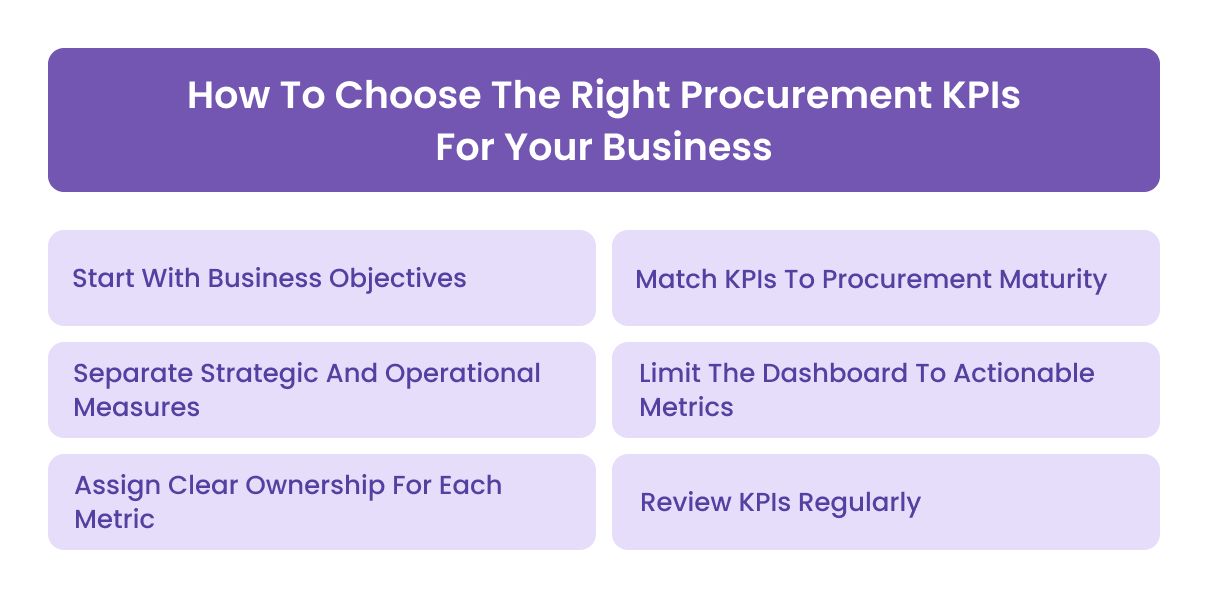
1. Start With Business Objectives
Procurement KPIs should align with broader business goals. A company focused on cost reduction will prioritise different metrics than one focused on supply reliability or growth.
2. Match KPIs To Procurement Maturity
Early-stage businesses may focus on basic control metrics such as spend visibility and approval discipline. More mature organisations can track advanced supplier performance and optimisation metrics.
3. Separate Strategic And Operational Measures
Strategic KPIs focus on long-term outcomes such as supplier performance and cost structure, while operational KPIs focus on process efficiency and execution quality.
Both are necessary, but they should not be mixed without clarity.
4. Limit The Dashboard To Actionable Metrics
Tracking too many KPIs reduces focus. A smaller set of metrics that directly influence decisions is more effective.
5. Assign Clear Ownership For Each Metric
Every KPI should have an owner responsible for monitoring and improving it. Without ownership, metrics become passive reports rather than active management tools.
6. Review KPIs Regularly
Procurement KPIs should evolve as the business grows and priorities change. Static KPI frameworks quickly become outdated.
Related: Financial Planning And Analysis Guide
Common Mistakes Businesses Make With Procurement KPIs
Most procurement KPI issues do not come from a lack of data. They come from how metrics are defined, prioritised, and used in practice. When KPIs are poorly structured or disconnected from actual workflows, they fail to improve control, efficiency, or supplier performance.
Here are the most common mistakes businesses make with procurement KPIs:
1. Treating Cost Savings As The Only Measure Of Success
Focusing only on savings ignores other critical factors such as supplier quality, reliability, and risk. This can lead to decisions that reduce cost in the short term but create problems later.
2. Measuring Suppliers Without Measuring Internal Process Quality
Supplier performance is important, but internal inefficiencies can have an equally large impact. Ignoring process KPIs leads to incomplete performance evaluation.
3. Tracking Too Many Metrics Without Clear Focus
Large KPI dashboards often dilute attention. When everything is measured, it becomes difficult to prioritise what actually matters.
4. Not Defining Data Ownership And Accountability
Without clear ownership, KPIs are monitored but not acted upon. Accountability is essential for turning data into improvement.
5. Ignoring Stakeholder Experience
If procurement processes are difficult to use, stakeholders will bypass them. Metrics should reflect not just efficiency but also usability.
6. Reviewing KPIs Too Late To Influence Decisions
KPIs should be reviewed in real time or near real time. Delayed reviews limit their usefulness in improving ongoing processes.
Also Read: Guide Logistics Spend Analysis
How Finance And Procurement Should Review Procurement Kpi Performance Together
Procurement KPIs are most effective when reviewed jointly by finance and procurement teams. This ensures alignment between cost control, operational efficiency, and business objectives.
1. Compare Savings Quality Against Compliance
Savings should be evaluated alongside contract compliance to ensure they are sustainable and properly implemented.
2. Review Cycle Time Against Process Discipline
Faster processes should not come at the expense of control. Cycle time improvements should be balanced with adherence to approval and documentation standards.
3. Link Supplier Performance To Business Risk
Supplier metrics should be evaluated in the context of operational impact and risk exposure.
4. Connect Spend Visibility To Forecast Accuracy
Better visibility into procurement spend supports more accurate financial forecasting and planning.
5. Use Exceptions And Rework As Control Signals
High levels of exceptions or rework indicate weaknesses in process design or policy enforcement.
6. Maintain Focus On Audit Readiness
Strong documentation and compliance ensure that procurement activity can withstand audit scrutiny.
Related: Improving Internal Control Financial Reporting Icfr
How Alaan Supports Better Procurement Kpi Performance In Practice
Procurement KPIs improve only when the underlying processes are controlled and visible. Many businesses define metrics but struggle to improve them because execution remains fragmented.
Alaan helps strengthen the execution layer so procurement and finance teams can track and improve KPIs more effectively.
- Corporate Cards With Spend Controls And Vendor Restrictions
At Alaan, businesses can issue corporate cards with defined limits and merchant controls. This helps reduce maverick spend and improves compliance metrics. - Structured Approval Workflows Before Spend Happens
Approval workflows ensure that procurement decisions are reviewed before transactions occur, improving control and reducing process inefficiencies. - Centralised Receipt And Invoice Capture
Linking documents directly to transactions improves documentation completeness and reduces reconciliation effort. - Real-Time Visibility Into Procurement Spend
Procurement and finance teams can track spending in real time, improving visibility and enabling faster decision-making. - Cleaner Reconciliation And Accounting Sync
Integrations with accounting systems such as Xero, QuickBooks, NetSuite, and Microsoft Dynamics help ensure accurate and efficient financial reporting. - Better Audit Readiness Across Procurement Activity
Clear audit trails improve compliance and make it easier to review procurement activity.

Procurement KPIs become meaningful only when the processes behind them are consistent and well-controlled.
Also Read: Expense Management Software Business Spend Tracking
Conclusion
Procurement KPIs are most valuable when they improve decision-making, not just reporting. The goal is not to track more metrics, but to track the right ones that reflect cost control, supplier performance, and process efficiency.
For growing businesses, the focus should be on building a balanced KPI framework that combines financial, operational, and compliance measures. This ensures that procurement supports both short-term efficiency and long-term business performance.
The key is consistency. Even the best KPI framework will fail if the underlying processes are weak or poorly enforced.
If your organisation is looking to improve procurement performance, strengthen spend control, and gain better visibility into procurement activity, Book A Demo to see how Alaan can support your procurement workflows.
A lot of these KPIs, like cycle time and on-time payment, improve fastest once invoices stop moving by email, and our guide on AP automation and how it works explains what changes when they do.
FAQs
1. What Is A Good Procurement Kpi To Start With
A good starting point is spend under management, as it reflects how much of your organisation’s spend is controlled by procurement.
2. What Is The Difference Between Procurement Kpis And Procurement Metrics
Procurement KPIs are key indicators tied to business outcomes, while procurement metrics are general data points that may or may not influence decision-making.
3. How Many Procurement KPIs Should A Team Track
Most teams should focus on a small set of high-impact KPIs rather than a large number of metrics to maintain clarity and accountability.
4. What Is A Good Kpi For Procurement Process Efficiency
Requisition-to-approval cycle time is a commonly used KPI for measuring procurement process efficiency.
5. Which Operational Excellence KPIs for Efficiency of the Procurement Process Matter Most
Cycle time consistency, first-time approval quality, and document completeness are among the most important indicators.
6. How Can Procurement Teams Improve Kpi Performance Over Time
Improvement comes from strengthening processes, increasing visibility, standardising workflows, and ensuring accountability for each KPI.
Gain control over business expenses with Alaan corporate cards
Invygo earned AED 100,000 in cashback using Alaan cards
Personalise approval workflows to align with your business needs with Alaan's Spend Management platform
Discover the power of automated expense tracking and smarter spend control with Alaan
Turn data into actionable insights with Alaan's spend management tools
Stay Tax Compliant with UAE's #1 Corporate Card and Spend Management Platform
Customisable corporate card policy template
Know how much Corporate Tax you have to pay this fiscal year
Easily integrate Alaan with your ERP for accurate, real-time expense tracking
Close books faster with Alaan's AI-powered accounting automation
Reconcile your books in minutes instead of hours, every single month.
Keep petty cash organized with Alaan corporate cards and automated expense management