.avif)


Procurement planning connects business need, sourcing route, budget ownership, and internal timelines before purchasing pressure builds, and defining full-workflow dates keeps execution predictable.
- Most procurement trouble starts before anyone buys anything, when teams have not agreed on what they need, when they need it, who owns the budget, or how it will be sourced.
- A procurement plan works best when it connects business need, sourcing route, budget owner, and internal timelines, so requests stop arriving as rushed, one-by-one approvals.
- Defining procurement dates properly means mapping the whole workflow, from requirement confirmation through sourcing, approval, and delivery, rather than only the final purchase date.
- An annual plan should stay live all year with monthly or quarterly reviews, because projects move, budgets change, and renewals sneak up on teams that treat it as a one-time document.
- Alaan carries that planning discipline into execution through corporate cards with spend controls, configurable approval workflows, real-time visibility into company spend, and receipt and invoice capture for cleaner documentation.
Most procurement problems do not begin when a purchase is made. They begin earlier, when teams have not clearly defined what they need, when they need it, how it should be sourced, or which budget should carry the cost. That is when routine purchasing starts turning into rushed approvals, duplicated requests, supplier delays, and avoidable pressure on finance.
That pressure is only increasing. PwC’s 2024 Digital Procurement Survey reported a current procurement digitalisation rate of 42% in Asia Pacific, with a 2027 target of 63%, which reflects how quickly procurement functions are being pushed to operate with more structure, visibility, and scale. In that environment, procurement planning stops being an administrative document and becomes a practical control mechanism.
In this article, we explain what a procurement plan is, how the procurement planning process works, what an annual procurement planning process should include, and how businesses can define procurement dates more clearly before spend begins.
TL;DR / Key Takeaways
- Procurement planning works best when it connects business need, sourcing route, budget ownership, and internal timelines before purchase requests start piling up.
- A useful annual procurement planning process should stay live through the year rather than sit untouched after one planning cycle.
- Defining procurement dates properly means mapping the full workflow, not only the final purchase date.
- Good procurement planning reduces avoidable urgency, improves approval discipline, and gives finance earlier visibility into likely spend.
- Alaan helps carry that planning discipline into execution through corporate cards, approval workflows, real-time visibility, and cleaner documentation.
What Is A Procurement Plan?
A procurement plan is a working document that sets out what the business expects to buy over a defined period and how those purchases will be handled. In practical terms, it should show what is needed, why it is needed, when it is required, how it will be sourced, who owns it, and how it will move through approvals.
That is why a procurement plan should never be treated as a simple purchase list. A useful procurement business plan connects demand to budgets, timelines, supplier decisions, and internal ownership. It gives procurement, finance, and department heads a shared view of upcoming spend before urgent requests start arriving one by one.
A strong procurement plan usually covers a few core points:
- Business Need
What the business is buying and why the purchase matters. - Sourcing Route
Whether the purchase will go through a preferred supplier, competitive quotes, renewal, negotiation, or a more formal sourcing process. - Budget Owner
Which team or function owns the cost and whether the spend is already approved, planned, or still provisional. - Required Timing
When sourcing needs to begin, when approvals should be completed, and when delivery or implementation must happen. - Approval Path
Who reviews the request, who approves the spend, and who is responsible for tracking execution.
When those elements are missing, procurement planning becomes vague very quickly. Teams may know that a purchase is needed, but not whether it is budgeted, urgent, or realistically ready to move forward.
Also read: Paperless expense management automation benefits
Why The Procurement Planning Process Matters
A good procurement planning process gives the business time to make better decisions before purchasing pressure builds. It improves coordination across departments, makes approval workloads easier to manage, and reduces the number of supplier decisions made under avoidable urgency.
Reduces Reactive Buying
Reactive buying usually looks like speed, but it usually comes from weak visibility. Teams discover a requirement too late, renewal dates are missed, budgets are checked at the last moment, and procurement is asked to move immediately.
A stronger planning process reduces that pattern. It surfaces demand earlier, separates genuine priorities from low-urgency requests, and gives the business more time to compare suppliers properly.
Improves Budget Alignment
Procurement planning also matters because purchasing decisions do not sit outside finance. Every planned purchase affects budget usage, cash timing, and approval pressure.
When demand is mapped earlier, finance can see what is likely to hit the budget, which purchases are committed, and where additional review may be needed. That makes budget conversations more grounded and reduces surprises later in the cycle.
Creates Clearer Internal Ownership
Many procurement delays are not caused by suppliers. They are caused by uncertainty inside the business. One team raises the request, another team owns the budget, someone else approves it, and no one is fully responsible for moving it through the process.
A proper procurement planning process makes ownership clearer. It shows who requested the purchase, who validates the need, who manages sourcing, and who approves the spend. That structure removes avoidable confusion before the transaction stage begins.
Gives Procurement More Time To Source Properly
Supplier selection is stronger when procurement has time to assess options with context. That includes reviewing commercial fit, checking whether a preferred supplier already exists, assessing renewal versus replacement, and aligning the purchase method to the size and importance of the spend.
Without planning, those decisions happen under pressure. With planning, procurement can approach them with more leverage, cleaner timelines, and better internal alignment.
Related: Business spend management tools and importance
Core Elements Of A Good Procurement Business Plan
A procurement business plan works best when it is specific enough to guide action, but simple enough to update as priorities change. It should help the business prepare for spend before that spend becomes operationally urgent.
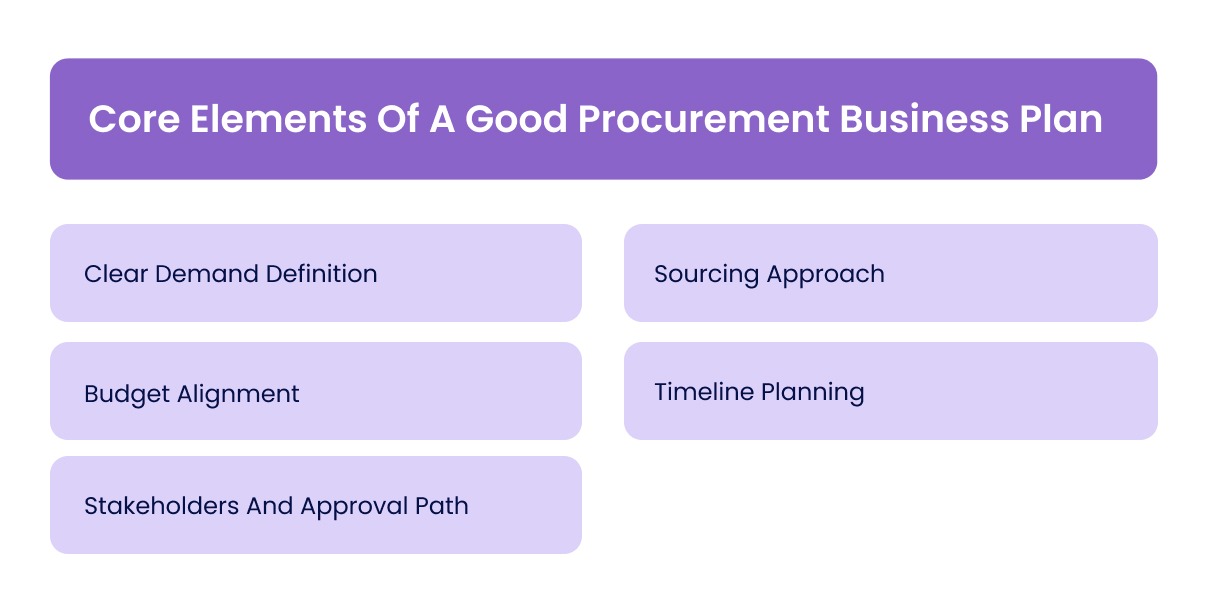
1. Clear Demand Definition
Every planned purchase should start with a clearly defined requirement. That means knowing what is needed, what problem it solves, what quantity or scope is involved, and whether it is recurring or one-off.
Weak demand definition creates avoidable delay. Procurement cannot source properly when the requirement itself is still vague, duplicated, or shifting between teams.
2. Sourcing Approach
A good plan should also indicate how the purchase is likely to be handled. Some requirements may fit an existing supplier relationship. Others may need fresh quotes, commercial comparison, or a broader sourcing exercise.
Defining the likely sourcing route early helps the business avoid unnecessary delay later. It also makes it easier to decide how much review, documentation, and commercial scrutiny the purchase actually needs.
3. Budget Alignment
A plan becomes much more useful when each major purchase is attached to a budget owner. That allows finance to separate approved demand from tentative demand and gives the business a clearer view of what is expected to move during the period.
Budget alignment is also where procurement planning becomes commercially meaningful. It stops purchases from sitting in a vague future bucket and forces earlier clarity around cost ownership.
4. Timeline Planning
Timing is one of the most overlooked parts of procurement planning. Many teams know that a purchase is needed “next quarter” or “before launch”, but they do not define when sourcing should start, when approvals must be completed, or how much lead time the process actually needs.
A better plan links the purchase to real internal milestones. That is what makes execution more predictable and reduces last-minute bottlenecks.
5. Stakeholders And Approval Path
A strong procurement plan should show who is involved before the purchase reaches the transaction stage. That includes the request owner, the budget owner, any procurement support, and the final approver.
Without that clarity, even simple purchases can stall. With it, the process becomes easier to manage because each step already has visible accountability.
Also read: Automate expense management approvals
Annual Procurement Planning Process: Step By Step
A strong annual procurement planning process should make upcoming purchasing easier to organise, easier to approve, and easier to execute. It should give the business a clear view of what is likely to happen across the year before requests start arriving in isolation.
1. Gather Requirements Across Teams
The process starts by collecting expected purchasing needs from the teams that will actually create demand. That usually includes operations, finance, IT, facilities, HR, and any function managing supplier-led projects or recurring spend.
At this stage, the goal is not to capture every possible idea. It is to identify the purchases that are likely to matter during the period ahead. That includes contract renewals, recurring operating spend, project-based buying, equipment needs, software requirements, and any date-sensitive supplier activity.
2. Consolidate And Categorise Demand
Once those requirements are collected, they need to be grouped into a workable view. Similar purchases should be brought together so the business can see where demand overlaps, where supplier consolidation may be possible, and where separate requests are really part of the same category.
This is where procurement planning starts becoming commercially useful. A scattered list of requests creates noise. A consolidated view creates visibility, better prioritisation, and a stronger basis for supplier decisions.
3. Prioritise By Business Need
Not every planned purchase carries the same urgency or impact. Some items are critical to operations. Others are linked to growth projects, compliance deadlines, or contract continuity. Some are useful but non-essential.
A good plan should make that distinction visible. Confirmed operational needs, strategic purchases, renewals, and lower-priority requests should not all sit in one undifferentiated list. Procurement planning works better when the business can see what must move, what can wait, and what still depends on another decision.
4. Match Requirements To Budget And Sourcing Route
Each major purchase should then be linked to a budget owner and a likely sourcing path. That means clarifying whether the spend is already approved, expected but not yet signed off, or still provisional.
It also means deciding whether the requirement is likely to go through a preferred supplier, competitive quotes, renewal, negotiation, or a broader sourcing process. That clarity helps reduce last-minute confusion and gives procurement a cleaner starting point once execution begins.
5. Set Timelines And Internal Milestones
This is where many procurement plans weaken. Teams record what they need, but not the steps required to get there on time.
A better plan does not rely on one vague target date. It maps the internal milestones around the purchase, including when sourcing should begin, when supplier review should happen, when approvals need to be complete, and when the purchase must be ready for ordering, payment, or implementation.
That turns procurement planning into an execution tool rather than a list of future intentions.
6. Review And Approve The Plan
Before the plan is treated as actionable, it should be reviewed across the relevant stakeholders. Procurement, finance, and business owners should be able to challenge timing, duplication, budget assumptions, and sourcing logic before the period begins.
This review matters because many procurement problems are visible early if the right people look at the plan together. A deadline may be unrealistic, a budget may not yet exist, or a purchase may already be covered elsewhere.
7. Keep The Plan Updated
A procurement plan should never be treated as fixed for the full year. Projects move, budgets change, suppliers slip, and new requirements appear.
That is why the annual procurement planning process should include a regular review rhythm. Monthly or quarterly reviews are usually enough to keep the plan current without turning it into a reporting exercise. The objective is not to rewrite the plan constantly. It is to review it often enough that timelines, priorities, and ownership still reflect actual business conditions.
Related: Sample business expense policy guidelines and examples
How To Define Procurement Dates For A Business Plan Properly
One of the most useful parts of procurement planning is also one of the most misunderstood. Many businesses define only the final purchase date. That is too narrow to be useful.
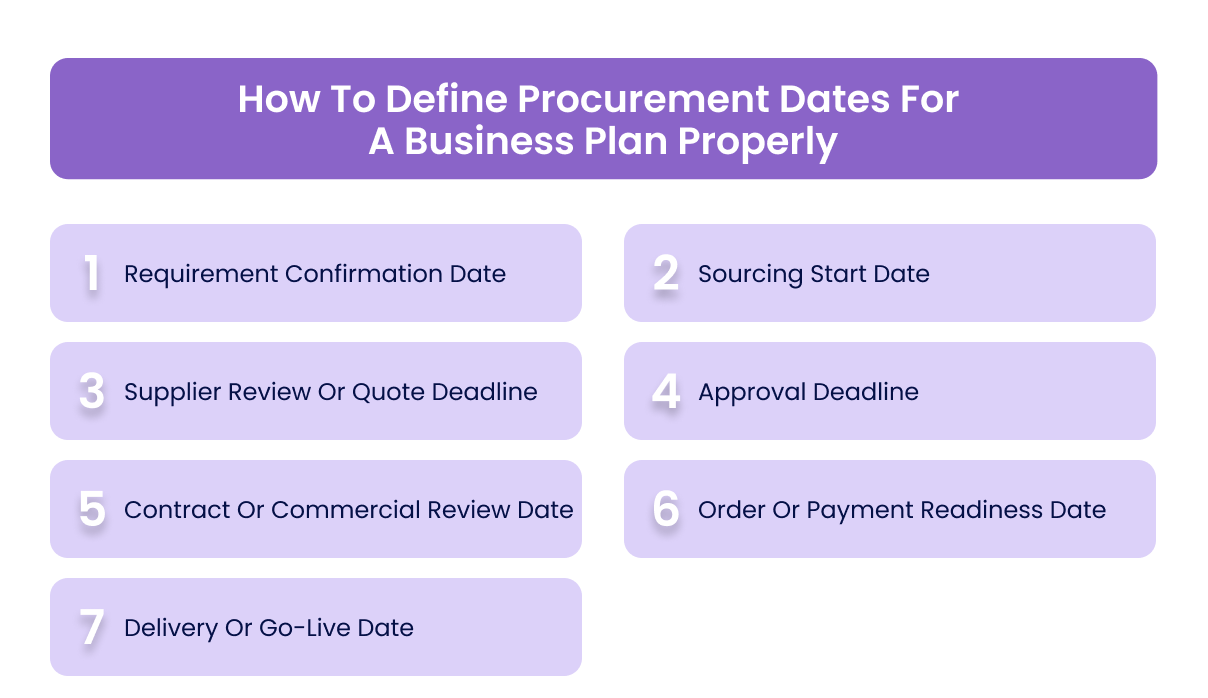
A proper procurement timeline should reflect the full path that leads to the purchase. That gives teams a more realistic view of what needs to happen and when.
1. Requirement Confirmation Date
This is the point at which the business formally agrees that the purchase is needed. Without this date, sourcing often starts before the scope or priority is fully clear.
2. Sourcing Start Date
This is when procurement activity should begin. It may involve reviewing existing suppliers, requesting quotes, preparing commercial comparisons, or reopening a category review.
If this date is set too late, the entire process compresses and approval pressure rises quickly.
3. Supplier Review Or Quote Deadline
There should be a clear point by which supplier options, pricing, or proposals need to be reviewed. Otherwise, purchasing decisions drift until the deadline becomes urgent.
This date is especially important where multiple stakeholders need time to review supplier responses before making a decision.
4. Approval Deadline
Approvals should have a date of their own rather than being treated as something that will happen somewhere near the end. This helps business owners and finance teams prepare in advance, especially for higher-value or cross-functional spend.
5. Contract Or Commercial Review Date
Where the purchase requires a contract, negotiation, or more detailed commercial review, that step should also be visible in the timeline. It is a common source of delay, especially when it appears late.
6. Order Or Payment Readiness Date
The plan should show when the transaction itself needs to be ready. That might mean issuing a purchase order, loading an approved supplier, preparing a payment workflow, or confirming that documentation is complete.
7. Delivery Or Go-Live Date
This is the operational date the business is usually focused on. It matters, but it should sit at the end of the planning chain, not at the beginning of it.
When businesses define procurement dates this way, the process becomes easier to manage. Teams stop asking only, “When do we need to buy this?” and start asking, “What has to happen before we can buy this properly?”
Also read: Automated procurement processes and workflows
Common Procurement Planning Mistakes
Even when businesses try to plan ahead, the process often breaks down in familiar ways.
1. Treating The Plan As A One-Time Document
A procurement plan quickly loses value if it is written once and not touched again. The business moves on, priorities shift, and the document stops reflecting reality.
2. Planning Demand But Not Lead Time
This is one of the most common mistakes. Teams list the purchases they want to make but do not define how long sourcing, review, approval, and execution will actually take.
The result is a plan that looks complete on paper but still creates urgency in practice.
3. Leaving Ownership Unclear
Procurement slows down when no one is clearly responsible for moving a request forward. A department may need the purchase, finance may own the budget, and procurement may support sourcing, but unless responsibility is visible, delays appear early.
4. Mixing Confirmed Need With Wishlist Demand
A plan becomes much harder to use when committed purchases and speculative ideas are grouped together without distinction. Procurement needs to know what is genuinely expected to move and what is still conditional.
5. Ignoring Contract Renewal Dates
Renewals often create avoidable pressure because teams remember them too late. A stronger planning process brings contract expiry, notice periods, and replacement decisions into view much earlier.
6. Disconnecting Planning From Execution
Some businesses plan well on paper, then lose control once the purchase moves into approvals, transactions, and documentation. That gap weakens the value of the plan itself.

What Good Procurement Planning Looks Like In Practice
Good procurement planning is visible, realistic, and easy to act on. It gives the business a clearer view of what is coming, who owns it, how it will be sourced, and which internal deadlines matter.
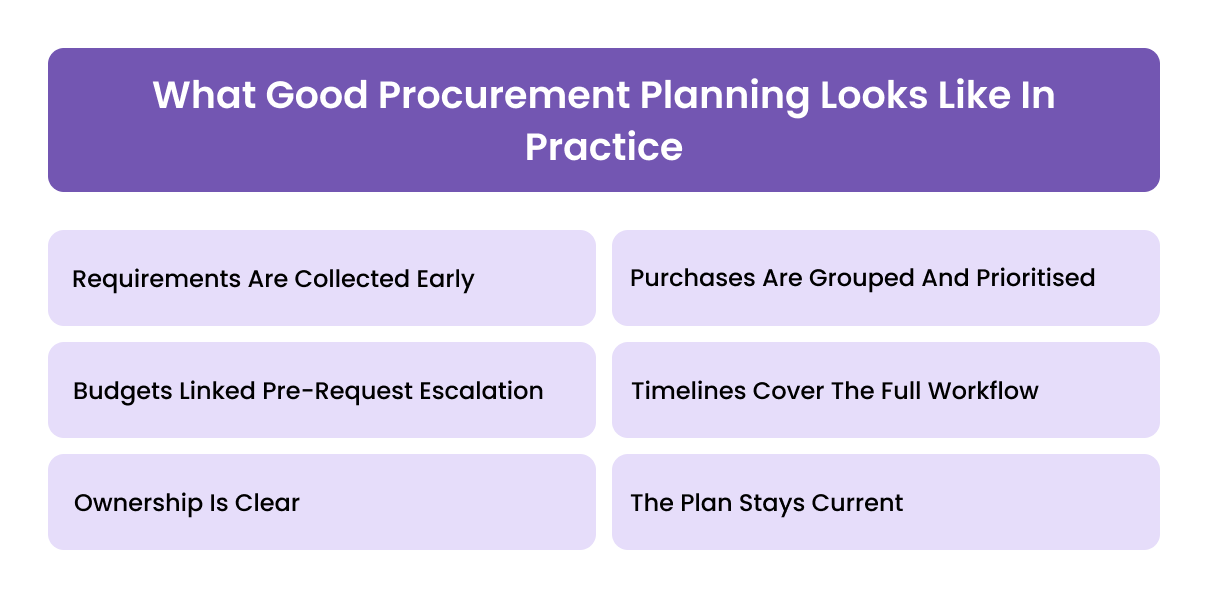
In practice, that usually means:
- Requirements Are Collected Early
Teams surface expected demand before urgency takes over. - Purchases Are Grouped And Prioritised
Similar requests are consolidated and critical items are easier to identify. - Budgets Are Linked Before Requests Escalate
Finance can see what is likely to move and where additional review may be needed. - Timelines Cover The Full Workflow
Dates are defined across sourcing, review, approval, and execution rather than treated as a single endpoint. - Ownership Is Clear
Request owners, budget owners, procurement support, and approvers are visible from the start. - The Plan Stays Current
The document is updated often enough to reflect real business movement.
That is what makes the procurement planning process useful. It helps the business buy with more control, less urgency, and fewer surprises.
Also read: Enterprise spend management software solutions
How Alaan Helps Turn Procurement Plans Into Controlled Spend
A procurement plan improves decisions before money moves. The next challenge is execution. If approved purchases still move through scattered approvals, weak spend controls, and disconnected documentation, the discipline created during planning starts breaking down.
At Alaan, we help finance teams carry that control into the spend stage. We do that through corporate cards, configurable approval workflows, real-time visibility, receipt and invoice capture, AI-assisted verification, and accounting integrations that keep business spend easier to track and reconcile. Alaan is positioned as an expense management platform integrated with accounting tools, not as accounting software.
- Corporate Cards With Spend Controls
At Alaan, we provide corporate cards with spend limits and vendor restrictions, which makes it easier to keep approved purchases within defined boundaries instead of relying on loosely managed payment methods. That is especially useful when procurement-related spend needs to stay tied to a known supplier, category, or budget owner. - Approval Workflows Before Spend Happens
Alaan supports configurable approval workflows so businesses can review purchases before they are completed. That helps turn procurement decisions into enforceable controls rather than post-transaction clean-up. - Real-Time Visibility Into Business Purchases
Alaan provides finance teams centralised visibility into company spend as it happens. That makes it easier to see which teams are spending, which suppliers are being used, and where unplanned buying may be appearing. - Receipt And Invoice Capture In One Flow
Teams can upload receipts and invoices through the alaan app, email, or extension, while Alaan Intelligence extracts key details, matches them to transactions, and flags discrepancies or duplicates. That reduces fragmented documentation and makes procurement-related spend easier to verify. - Accounting Integrations For Cleaner Reconciliation
At Alaan, we integrate with tools including Xero, QuickBooks, Oracle NetSuite, and Microsoft Dynamics, with real-time syncing and automation rules that reduce manual entry and make downstream reconciliation cleaner. - Better Audit Readiness Across Business Spend
We connect approvals, transaction records, and supporting documents in one place. That gives finance teams a clearer audit trail across supplier-related spend and makes it easier to trace how a planned purchase moved from approval to recorded expense.

Conclusion
A strong procurement planning process gives businesses more than a list of future purchases. It creates earlier clarity around demand, timing, sourcing, budgets, and ownership, which makes purchasing easier to manage before urgency takes over.
That matters because procurement problems are usually easier to prevent than to correct. When teams plan demand properly, define procurement dates clearly, and align approvals before spend begins, procurement becomes more predictable and much easier to control.
Once those purchases move into execution, the same discipline needs to continue. That is where Alaan helps finance teams keep approved spend visible, structured, and easier to manage from request to reconciliation. Book a demo to see how Alaan helps turn procurement plans into controlled business spend.
A plan holds up better when the invoices that follow it are handled properly, and our guide to how AP automation works covers that half, including when teams usually make the switch.
FAQs
1. What Is The Difference Between A Procurement Plan And A Purchase Requisition?
A procurement plan is forward-looking. It maps expected purchasing needs, budgets, timelines, and sourcing routes over a period. A purchase requisition is a specific request raised when a particular purchase is ready to move through approval.
2. Who Should Own The Procurement Planning Process In A Business?
Procurement planning usually works best when ownership is shared but coordinated. Department heads should define demand, finance should validate budget impact, procurement should guide sourcing logic, and one central owner should keep the plan current.
3. How Far In Advance Should Procurement Planning Start?
That depends on the complexity of the spend, but most businesses should start annual procurement planning before the budget cycle closes and then refresh it regularly. High-value purchases, supplier changes, and contract renewals usually need much more lead time than routine operating spend.
4. How Does Procurement Planning Help Small And Mid-Sized Businesses?
Smaller businesses often feel procurement pressure faster because approvals are concentrated, budgets are tighter, and supplier mistakes are harder to absorb. A simple planning process helps them avoid rushed buying, missed renewals, and poor visibility into upcoming spend.
5. What Should Be Reviewed In A Procurement Plan Each Quarter?
Quarterly reviews should check whether planned purchases are still needed, whether timelines still hold, whether budgets have changed, whether renewals are approaching, and whether any new purchases need to be added to the plan.
6. How Do You Measure Whether Procurement Planning Is Working?
A useful procurement planning process usually shows up in fewer urgent purchases, better visibility into upcoming spend, smoother approvals, fewer missed renewals, and less friction between procurement, finance, and business teams.
Gain control over business expenses with Alaan corporate cards
Invygo earned AED 100,000 in cashback using Alaan cards
Personalise approval workflows to align with your business needs with Alaan's Spend Management platform
Discover the power of automated expense tracking and smarter spend control with Alaan
Turn data into actionable insights with Alaan's spend management tools
Stay Tax Compliant with UAE's #1 Corporate Card and Spend Management Platform
Customisable corporate card policy template
Know how much Corporate Tax you have to pay this fiscal year
Easily integrate Alaan with your ERP for accurate, real-time expense tracking
Close books faster with Alaan's AI-powered accounting automation
Reconcile your books in minutes instead of hours, every single month.
Keep petty cash organized with Alaan corporate cards and automated expense management