.avif)

A purchase requisition approval is the pre-spend control that decides whether a purchase should go ahead before a purchase order is ever issued.
- Procurement control usually breaks down before the purchase order exists, when a request is raised informally and approved without full context, so finance only sees the problem after the money is already committed.
- A purchase requisition is an internal request to buy, raised before any supplier commitment, and it is the point where budget owners can check need, estimated cost, and policy fit.
- Approval should follow budget ownership and spend thresholds rather than pure hierarchy, with line managers, budget owners, procurement, and finance each reviewing at the right stage.
- Common routing models include single-step, sequential, parallel, threshold-based, and category-based, and most businesses do best with a mix rather than one rigid flow.
- Alaan supports this with corporate cards carrying spend limits and merchant controls, configurable approval workflows before spend, linked receipt and invoice capture, and syncs into Xero, QuickBooks, NetSuite, and Microsoft Dynamics.
Procurement control often breaks down before a purchase order is even created. A team raises a request informally, a manager approves it quickly without full context, and the purchase moves forward without proper validation. By the time finance reviews the transaction, the decision has already been made and documented poorly.
This is where purchase requisition approval plays a critical role. It is not just an internal formality. It is the control point that determines whether a purchase should happen, under what conditions, and with which level of oversight.
In practical terms, a purchase requisition (PR) is an internal request raised before any commitment is made to a supplier. Once approved, it allows procurement to move forward with issuing a purchase order. That distinction matters because the PR stage is where businesses can enforce budget discipline, validate need, and ensure policy alignment before money is committed.
TL;DR / Key Takeaways
- Purchase Requisition Approval Is A Pre-Spend Control That Determines Whether A Purchase Should Proceed Before A Purchase Order Is Issued.
- A Strong Purchase Requisition Creation And Approval Process Improves Budget Visibility, Reduces Off-Contract Spend, And Strengthens Documentation.
- What Is Pr In Procurement Is Simple: It Is The Internal Trigger That Authorises Procurement To Move Forward.
- Weak PR Workflows Lead To Approval Delays, Incomplete Requests, And Finance Rework Later In The Process.
- Structured Approval Workflows And Clear Documentation Standards Improve Control Across Procurement And Finance.
Related: Business Spend Management Tools Importance
What Is Pr In Procurement
A purchase requisition (PR) is an internal document used to request the purchase of goods or services. It is created by an employee or department when there is a business need, and it must be reviewed and approved before procurement can proceed.
The PR is not sent to the supplier. It stays within the organisation as a control mechanism.
To understand its role clearly, it helps to distinguish it from other procurement documents:
- Purchase Requisition: Internal request to buy
- Purchase Order: External document sent to the supplier after approval
- Invoice: Supplier request for payment after goods or services are delivered
This sequence is important because it shows where control should happen. If the PR stage is weak, the rest of the procurement process becomes reactive instead of controlled.
Also Read: Purchase Order Vs Invoice
Why Purchase Requisition Approval Matters Before Spend Happens
A strong purchase requisition approval process does more than route requests. It creates structure around how spending decisions are made.

1. It Creates Budget Visibility Before Commitment
When a requisition is raised properly, it includes estimated cost and cost centre information. This allows budget owners to review whether the purchase fits within planned spend before any commitment is made.
Without this step, budget overruns are often discovered after the purchase has already happened.
2. It Reduces Unauthorised Or Duplicate Purchases
PR approval ensures that purchases are reviewed before they are executed. This reduces the risk of duplicate orders, unnecessary purchases, or spend outside approved categories.
It also helps enforce preferred vendor usage where applicable.
3. It Gives Procurement Time To Validate Supplier And Policy Fit
Procurement teams need visibility into upcoming purchases to ensure supplier selection aligns with contracts, pricing agreements, and policy requirements.
If requests bypass the PR stage, procurement loses the ability to influence supplier decisions effectively.
4. It Improves Documentation Before Finance Reviews The Transaction
A well-structured PR includes key details such as business purpose, cost estimate, and supporting context. This reduces the need for finance teams to reconstruct the transaction later.
Better documentation early in the process leads to cleaner accounting and easier audit readiness.
5. It Reduces Rework Across Teams
When requests are incomplete or unclear, they are often sent back for correction or clarified later during invoice processing. A strong PR approval process reduces this back-and-forth by ensuring requests are complete before approval.

How Purchase Requisition Creation And Approval Should Work
A structured purchase requisition creation and approval process ensures that every request moves through the right checks before procurement proceeds.
1. The Requester Raises A Clear Purchase Need
The process starts when an employee or team identifies a requirement for goods or services. The request should be tied to a clear business purpose rather than an informal or ad hoc need.
2. The Requisition Includes Complete And Relevant Information
A strong requisition includes:
- Business justification
- Description of goods or services
- Estimated cost
- Required timeline
- Suggested vendor if known
Incomplete requisitions slow down approval and create confusion later in the process.
3. The Request Routes To The Right Approver
Approval should not be based only on hierarchy. It should reflect:
- Budget ownership
- Category responsibility
- Spend thresholds
This ensures that the right person reviews the request with the right context.
4. Procurement Reviews Supplier And Policy Alignment
Once approved at the request level, procurement may review the requisition to ensure:
- Vendor selection aligns with preferred suppliers
- Pricing and terms are appropriate
- Policy requirements are met
This step helps maintain consistency across purchasing decisions.
5. Approved Requisitions Move To Purchase Order Creation
After approval, the requisition becomes the basis for issuing a purchase order to the supplier. This ensures that procurement decisions are documented and traceable.
6. Rejected Or Returned Requisitions Are Corrected
If a requisition is incomplete or does not meet requirements, it should be returned with clear feedback. This improves request quality over time and reduces repeated errors.
Related: Procure To Pay Systems Process Steps
What Information A Good Purchase Requisition Should Include
The quality of a purchase requisition determines the quality of the approval decision. Weak requests lead to weak approvals.

1. Business Justification
Every requisition should explain why the purchase is necessary. This helps approvers evaluate whether the request aligns with business priorities.
2. Item Or Service Details
Clear descriptions reduce ambiguity and ensure procurement understands what is being requested.
3. Quantity And Timing
Specifying how much is needed and when helps with planning and avoids unnecessary urgency.
4. Estimated Cost
Even if the final price is not known, an estimate helps budget owners assess the impact before approval.
5. Budget Or Cost Centre
Linking the request to a cost centre ensures accountability and proper financial tracking.
6. Suggested Vendor Or Sourcing Context
If a vendor is already identified, this should be included. If not, procurement can use the information to identify appropriate suppliers.
7. Supporting Documents Where Needed
Quotes, specifications, or prior agreements can strengthen the request and reduce follow-up questions during approval.
Also Read: Business Expense Categories Accounting Examples
Who Should Approve A Purchase Requisition
A purchase requisition approval process only works when the right people are reviewing the request at the right stage. Approval should not be based purely on hierarchy. It should reflect ownership, risk, and financial impact.
1. Line Manager For Need Validation
The first level of approval typically sits with the requester’s line manager. This ensures that the request is legitimate, aligned with team priorities, and not duplicative.
Without this step, unnecessary or poorly justified requests can move forward too easily.
2. Budget Owner For Spend Authority
The budget owner plays a critical role in controlling costs. They assess whether the requested spend fits within allocated budgets and whether it aligns with current priorities.
This step ensures that spending decisions are tied directly to financial accountability.
3. Procurement For Supplier And Policy Alignment
Procurement teams review whether the request follows sourcing policies, uses preferred vendors, and aligns with contract terms where applicable.
This helps maintain consistency across supplier usage and prevents fragmented purchasing.
4. Finance For Exceptions And High-Value Spend
Finance may be involved for higher-value requests or budget exceptions. This ensures that unusual or high-risk purchases receive additional scrutiny before approval.
Finance involvement is especially important when spend affects cash flow planning or financial reporting.
5. Senior Approvers For Strategic Or High-Risk Requests
For large, complex, or high-risk purchases, senior leadership may need to approve the requisition. This ensures that strategic decisions are reviewed at the appropriate level.
A well-designed approval chain ensures that decisions are informed without becoming unnecessarily slow or bureaucratic.
Also Read: Approval Matrix Meaning Process
Purchase Requisition Approval Models Businesses Commonly Use
Different organisations use different approval structures depending on complexity, risk, and scale. The goal is to balance control with efficiency.

1. Single-Step Approval Model
In smaller organisations or low-value purchases, a single approver may be sufficient. This keeps the process fast but may limit oversight for more complex requests.
2. Sequential Multi-Step Approval Model
In this model, requisitions move through a defined sequence of approvers. Each stage adds a layer of review, such as manager → budget owner → procurement.
This is one of the most common models for structured organisations.
3. Parallel Approval Model For Cross-Functional Spend
Some purchases require input from multiple stakeholders at the same time. For example, IT and finance may both need to approve a software purchase.
Parallel approvals reduce delays in such cases while still ensuring proper review.
4. Threshold-Based Approval Routing
Approval levels are determined by the value of the purchase. Lower-value requests may require fewer approvals, while higher-value requests trigger additional review layers.
This model helps maintain efficiency while increasing control for larger spend.
5. Category-Based Approval Routing
Certain categories, such as IT, marketing, or capital expenditure, may require specialised approval paths. This ensures that domain experts review relevant purchases.
6. Exception-Based Approval For Urgent Requests
Urgent purchases may require a fast-track approval process. However, these exceptions should be controlled and documented to prevent misuse.
The best model is usually a combination of these approaches rather than relying on a single structure.
Related: Procurement Automation Software Solution
Common Mistakes Businesses Make With Purchase Requisition Approval
Most purchase requisition issues do not come from the process itself, but from how requests are created, reviewed, and enforced in practice. Weak inputs and inconsistent approvals quickly reduce control.
1. Treating Purchase Requisition Approval As A Formality Rather Than A Control
When approvals become routine or automatic, they stop serving their purpose. Approvers may approve requests without reviewing details, which weakens the entire control framework.
A PR should trigger a meaningful review, not a checkbox exercise.
2. Allowing Incomplete Requisitions Into The Workflow
Requests that lack key information such as cost estimates, business purpose, or vendor details slow down the process and lead to poor decision-making.
Incomplete inputs almost always result in rework later in procurement or finance.
3. Using A One-Size-Fits-All Approval Flow
Routing every requisition through the same approval path creates unnecessary delays for low-value purchases and insufficient scrutiny for high-value ones.
Approval design should reflect spend thresholds, risk levels, and category requirements.
4. Approving Spend Without Budget Context
Approvals made without visibility into budget availability weaken financial control. Budget owners must have the ability to validate whether spend aligns with planned allocations.
Without this, overspending becomes easier to overlook.
5. Allowing Urgent Purchases To Bypass The Process Permanently
While urgent purchases are sometimes necessary, repeated bypassing of the PR process creates long-term control issues.
Exception handling should be clearly defined and limited, not used as a workaround for weak processes.
6. Separating Approval From Documentation And Payment Controls
A purchase requisition approval is only one part of the control system. If approvals are not linked to proper documentation, invoices, and payment workflows, the process becomes fragmented.
End-to-end visibility is essential for maintaining control across procurement and finance.
Also Read: Guide Logistics Spend Analysis
How Finance And Procurement Should Measure PR Approval Performance
A purchase requisition approval process should not be evaluated only on whether requests get approved. The real question is whether the process improves control, reduces rework, and supports better purchasing decisions.
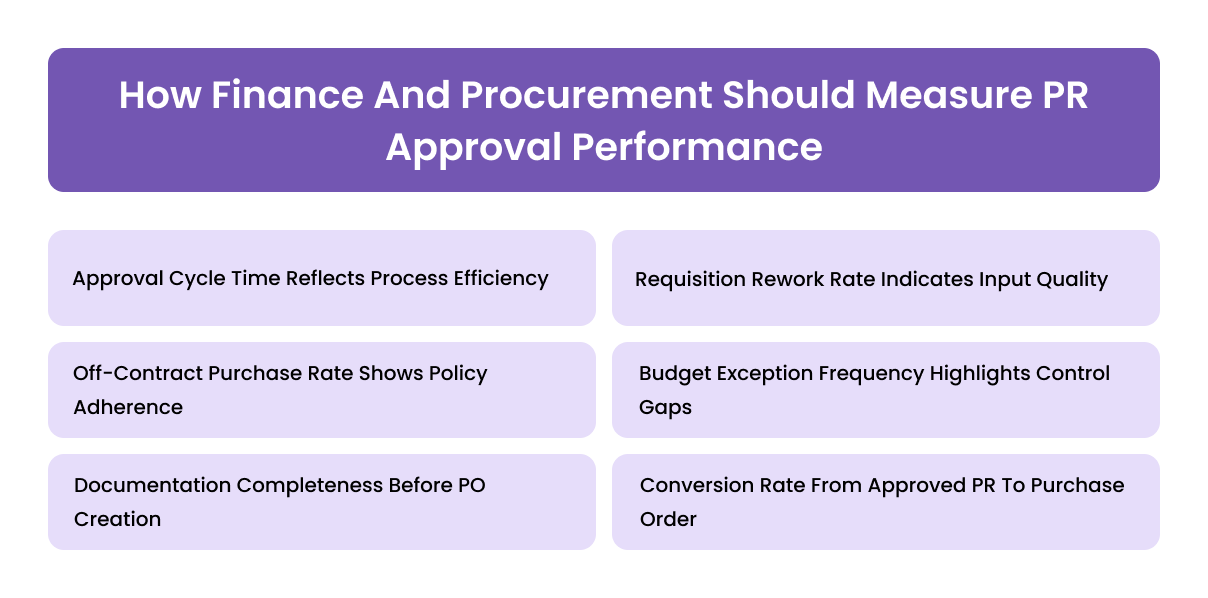
Finance and procurement teams should focus on a small set of metrics that reflect both efficiency and control.
1. Approval Cycle Time Reflects Process Efficiency
Approval workflows need to be fast enough that teams do not bypass them. Tracking how long requisitions take to move from submission to approval helps identify bottlenecks and unnecessary delays.
If cycle time becomes too long, stakeholders will find informal ways to make purchases.
2. Requisition Rework Rate Indicates Input Quality
A high number of returned or rejected requisitions usually signals poor input quality. This may include missing cost estimates, unclear business justification, or incomplete vendor details.
Reducing rework improves both speed and decision quality.
3. Off-Contract Purchase Rate Shows Policy Adherence
If a significant portion of purchases happens outside approved vendors or contracts, it indicates that the PR approval process is not being followed effectively.
This metric helps assess whether procurement strategy is actually being enforced.
4. Budget Exception Frequency Highlights Control Gaps
Frequent approvals of requests that exceed budget or fall outside planned spend can signal weak budget discipline or poor forecasting.
Tracking this helps finance teams understand where tighter control or better planning is needed.
5. Documentation Completeness Before PO Creation
A strong PR process ensures that required documents are available before a purchase order is issued. Missing documentation at this stage creates delays and increases audit risk later.
6. Conversion Rate From Approved PR To Purchase Order
Not all approved requisitions result in a purchase. Tracking how many approved PRs convert into actual POs helps identify inefficiencies or unnecessary approvals in the process.
Related: Analyse Business Expense Analysis
How Alaan Supports Purchase Requisition Control Before Spend Happens
A purchase requisition approval process is only effective if it holds up during execution. Many businesses define approval rules but struggle to enforce them consistently across teams, vendors, and transactions.
Alaan helps finance and procurement teams strengthen this execution layer so that approved purchasing decisions translate into controlled and well-documented spend.
- Corporate Cards With Spend Controls And Vendor Restrictions
At Alaan, businesses can issue corporate cards with defined limits and merchant controls. This helps ensure that purchases remain within approved categories and reduces the risk of off-policy spending. - Structured Approval Workflows Before Spend Happens
At Alaan, purchase requests can be routed through configurable approval workflows. This ensures that requisitions are reviewed and approved before transactions take place, reinforcing pre-spend control. - Centralised Receipt And Invoice Capture
Invoices and receipts are captured and linked directly to transactions, making it easier to verify purchases and maintain proper documentation across procurement activity. - Real-Time Visibility Into Business Spend
Finance and procurement teams gain visibility into spending as it happens. This allows them to identify deviations from approved requisitions and address issues early. - Cleaner Reconciliation And Accounting Sync
With integrations into accounting systems such as Xero, QuickBooks, NetSuite, and Microsoft Dynamics, approved transactions flow more cleanly into financial records. This reduces manual reconciliation effort and improves accuracy. - Better Audit Readiness Across Purchases
Each transaction includes a clear trail of approvals, supporting documents, and categorisation. This strengthens audit readiness and ensures that procurement activity is properly documented.

Purchase requisition approval should not stop at the request stage. It should extend through approvals, payments, and documentation across the full spend lifecycle.
Also Read: Expense Management Software Business Spend Tracking
Conclusion
Purchase requisition approval is where procurement control should begin, not where paperwork starts. A well-designed PR process ensures that every purchase is reviewed with the right level of context, approval, and documentation before a commitment is made.
For growing businesses, this becomes critical. As teams expand and purchasing activity increases, informal processes quickly lead to fragmented spend, inconsistent approvals, and weak financial control. A structured purchase requisition process helps prevent these issues by introducing discipline early in the procurement cycle.
The most effective approach is not just to define approval steps, but to ensure they are consistently applied across the organisation. This requires clear workflows, defined roles, proper documentation, and visibility into purchasing activity.
If your organisation is looking to strengthen pre-spend control, improve documentation, and maintain better visibility across procurement, Book A Demo to see how Alaan can support your purchase requisition approval process.
Requisition approval controls spend before it happens, and the invoice side needs the same kind of discipline, which our guide on how AP automation works covers from capture all the way to payment.
FAQs
1. What Is PR In Procurement In Simple Terms
A purchase requisition (PR) is an internal request raised by an employee or department to obtain approval before purchasing goods or services. It is the first step in the procurement process.
2. Who Should Approve A Purchase Requisition
Approval typically involves a line manager, budget owner, procurement team, and sometimes finance or senior management depending on the value and nature of the purchase.
3. What Is The Difference Between A Purchase Requisition And A Purchase Order
A purchase requisition is an internal approval document, while a purchase order is an external document sent to the supplier after approval to confirm the purchase.
4. What Should Be Included In A Purchase Requisition Before Approval
A requisition should include business justification, item or service details, estimated cost, timing, cost centre, and any supporting documents required for review.
5. Why Do Purchase Requisition Approval Workflows Get Delayed
Delays often occur due to incomplete information, unclear approval paths, or bottlenecks in the approval chain. Improving input quality and workflow design can reduce delays.
6. How Can Businesses Improve Purchase Requisition Creation And Approval
Businesses can improve PR processes by standardising request formats, defining clear approval workflows, ensuring proper documentation, and using systems that provide visibility and control over purchasing activity.
Gain control over business expenses with Alaan corporate cards
Invygo earned AED 100,000 in cashback using Alaan cards
Personalise approval workflows to align with your business needs with Alaan's Spend Management platform
Discover the power of automated expense tracking and smarter spend control with Alaan
Turn data into actionable insights with Alaan's spend management tools
Stay Tax Compliant with UAE's #1 Corporate Card and Spend Management Platform
Customisable corporate card policy template
Know how much Corporate Tax you have to pay this fiscal year
Easily integrate Alaan with your ERP for accurate, real-time expense tracking
Close books faster with Alaan's AI-powered accounting automation
Reconcile your books in minutes instead of hours, every single month.
Keep petty cash organized with Alaan corporate cards and automated expense management