.avif)

Sustainable procurement means judging suppliers on long-term impact and risk rather than the lowest quote, and it only holds up when those standards are built into approvals, records, and ongoing review.
- Buying on price, timing, and availability alone hides the real cost of a supplier, which tends to show up later as disruption, poor documentation, or reputational risk.
- Sustainable procurement widens the decision to include reliability, governance, documentation quality, and lifecycle value, so the cheapest quote does not automatically win.
- Most of the trouble starts in the workflow rather than the policy, when supplier information, approvals, and records sit scattered across chats, inboxes, and spreadsheets.
- Alaan supports procurement control with corporate cards that carry spend limits and vendor restrictions, approval workflows before spend is committed, real-time visibility into supplier spend, and accounting integrations for cleaner records.
Procurement decisions are often judged first on price, timing, and supplier availability. That is understandable, but it is also incomplete. Over time, the cost of a procurement decision is shaped by much more than the purchase price alone. It is shaped by supplier reliability, documentation quality, regulatory exposure, operational resilience, and whether the supplier creates hidden risk further down the line.
That is why sustainable procurement matters more now. It gives businesses a more durable way to evaluate suppliers and purchasing decisions by looking beyond short-term cost alone. International guidance already frames sustainable procurement as procurement that considers environmental, social, and economic impacts across the lifecycle, while the UAE’s federal procurement framework explicitly links procurement to sustainable development alongside transparency, competitiveness, and value.
In this article, we explain what sustainable procurement means in practice, why it matters for modern businesses, how it changes supplier selection, and what stronger spend control looks like when procurement standards need to hold up beyond policy language alone.
TL;DR / Key Takeaways
- Sustainable procurement means evaluating suppliers on long-term business impact, not just upfront price.
- The strongest procurement decisions balance cost with reliability, documentation quality, resilience, and governance.
- Sustainable procurement works only when supplier standards are built into approvals, reviews, and ongoing monitoring.
- Many procurement problems start in fragmented workflows rather than in the policy itself.
- Better supplier visibility, cleaner documentation, and stronger approval discipline make sustainable procurement more practical.
- Alaan helps businesses support procurement control with real-time spend visibility, approval workflows, and cleaner records.
Related: Business Spend Management Tools Importance
Why Sustainable Procurement Matters More Now
Sustainable procurement matters because supplier decisions now carry a wider business impact than they once did. A supplier is no longer judged only by whether it can deliver on time and at the right price. Businesses are increasingly expected to understand how suppliers operate, how resilient they are, how well they document what they do, and whether they create avoidable environmental, social, or governance risk.
This is also no longer a side topic for CSR teams alone. Procurement sits close to the operational reality of supplier choice, contract quality, spend control, and business continuity. When procurement standards are weak, the business may still save money on paper in the short term, but pay more later through disruption, poor documentation, reputational risk, or unreliable supply relationships. Recent supply chain reporting continues to link sustainability more closely with resilience, continuity, and long-term operating performance.
Where The Pressure Is Coming From
- Supplier Risk Is More Visible
Businesses are under more pressure to understand whether suppliers can meet standards consistently, not just whether they can quote competitively. - Documentation Expectations Are Higher
Procurement decisions increasingly need cleaner evidence, clearer traceability, and better records for internal review, external stakeholders, or tender requirements. - Resilience Now Matters More Commercially
A supplier that looks cheap at the start may still become expensive if its operating model creates delays, substitutions, or continuity problems later.
Why This Is A Procurement Issue, Not Just A Sustainability Issue
- Supplier Choice Shapes Business Risk
Procurement decisions influence who the business depends on, how reliable that supplier base is, and how exposed the organisation becomes to disruption. - Spend Decisions Affect More Than Cost
They also influence governance quality, supplier accountability, and the practical standards that sit behind the supply chain. - Policies Mean Very Little Without Procurement Control
Sustainability language can look strong at policy level and still fail in practice if the supplier-selection and approval process does not support it.
What Sustainable Procurement Actually Means
Sustainable procurement means buying goods and services in a way that considers long-term impact alongside immediate procurement requirements. That includes traditional procurement priorities such as cost, quality, and delivery, but it also includes the broader effect of purchasing decisions on environmental performance, labour standards, governance quality, supplier accountability, and lifecycle value.
In practice, this means procurement becomes a more balanced decision process. The business is not ignoring price. It is placing price in the right context. A cheaper supplier may not be the better procurement decision if it creates weak documentation, unreliable quality, poor labour practices, waste, or hidden compliance risk that becomes visible later.
The Core Dimensions Of Sustainable Procurement
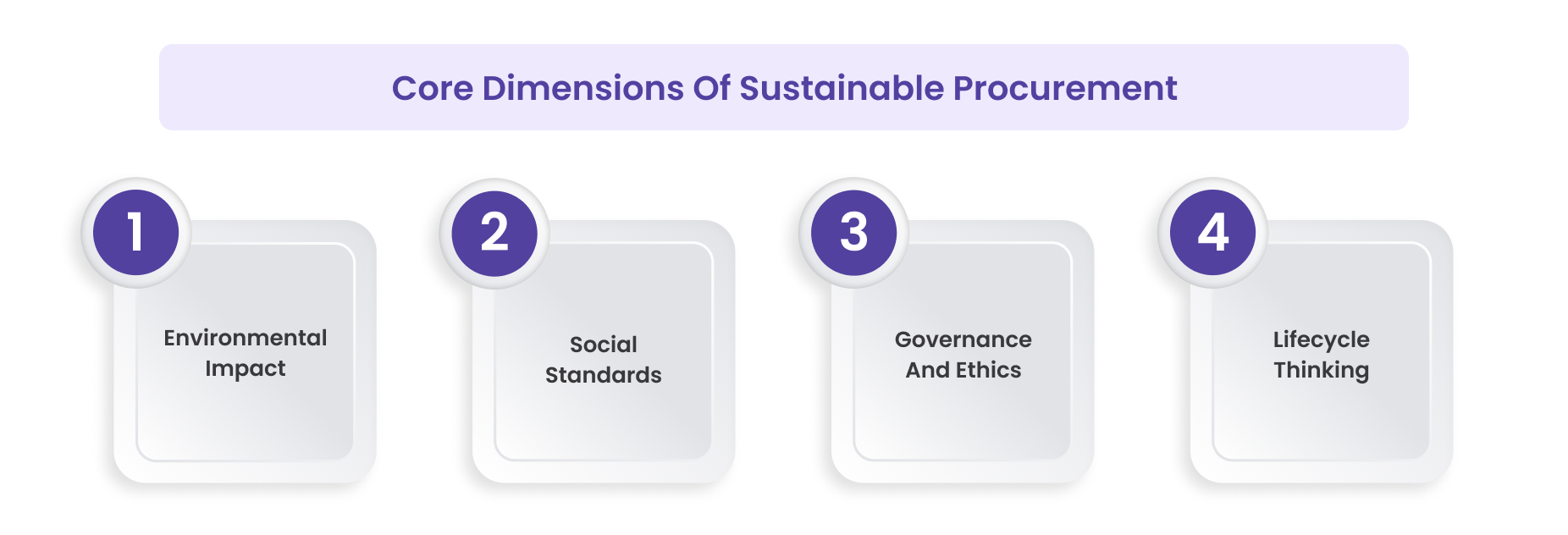
- Environmental Impact
This includes how products are sourced, produced, packaged, transported, and disposed of over time. - Social Standards
This includes labour conditions, worker treatment, human rights exposure, and broader supplier conduct. - Governance And Ethics
This covers integrity, anti-corruption standards, accountability, documentation quality, and how responsibly the supplier operates. - Lifecycle Thinking
This means looking beyond purchase price alone and considering durability, waste, maintenance, replacement frequency, and total value over time.
What Sustainable Procurement Is Not
- It Is Not Just Buying From Suppliers With Green Marketing
Labels and claims are not enough on their own without evidence and supplier scrutiny. - It Is Not Separate From Commercial Decision-Making
Sustainable procurement should improve procurement quality, not sit outside it. - It Is Not A One-Time Supplier Exercise
It requires ongoing review, especially where supplier risk, spend value, or category importance is high.
Related: What Qualifies As A Business Expense
The Benefits Of Sustainable Procurement
The benefits of sustainable procurement become clearer when procurement is viewed as a long-term value function rather than a short-term buying function. A stronger supplier decision does more than secure supply for today. It helps the business reduce disruption, improve supplier accountability, support internal governance, and make purchasing choices that remain commercially sound over time.
This is why sustainable procurement should not be framed as a trade-off between ethics and efficiency. In many cases, it improves decision quality by forcing the business to look more closely at the suppliers it depends on, the risks it is taking on, and the quality of the value it is actually buying. Broader supply chain reporting continues to show that resilience, sustainability, and long-term operating performance are increasingly connected rather than separate issues.
The Most Important Benefits
- Stronger Supplier Quality
Businesses are more likely to work with suppliers that are better documented, better governed, and more dependable over time. - Lower Long-Term Risk Exposure
Better supplier evaluation reduces the chance of hidden compliance, labour, operational, or reputational issues surfacing later. - Better Supply Chain Resilience
Sustainable procurement encourages businesses to look at continuity and supplier strength, not just transactional price. - Smarter Cost Decisions
It supports better total-cost thinking by looking at waste, reliability, replacement, and lifecycle value instead of only the cheapest quote. - Better Stakeholder Alignment
It becomes easier to support customer expectations, tender requirements, and internal governance standards when procurement decisions are more defensible.
Also Read: Guide To Manage Overall Spending
How Sustainable Procurement Works In Practice
Sustainable procurement works best when it is built into the procurement process itself rather than added as a final checklist. The business needs a usable structure for deciding which supplier standards matter, where scrutiny should be stronger, and how procurement teams should apply those standards consistently.
That does not mean every supplier needs the same level of review. A more practical approach is to apply stronger control where spend, risk, criticality, or supplier exposure is higher, and then build the process out from there.

1. Set A Clear Procurement Policy
The policy should explain what the business expects from suppliers, what factors sit alongside price in supplier decisions, and what documentation or standards are required for higher-risk categories. Without this, sustainable procurement usually stays too informal to apply consistently.
2. Identify High-Risk Supplier Categories
Not every category needs the same level of attention. High-spend, operationally critical, reputation-sensitive, or harder-to-replace suppliers usually deserve stronger review than low-risk routine purchases.
3. Add Sustainability Criteria Into Supplier Evaluation
Supplier assessment should include relevant non-price criteria where they matter. That might include documentation quality, governance controls, traceability, labour practices, certifications, waste practices, or other category-specific factors.
4. Build Standards Into Contracts And Reviews
Supplier expectations are easier to enforce when they are reflected in contracts, renewal discussions, and review cycles rather than left as informal preference.
5. Monitor And Improve Over Time
Sustainable procurement is not complete once a supplier is onboarded. Supplier behaviour, business risk, and procurement priorities change over time, so the review process needs to change with them.

How Sustainable Procurement Changes Supplier Selection
Sustainable procurement changes supplier selection by widening the decision frame. Instead of comparing suppliers only on price, speed, and basic commercial terms, the business also looks at how a supplier operates, how well it documents its practices, and whether it introduces avoidable risk into the supply chain. That does not make procurement slower by default. It makes procurement more informed.
This is where sustainable procurement becomes commercially useful. A supplier that looks cheaper at quote stage may still prove more expensive if it creates quality issues, higher replacement rates, poor traceability, weak labour standards, or repeated operational disruption. Better supplier selection therefore depends on looking at total decision quality, not only initial purchase cost.
What Better Supplier Selection Looks Like
- Looking Beyond Headline Price
The lowest quote does not always produce the best procurement outcome. A stronger decision looks at the full commercial effect of choosing that supplier, including reliability, continuity, and downstream risk. - Assessing Operational Reliability
Supplier performance matters as much as supplier price. If the supplier cannot meet delivery standards, maintain quality, or support continuity, the procurement decision becomes weaker even if the upfront cost looked attractive. - Reviewing Documentation And Traceability
Good supplier decisions rely on more than commercial confidence. The business also needs evidence, cleaner documentation, and a clearer record of how the supplier operates and supports procurement expectations. - Considering Lifecycle Value
Procurement quality improves when the business looks at durability, replacement frequency, waste, and long-term value rather than evaluating cost only at the moment of purchase.
Also Read: Cost Reduction Strategies Procurement
Common Mistakes Businesses Make With Sustainable Procurement
Many businesses do not struggle with sustainable procurement because they reject the idea. They struggle because they treat it too loosely. The policy language may sound right, but the process underneath it remains too informal to influence real supplier decisions consistently.
That is why sustainable procurement often looks stronger in presentation than in practice. The business may use the right terminology, ask suppliers broad questions, or include sustainability in tender language, but still fail to build those standards into approvals, supplier reviews, contracts, or ongoing monitoring.
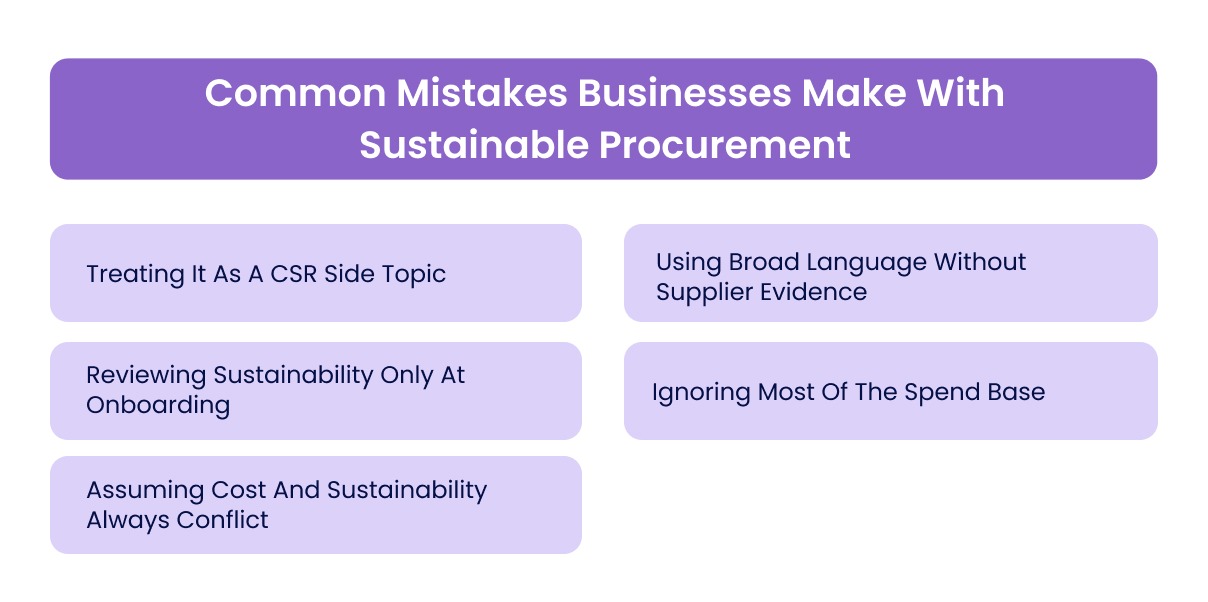
The Usual Failure Points
- Treating It As A CSR Side Topic
Sustainable procurement becomes weak very quickly when it is discussed separately from supplier risk, purchasing quality, and operational resilience. - Using Broad Language Without Supplier Evidence
Supplier claims are easy to collect and harder to validate. Without evidence and follow-up, procurement teams can end up relying on statements that do not change decision quality meaningfully. - Reviewing Sustainability Only At Onboarding
A supplier may look acceptable at onboarding and then drift over time. Sustainable procurement works better when review continues after selection, especially in higher-risk or higher-value categories. - Ignoring Most Of The Spend Base
Some businesses focus only on a small number of visible suppliers while leaving the wider procurement base untouched. That limits the practical effect of the policy. - Assuming Cost And Sustainability Always Conflict
In many cases, stronger supplier choices reduce waste, disruption, rework, and hidden risk. Treating sustainability as automatically more expensive can prevent better procurement decisions from being made at all.
Related: Sample Business Expense Policy Guidelines Examples
Why Sustainable Procurement Often Breaks In The Workflow
Sustainable procurement often fails after the policy stage because the workflow around procurement is fragmented. Supplier information may sit in one place, approvals in another, purchase records somewhere else, and supporting documentation across inboxes, spreadsheets, or local files. When that happens, even a sensible procurement standard becomes harder to apply consistently.
This fragmentation creates two problems at once. First, it weakens supplier visibility because procurement and finance teams do not always have the same view of what was bought, from whom, and under what approval logic. Second, it weakens accountability because the audit trail for supplier decisions becomes harder to follow.
Where Control Usually Gets Lost
- Informal Approvals
Procurement decisions become harder to govern when approvals happen across chats, emails, or verbal sign-off rather than a structured process. - Supplier Information Stored Separately
When supplier standards, documents, and decision notes are scattered across locations, it becomes harder to evaluate consistency across purchases. - Incomplete Purchase Documentation
Missing records weaken both procurement review and finance reconciliation, especially where supplier scrutiny is supposed to be part of the decision process. - Weak Audit Trail For Spend Decisions
If the business cannot clearly trace what was approved, what was purchased, and why the supplier was chosen, sustainable procurement becomes difficult to defend in practice. - Limited Visibility Into Procurement Activity
Teams often lose sight of which suppliers are being used most, how often exceptions happen, or whether procurement standards are actually being followed across the spend base.
Also Read: Understanding Recording Business Expenses Efficiency Strategies
How Better Spend Control Supports Sustainable Procurement
Sustainable procurement becomes much harder to apply when supplier decisions, approvals, and purchase records are spread across emails, chats, spreadsheets, and disconnected systems. That is where Alaan is relevant. It helps businesses manage procurement-related spend through corporate cards, spend controls, approval workflows, receipt capture, AI verification, and accounting integrations, so supplier-related purchases become easier to review, document, and trace while they are happening.

- Corporate Cards With Spend Limits And Vendor Controls
Alaan lets businesses issue corporate cards with spending limits and vendor restrictions. That helps teams apply more discipline to supplier-related purchases and reduces ad hoc buying outside approved parameters. - Approval Workflows Before Supplier Spend Is Finalised
Alaan supports custom approval workflows, so procurement-related expenses can be reviewed before money is committed. That helps businesses apply supplier and purchasing standards earlier instead of relying on after-the-fact cleanup. - Real-Time Visibility Into Supplier Spend
Finance teams can see transactions as they happen across employees, vendors, and categories. That makes it easier to identify which suppliers are being used, where purchasing patterns are changing, and where exceptions may need closer review. - Receipt Capture And Supporting Documentation
Employees can upload receipts and invoices through the mobile app, Chrome extension, or email, so supplier-related transactions carry cleaner supporting records from the start. - AI Verification And Duplicate Detection
Alaan extracts receipt data, matches it to transactions, and flags inconsistencies or duplicates. That reduces manual checking and helps finance teams review procurement-related spend more efficiently. - Accounting Integration For Cleaner Reconciliation
Alaan integrates with Xero, QuickBooks, NetSuite, and Microsoft Dynamics, allowing expense data to sync in real time. That makes supplier spend easier to reconcile and gives finance a cleaner audit trail around procurement activity.
In practice, that gives businesses a stronger control layer around procurement spend, which makes sustainable procurement easier to apply consistently instead of leaving it stranded at policy level.
Related: Expense Management Software Business Spend Tracking
Conclusion
Sustainable procurement works best when it is treated as a business control discipline rather than a branding theme. The strongest procurement decisions do not ignore cost, but they place it in the context of supplier quality, resilience, governance, documentation, and long-term value.
That is why sustainable procurement depends on more than good intentions. It depends on whether the business can apply supplier standards through real workflows, approvals, records, and review discipline while procurement activity is actually taking place.
Alaan helps businesses strengthen that operating layer with corporate cards, spend limits, approval workflows, real-time visibility, cleaner documentation, and faster reconciliation. That makes procurement-related spend easier to control, easier to review, and easier to connect back to stronger supplier decisions. Book a Demo Today!
Supplier choices only stick if invoices and approvals follow the same rules, which is the everyday job of AP automation software, from invoice capture all the way to payment. Paying overseas suppliers is part of it too, and SuperPay for international supplier payments sends those at live FX rates with zero fees and same-day settlement.
FAQs
1. Is sustainable procurement only relevant for large companies?
No. Smaller businesses may not use the same level of formal supplier assessment, but the core idea still matters. Choosing suppliers based on reliability, documentation, and long-term value is useful at almost any scale.
2. Does sustainable procurement always mean paying more?
Not necessarily. A supplier with a lower headline price can still create higher total cost through delays, poor quality, rework, weak documentation, or continuity problems. Sustainable procurement is about better decision quality, not automatic premium pricing.
3. How often should suppliers be reviewed under a sustainable procurement approach?
That depends on spend size, supplier criticality, and category risk. Higher-value or operationally important suppliers usually need more regular review, while lower-risk suppliers may need lighter monitoring.
4. What is the difference between sustainable procurement and responsible sourcing?
They overlap, but sustainable procurement is broader. Responsible sourcing usually focuses more directly on how goods or materials are sourced, while sustainable procurement covers the wider purchasing decision, including supplier standards, governance, lifecycle value, and operational resilience.
5. Where do businesses usually struggle most when trying to apply sustainable procurement?
Usually in execution, not policy. Supplier standards may exist on paper, but approvals, documentation, and spend records are often too fragmented to apply those standards consistently in practice.
6. Should every supplier be assessed using the same sustainability criteria?
No. A risk-based approach is usually more practical. High-spend, high-risk, or harder-to-replace suppliers usually deserve deeper review than low-risk routine purchases.
Gain control over business expenses with Alaan corporate cards
Invygo earned AED 100,000 in cashback using Alaan cards
Personalise approval workflows to align with your business needs with Alaan's Spend Management platform
Discover the power of automated expense tracking and smarter spend control with Alaan
Turn data into actionable insights with Alaan's spend management tools
Stay Tax Compliant with UAE's #1 Corporate Card and Spend Management Platform
Customisable corporate card policy template
Know how much Corporate Tax you have to pay this fiscal year
Easily integrate Alaan with your ERP for accurate, real-time expense tracking
Close books faster with Alaan's AI-powered accounting automation
Reconcile your books in minutes instead of hours, every single month.
Keep petty cash organized with Alaan corporate cards and automated expense management