.avif)


A guide to UAE excise tax in 2026, covering the new sugar-based tiers on sweetened drinks, which businesses must register, and the monthly filing and record-keeping rules.
- From January 1, 2026, sweetened drinks are taxed by sugar content, at AED 0.79 per litre for 5 to under 8g per 100ml and AED 1.09 for 8g or more, replacing the old flat 50% rate.
- Tobacco, energy drinks, and electronic smoking devices all stay taxed at 100%, while drinks under 5g of sugar per 100ml or with only artificial sweeteners are exempt.
- Anyone who produces, imports, stockpiles, or releases excisable goods must register with the FTA, with no turnover threshold and a penalty starting at AED 10,000 for registering late.
- Registered businesses file excise returns monthly through EmaraTax, usually by the 15th of the following month, and must keep transaction and inventory records for at least five years.
- Alaan brings company spending, receipts, and approvals into one platform with automated VAT data capture and full audit trails, helping finance teams keep tax-ready records.
If your company imports, distributes, or sells beverages in the UAE, excise tax is no longer just a regulatory checkbox. It directly affects pricing, margins, and how products move through your supply chain. Even small changes in how the tax is calculated can alter cost structures for manufacturers, distributors, and retailers.
That shift is already happening. The Federal Tax Authority introduced a new mechanism for calculating excise tax on sweetened drinks from January 1, moving to a tiered volumetric model that links tax rates to the sugar and sweetener content of beverages. This change means businesses must reassess product pricing, compliance processes, and tax reporting practices.
Understanding the UAE excise tax, applicable products, calculation methods, and compliance is now essential for companies. This guide outlines the rules, recent changes, and what finance teams must do to manage excise tax correctly.
Key Takeaways:
- Taxable products: UAE excise tax applies to tobacco, energy drinks, electronic smoking devices, and sweetened beverages, with 100% tax rates for tobacco and energy drinks.
- 2026 sugar-based model: From January 1, 2026, sweetened drinks follow a tiered tax system: 5–8g sugar per 100ml taxed at AED 0.79/litre and ≥8g at AED 1.09/litre.
- Mandatory registration: Producers, importers, stockpilers, and businesses releasing excisable goods must register with the Federal Tax Authority, with AED 10,000 penalties for late registration.
- Monthly filing rules: Registered businesses must submit excise tax returns via EmaraTax by the 15th of the following month and maintain records for five years.
- Compliance management: Centralised spend tracking, documentation, and approvals through platforms like Alaan help finance teams maintain accurate tax records.
What Is UAE Excise Tax?
UAE excise tax is an indirect tax applied to specific products that are considered harmful to public health or the environment, such as tobacco, energy drinks, and sugary beverages. The tax was introduced in 2017 under Federal Decree-Law No. 7 of 2017 to discourage consumption of these products while supporting public health goals and diversifying government revenue.
Unlike VAT, which applies broadly to most goods and services, excise tax is generally charged once in the supply chain; when excise goods are imported, produced locally, or released for consumption in the UAE. This structure places responsibility on manufacturers, importers, and distributors to calculate and report the tax correctly before products reach the consumer market.
Understanding how this tax works is important because it applies only to specific product categories, each with defined rates and compliance requirements.
Products Subject to Excise Tax in the UAE
According to government announcements reported by regional news outlets, the policy was designed to discourage the consumption of products linked to smoking, obesity, and other public health concerns while also supporting national health strategies.
These taxes apply when the goods are imported, manufactured locally, or released for consumption in the UAE. The following categories are currently subject to excise tax.
Product Category
| Product Category | Description | Excise Tax Rate (2026) |
|---|---|---|
| Tobacco Products | Cigarettes, cigars, chewing tobacco, herbal smoking products, snuff, and other tobacco items are listed under GCC Schedule 24. | 100% |
| Energy Drinks | Non-alcoholic beverages are marketed as energy boosters, regardless of sugar content. | 100% (flat rate) |
| Electronic Smoking Devices | Electronic smoking devices, vaping tools, and related e-liquids. | 100% |
| Sweetened Drinks | Non-alcoholic drinks with added sugar or sweeteners, including juices, syrups, and concentrates. | Tiered volumetric system (per litre) |

Also Read: Comprehensive Guide to Business Tax Management and Planning
The UAE introduced a new structure for taxing sweetened beverages to better link excise tax with sugar content. Instead of applying a flat rate, the updated framework uses a tiered system where tax increases as the sugar concentration in the drink rises.
UAE’s 2026 Tiered Excise Tax on Sweetened Drinks
From January 1, 2026, the UAE replaced the earlier flat 50% excise tax on sugary drinks with a tiered volumetric system linked directly to sugar content. Introduced under Cabinet Decision No. (197) of 2025, the new model taxes beverages per litre based on the grams of sugar in each 100ml.
The change aims to encourage manufacturers to reduce sugar levels and promote healthier consumption patterns.
Tax Tiers by Sugar Content
Under the new framework, all non-alcoholic beverages with added sugar or sweeteners fall within the “sweetened drinks” category. The applicable tax is determined by the drink’s sugar concentration.
| Tier | Sugar Content (per 100ml) | Excise Tax per Litre |
|---|---|---|
| Low | Less than 5g | AED 0 (exempt) |
| Moderate | 5g to less than 8g | AED 0.79 |
| High | 8g or more | AED 1.09 |
Drinks containing only artificial sweeteners are exempt, and beverages with naturally occurring sugar but no added sweeteners are generally not classified as sweetened drinks.
What Counts as Sweetened Drinks?
The category covers a wide range of beverage formats that can be consumed directly or converted into drinks, including:
- ready-to-drink beverages
- drink concentrates and syrups
- powdered drink mixes
- gels or extracts used to prepare beverages
Certain products are excluded, including milk-based drinks with at least 75% milk content, baby formula, and approved dietary or medical beverages.
Business Compliance Requirements
Businesses dealing with sweetened beverages must follow specific compliance procedures set by the Federal Tax Authority (FTA).
- Sugar content testing: Products must undergo laboratory testing to confirm sugar levels before import or market release.
- FTA registration: Producers, importers, and warehouse keepers must hold an excise tax registration certificate and submit returns through EmaraTax.
- Product labelling: Sugar content and applicable tax tier must be declared, and inventory should be classified by tier.
- Tax payment: Excise tax is usually paid when goods are imported or released from a designated warehouse.
The new model also replaces the earlier separate tax category for carbonated drinks, placing them under the sweetened drinks framework. Since the rollout, some retailers have reported 20–40% price increases for higher-sugar beverages, reflecting the higher tax burden on these products.

Also Read: How Businesses Pay Taxes: A Beginner's Guide
Who Must Register for Excise Tax in the UAE?
Excise tax registration with the Federal Tax Authority (FTA) is mandatory for businesses that produce, import, store, or release excisable goods in the UAE. Unlike VAT, excise tax does not have a minimum turnover threshold.
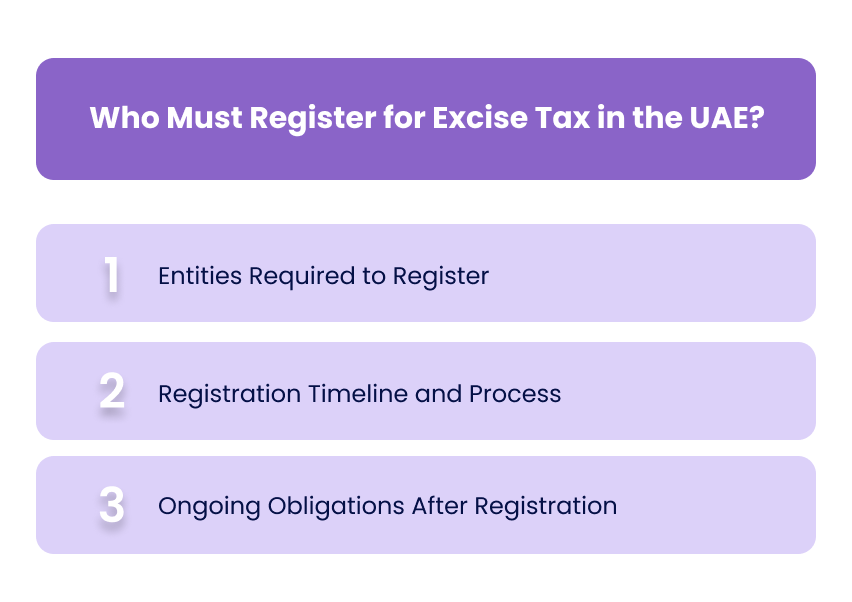
This means companies must register as soon as they become involved in activities related to excise goods such as tobacco, energy drinks, e-cigarettes, or sweetened beverages.
Entities Required to Register
The following entities are typically required to register for excise tax with the FTA:
- Producers manufacturing excisable goods within the UAE.
- Importers bringing excisable goods into the UAE market.
- Stockpilers or warehouse keepers storing excisable goods before they are sold or distributed.
- Businesses releasing excisable goods from Designated Zones, including free zones.
- Entities responsible for managing designated warehouses or zones where excisable goods are stored or released.
Also Read: Advantages of VAT in the UAE for Growth and Cash Flow
Registration Timeline and Process
Businesses must apply for excise tax registration through the FTA’s EmaraTax portal within 30 days of becoming liable for excise tax. Companies planning to start activities involving excisable goods are expected to register before beginning operations.
Once the application is approved, the FTA issues a Tax Registration Number (TRN). The approval process typically takes around 20 business days, depending on the completeness of the submitted documents.
Exceptions:
In limited situations, occasional importers may not need to register. Businesses importing excisable goods less than once every six months or fewer than four times within two years may pay the excise tax directly at customs instead of registering.
However, companies that fail to register when required may face administrative penalties starting at AED 10,000.
Ongoing Obligations After Registration
Once registered, businesses must comply with several reporting and record-keeping requirements:
- File excise tax returns monthly, typically by the 15th of the following month.
- Submit declarations through the EmaraTax system.
- Calculate tax based on product quantities and applicable rates.
- Pay excise tax using the Payment Reference Number (PRN) issued by the FTA.
- Maintain transaction and inventory records for at least five years.

Also Read: VAT Refunds in the UAE: What Businesses Need to Know in 2026?
With multiple reporting obligations and documentation requirements, finance teams often rely on systems that help track spending and maintain organised records.
How Alaan Helps Finance Teams Stay Tax-Compliant
For many UAE finance teams, tax compliance becomes difficult when transaction data is scattered across emails, cards, invoices, and accounting systems. This makes VAT reconciliation, corporate tax reporting, and excise documentation time-consuming.
Alaan addresses this challenge by bringing together company spending, approvals, receipts, and supplier payments into a single platform.
As a UAE-based spend management platform, it combines corporate cards, automated expense tracking, accounting integrations, and payment workflows. This helps finance teams keep financial records organised and ready for tax reporting.
Key ways Alaan supports tax compliance:
- Corporate Cards With Built-In Spend Controls
Finance teams can issue unlimited virtual or physical corporate cards with custom limits, merchant restrictions, and department allocations. These controls ensure purchases remain within company policy and are recorded correctly for accounting and tax reporting. - Automated VAT Data Capture
Receipt information, including supplier TRNs and VAT amounts, is automatically extracted and verified at the point of spend. Errors or missing details are flagged immediately, reducing manual checks and improving VAT reporting accuracy. - Real-Time Expense Visibility
Every transaction appears instantly in the dashboard, giving finance teams live visibility into spending across employees, projects, and vendors. This makes it easier to identify discrepancies before preparing tax returns. - Accounting And ERP Integrations
Alaan integrates with accounting systems such as QuickBooks, Xero, and Zoho, allowing transactions and receipts to sync directly with company ledgers. This simplifies VAT filings, corporate tax preparation, and audit documentation. - Automated Expense Categorisation
Expenses are categorised automatically and linked to the appropriate cost centres. This helps finance teams identify tax-deductible expenses and compliance-relevant transactions without manual data entry. - Integrated Supplier Payments With Super Pay
With the launch of Super Pay, businesses can manage international supplier payments directly within Alaan. Invoices, approvals, FX quotes, and payment records are stored in the same platform, improving financial traceability for tax reporting and audits. - Approval Workflows And Audit Trails
Custom approval policies ensure that higher-value or sensitive transactions require authorisation before payment. Each expense retains a complete digital audit trail, helping finance teams respond quickly to Federal Tax Authority reviews.
Book a demo with Alaan and see how your finance team can manage spending, supplier payments, and tax compliance in one place.
Conclusion
Excise tax in the UAE continues to evolve as regulations increasingly focus on product composition, documentation, and accurate reporting. For businesses dealing with excisable goods, staying compliant now depends on maintaining clear transaction records, understanding product classifications, and tracking tax obligations throughout the supply chain.
This is where structured financial workflows make a difference. Alaan helps finance teams centralise spending, supplier payments, receipts, and approvals in one platform, making it easier to maintain organised records and prepare for regulatory reporting.
If your team is looking for a simpler way to manage expenses while staying prepared for tax compliance, schedule a personalised demo with Alaan to see how your finance operations can run with greater visibility and control.
FAQs
1. What products are subject to excise tax in the UAE?
Excise tax applies to tobacco products, energy drinks, electronic smoking devices, and sweetened beverages. Tobacco, energy drinks, and vaping products are taxed at 100%, while sweetened drinks follow a tiered rate based on sugar content from 2026.
2. Who must register for excise tax in the UAE?
Manufacturers, importers, warehouse keepers, and businesses releasing excisable goods must register with the Federal Tax Authority (FTA). There is no minimum turnover threshold, and late registration can result in a AED 10,000 penalty.
3. How are sweetened drinks taxed under the 2026 excise rules?
From January 1, 2026, the UAE introduced a sugar-based tiered system: drinks with less than 5g sugar per 100ml are exempt, 5–8g are taxed at AED 0.79 per litre, and 8g or more at AED 1.09 per litre.
4. When do businesses need to file excise tax returns?
Registered companies must file monthly excise tax returns through the EmaraTax portal, usually by the 15th of the following month, and maintain records for at least five years.
5. Why was the excise tax introduced in the UAE?
The UAE introduced excise tax in 2017 under Federal Decree-Law No. 7 of 2017 to discourage the consumption of products linked to health risks, such as smoking and high-sugar beverages, while supporting government revenue diversification.
Gain control over business expenses with Alaan corporate cards
Invygo earned AED 100,000 in cashback using Alaan cards
Personalise approval workflows to align with your business needs with Alaan's Spend Management platform
Discover the power of automated expense tracking and smarter spend control with Alaan
Turn data into actionable insights with Alaan's spend management tools
Stay Tax Compliant with UAE's #1 Corporate Card and Spend Management Platform
Customisable corporate card policy template
Know how much Corporate Tax you have to pay this fiscal year
Easily integrate Alaan with your ERP for accurate, real-time expense tracking
Close books faster with Alaan's AI-powered accounting automation
Reconcile your books in minutes instead of hours, every single month.
Keep petty cash organized with Alaan corporate cards and automated expense management