.avif)


If your business deals with international payments, you're likely familiar with the constant frustration of cross-border payment issues. From the steep fees that seem to pile up with each intermediary, to the days-long waits for payments to clear, these challenges don't just cost you, they eat into your time and energy.
Mastercard reported that 82 % of SMEs in the UAE use apps to make cross-border payments, highlighting the growing operational reliance on digital payment tools. In a separate finding, 48% of people in the UAE said they expect to send more cross-border payments in the coming year.
On top of that, navigating the maze of compliance rules and the unpredictability of exchange rates can leave you feeling stuck. It's easy to see how these cross-border payment challenges can slow you down and affect cash flow. But it doesn’t have to be this way.
This guide explains the most common challenges associated with payments across international borders, why they occur, and what finance teams can do to reduce avoidable delays, cost surprises, and reconciliation workload.
TL;DR
- Payments across international borders break down because intermediaries, corridor calendars, FX pricing, and compliance checks create variable cost and timing.
- Unclear total cost is usually driven by fee deductions, fee handling, and FX spread that are not visible at approval time.
- Settlement delays and compliance holds are easier to reduce when required details and documents are captured before initiation.
- Weak tracking and reconciliation gaps create most of the operational workload, not the payment itself.
- Standardised beneficiary data, upfront cost visibility, and workflow-linked evidence are the most reliable ways to reduce repeated failures and manual follow-up.
Why Cross-Border Payments Often Create Friction
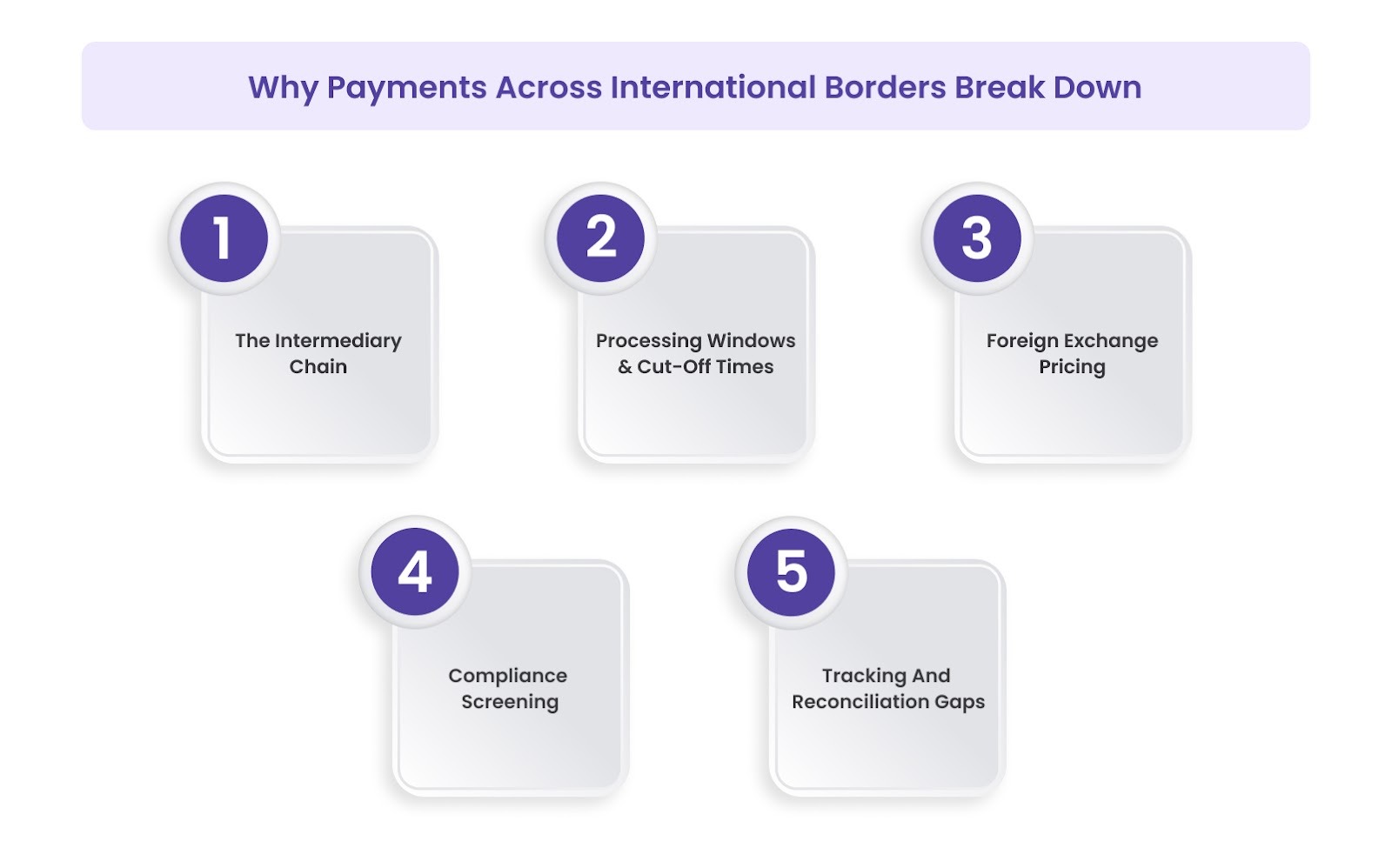
International payments rarely travel as a single, direct route from sender to recipient. Even when a business initiates the payment through one bank or platform, the transfer can pass through multiple steps and stakeholders, each with their own processing rules. Understanding the moving parts makes it easier to predict where payments slow down, why costs change, and what information triggers delays.
1. The Intermediary Chain
Many international transfers rely on correspondent networks to route funds to the recipient’s bank. Each intermediary may apply fees, hold the payment for checks, or request additional details. This is one of the most common reasons the all-in cost and end-to-end status are unclear at initiation.
2. Processing Windows And Cut-Off Times
Timing is shaped by processing windows rather than intent. A transfer initiated late in the day may effectively be processed the next business day, depending on cut-offs. Differences in weekends, bank holidays, and time zones can extend settlement, especially in corridors where multiple banks are involved.
3. Foreign Exchange Pricing
When payment currency differs from the business’s holding currency, conversion introduces both rate movement and pricing structure. The effective cost depends not just on the headline exchange rate but also on the spread and how conversion is applied during execution.
4. Compliance Screening
International payments may be paused if payment purpose, beneficiary details, or documentation are incomplete or inconsistent. These holds tend to create manual follow-ups and uncertainty because the request for information can come after the payment is initiated.
5. Tracking And Reconciliation Gaps
Tracking can be fragmented across intermediaries and systems. That makes it harder to answer basic operational questions quickly, including where a payment sits in the chain, whether it has been credited, and what deductions were applied along the way.
Also Read: Understanding the Differences between Accounts Payable and Accounts Receivable with Examples
Challenges Associated With Payments Across International Borders
The challenges below are the ones that most commonly impact cost predictability, settlement reliability, and finance workload. Each one has a practical fix, but the fixes only work consistently when applied as a repeatable process, not as one-off troubleshooting.
1. Unclear Total Cost
A payment is approved based on an expected cost, but the final debited amount is higher than planned, or the supplier receives less than the invoice amount. Finance then has to explain the variance, issue a shortfall payment, or reconcile a mismatch that was not visible at approval time.
Why it happens
Total cost becomes unclear when pricing is applied at multiple points in the flow. This typically includes a mix of intermediary deductions, FX spread, and fee handling that shifts cost between sender and recipient.
What it impacts
- Budget accuracy, because actual cost differs from expected cost
- Supplier relationships, because short-paid invoices trigger follow-ups and disputes
- Operational workload, because the team spends time explaining and correcting gaps
Practical fixes
- Require visibility into total fees and FX impact before payment approval.
- Align with suppliers on whether they expect full invoice value net of fees.
- Standardise payment methods per corridor so outcomes are consistent month to month.
Also Read: Cash Flow Forecasting: Best Practices and Key Methods
2. Settlement Delays
A supplier expects funds on a specific date, but payment arrival slips by days. Procurement escalates, deliveries may pause, and finance spends time chasing updates across stakeholders rather than moving to the next payment cycle.
Why it happens
Settlement time depends on processing windows, intermediary routing, and the risk profile of the transaction. Even when the payment is initiated on time, it may be queued due to cut-offs, held for screening, or slowed by corridor-specific banking calendars.
What it impacts
- Working capital planning, because outflows do not map cleanly to settlement timing
- Supplier fulfilment, especially for time-sensitive goods and services
- Internal confidence, because timelines appear inconsistent across similar payments
Practical fixes
- Initiate payments earlier for time-sensitive suppliers and higher-risk corridors.
- Treat cut-offs and corridor calendars as part of the payment plan, not an afterthought.
- Capture required fields, documentation, and payment purpose at approval time to reduce mid-route holds.
3. Compliance Holds And Documentation Gaps
A payment is initiated, then goes quiet. A day later, the bank or provider requests additional details such as the payment purpose, invoice, beneficiary information, or supporting documents. Until the request is resolved, the transfer remains pending, and the supplier starts following up.
Why it happens
Payments across international borders pass through screening controls that vary by corridor, bank, and transaction profile. Even when the sender has done everything “normally,” a transfer can be paused if any part of the payment data is incomplete, inconsistent, or triggers a risk flag. Holds are especially common when the payment purpose is vague, the beneficiary name does not match records, or the documentation requirements differ from previous transfers.
What it impacts
- Operational workload, because finance teams shift into manual follow-ups and document chasing.
- Supplier fulfilment, because goods or services may pause until funds are confirmed.
- Delivery predictability, because holds often appear mid-route rather than upfront.
Practical fixes
- Standardise what you capture before approval, including beneficiary details, invoice references, and payment purpose.
- Maintain a documentation pack template by corridor and supplier type so requests are resolved quickly.
- Use consistent formatting for beneficiary names and account details to reduce mismatch-based holds.
4. Weak Tracking And Status Visibility
A stakeholder asks a simple question: “Has the supplier received the payment.” Finance can confirm the payment was sent, but cannot confidently confirm where it is, when it will arrive, or whether deductions were applied. The result is repeated chasing across emails, bank portals, and relationship managers.
Why it happens
Tracking breaks down because a cross-border payment may touch multiple systems that do not share a single, end-to-end status view. Some updates describe the payment message rather than the settlement outcome, and intermediary steps can be opaque. When a payment changes hands across banks, visibility often becomes partial or delayed.
What it impacts
- Time cost, because teams spend hours on status chasing rather than payment control.
- Credibility, because finance cannot provide confident answers during escalations.
- Supplier relationships, because uncertainty triggers avoidable follow-ups and disputes.
Practical fixes
- Require tracking that shows a clear status progression, not just “processing.”
- Capture reference identifiers consistently so payments can be traced across systems.
- Build a standard internal response flow so escalations follow a repeatable checklist rather than ad hoc chasing.
5. Foreign Exchange Surprises
An invoice is approved at a budgeted AED cost, but the amount debited is higher by the time payment executes. In other cases, the supplier receives the correct foreign currency amount, but finance has to explain why the AED cost changed versus the approved expectation.
Why it happens
FX outcomes are shaped by timing and pricing structure. The conversion may happen at execution rather than approval, rates can move between those moments, and the effective rate can include spread or markups that are not obvious when approvals are made. Even when markets are relatively stable, spread and fee handling can materially change the final cost.
What it impacts
- Budget discipline, because approvals and outcomes drift apart.
- Margin control, especially when paying suppliers in volatile or less liquid currencies.
- Forecasting accuracy, because cash outflows become harder to predict.
Practical fixes
- Separate “invoice approval” from “FX exposure,” and define when the rate is locked versus when it floats.
- Prefer upfront FX quotes where possible, and document how spread and fees affect the effective rate.
- For recurring payments, consider policies that reduce timing variance, such as scheduled execution windows.
6. Payment Failures And Return Cycles
A payment is rejected or returned days later. The reason is often unclear at first, and finance must investigate, correct the details, and re-initiate the transfer. Meanwhile, the supplier’s invoice remains open, and internal teams assume the payment already went through.
Why it happens
Cross-border payments are sensitive to data quality. Minor errors in beneficiary details, name mismatches, missing intermediary requirements, or incomplete mandatory fields can trigger “repair” requests or outright returns. Some corridors have stricter formatting rules, and what worked for one bank or country may not work for another.
What it impacts
- Duplicate work, because teams end up repeating initiation and approval steps.
- Delayed settlement, because returns can consume days before a reattempt is even possible.
- Relationship strain, because suppliers see avoidable payment failures as operational weakness.
Practical fixes
- Create beneficiary templates and validate them before first payment, not during a failure.
- Use a standard checklist for required fields by corridor so initiations do not rely on memory.
- Track return reasons and fix the root causes rather than treating failures as one-off incidents.
7. Reconciliation And Audit Trail Gaps
Month-end close turns into a matching exercise. Finance has to connect invoices to payments, payments to bank confirmations, and confirmations to the final settlement amount after FX and deductions. When information lives across inboxes, spreadsheets, and portals, reconciliation becomes slow and error-prone.
Why it happens
International payments generate multiple references and artifacts, but they are not always captured in a single workflow. FX outcomes, fee deductions, and partial receipts can create mismatches that are difficult to explain after the fact. Without consistent references and documentation, the audit trail becomes fragmented.
What it impacts
- Close speed, because reconciliation delays carry into reporting timelines.
- Error risk, because manual matching increases the chance of misclassification or duplication.
- Audit effort, because evidence gathering becomes a separate project rather than a byproduct of the process.
Practical fixes
- Make invoice reference, supplier identifier, and payment reference mandatory fields at initiation.
- Store supporting documents alongside payment records so evidence is not reconstructed later.
- Standardise how FX differences and deductions are recorded so variances are explainable and repeatable.
Also Read: How to Prepare a Bank Reconciliation Statement: A Complete Guide
8. Data Handling And Cross-Border Processing Risk
Payment instructions, invoices, IDs, and banking details circulate across email threads, shared drives, and multiple systems. Over time, access control weakens, sensitive files persist longer than intended, and accountability becomes unclear.
Why it happens
Payments across international borders require more data than domestic transfers, and that data often moves across tools and counterparties. When teams rely on manual sharing and ad hoc storage, it becomes difficult to control who has access, what is retained, and whether the same data is being copied into multiple places.
What it impacts
- Operational exposure, because sensitive data can be mishandled without clear ownership.
- Compliance risk, because retention and access controls are harder to enforce consistently.
- Incident response complexity, because tracing what was shared and where becomes difficult.
Practical fixes
- Reduce data sprawl by centralising payment documentation and limiting sharing to need-to-know access.
- Define retention rules for payment documents and enforce them through process rather than reminders.
- Treat beneficiary data as controlled master data, not as something recreated in every payment cycle.

How UAE Finance Teams Reduce Cross-Border Payment Friction
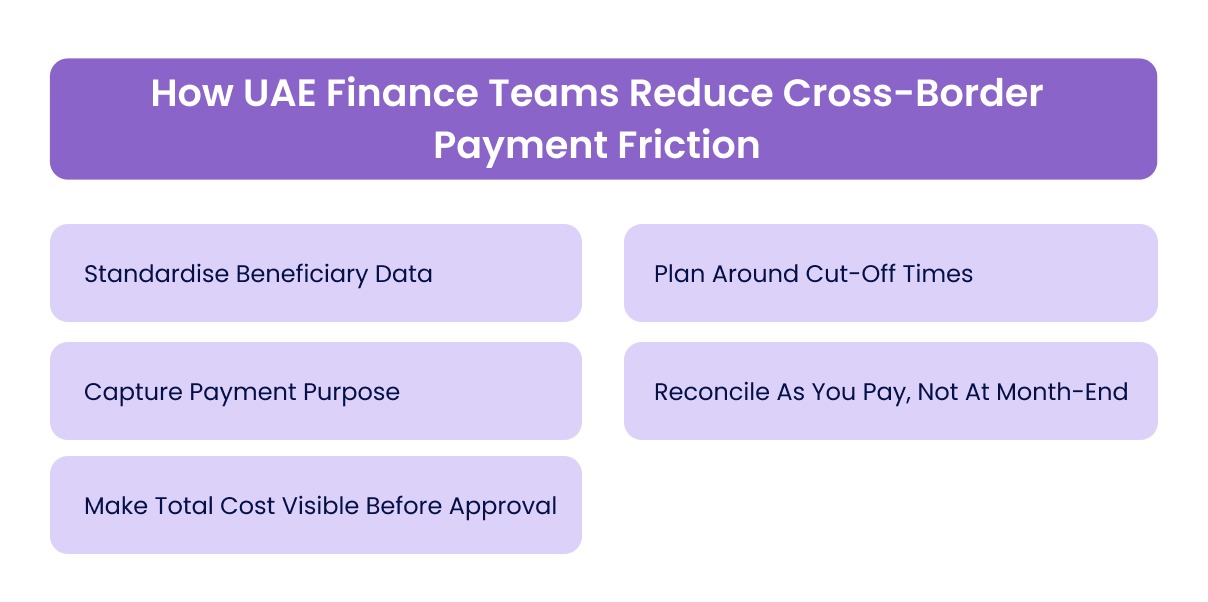
The eight challenges associated with payments across international borders are common because the process has many moving parts. The good news is that most of the pain comes from a small number of repeatable failure points, and those can be managed with better inputs, clearer approvals, and stronger visibility throughout execution and reconciliation.
1. Standardise Beneficiary Data
Most payment failures, repairs, and delays start with inconsistent beneficiary details. Treat beneficiary information as controlled master data, not something recreated each time an invoice lands.
- Maintain a single beneficiary record per supplier with consistent legal name formatting.
- Validate key fields before the first payment, so the first transfer does not become a trial run.
- Lock down edit access so changes are deliberate, reviewed, and traceable.
2. Capture Payment Purpose And Documents Upfront
Compliance holds tend to happen mid-route, which is the worst moment to start searching for invoices, contracts, or purpose-of-payment details. If the required context is collected at approval time, holds become far less disruptive.
- Use a standard purpose-of-payment format that finance, procurement, and suppliers understand.
- Attach supporting documents at the point of approval, not after initiation.
- Create a corridor-specific checklist for suppliers that regularly trigger requests.
3. Make Total Cost Visible Before Approval
Cost surprises usually come from a mix of fees, FX spread, and deductions that are only discovered after execution. The fix is to move cost visibility upstream, so approvals are based on the true all-in impact.
- Require an upfront breakdown of expected fees and the effective FX rate.
- Agree on who absorbs deductions for each supplier relationship to avoid shortfalls.
- Standardise your payment method per corridor, so outcomes become predictable over time.
4. Plan Around Cut-Off Times And Corridor Calendars
Settlement delays often feel random because teams plan around intent rather than processing windows. A simple shift in planning discipline reduces late surprises.
Where it matters, build a habit of confirming timing against:
- Daily cut-off windows for the sending rail and the receiving corridor.
- Weekends and bank holidays on both sides of the payment.
- Supplier timelines for when goods or services are released against payment confirmation.
5. Reconcile As You Pay, Not At Month-End
Reconciliation becomes painful when evidence is scattered across inboxes, portals, and spreadsheets. The cleanest approach is to make reconciliation a byproduct of the payment process.
- Make invoice references mandatory when initiating the payment.
- Keep confirmation artefacts linked to the original invoice and approval.
- Record variances consistently, so FX differences and deductions are explainable without rework.
Also Read: Steps to Automate Expense Management and Approvals
How Alaan SuperPay Simplifies International Supplier Payments
International transfers become complex when invoices, approvals, execution, and reconciliation are disconnected. That is where most cost surprises, compliance holds, and tracking gaps originate. SuperPay brings international supplier payments into one governed workflow, so finance teams do not manage transfers in isolation from the rest of their spend process.
- Transparent FX And Predictable Costs
With SuperPay, you see the FX rate and cost impact before execution. This reduces the uncertainty around effective rate, spread, and final debit amount. Instead of discovering deductions after settlement, finance teams can approve payments with clarity on the total cost upfront. - Structured Approvals Before Execution
SuperPay routes international transfers through defined approval workflows. Payment context, invoice reference, and supporting documents are captured before funds move. This reduces mid-route compliance holds and prevents ad hoc transfers outside policy. - Centralised Visibility Across Payments
SuperPay gives finance teams a single view of transfer status, documentation, and references. Instead of chasing updates across emails and bank portals, teams can trace payments and respond to supplier queries with confidence. - Cleaner Reconciliation At Month-End
Every international payment generates FX outcomes, confirmations, and supporting artefacts. SuperPay keeps this information connected to the original invoice and approval, making reconciliation faster and reducing manual stitching at close. - Built For How UAE Finance Teams Operate
SuperPay is designed to work alongside your existing banking relationships while improving control, visibility, and predictability within your internal workflow. It is designed for international supplier payments commonly made by UAE finance teams and continues to expand its coverage over time.
Conclusion
The challenges associated with payments across international borders are rarely isolated. Fees, timing uncertainty, compliance holds, fragmented tracking, FX variance, return cycles, and reconciliation workload tend to show up together because the payment process is structurally fragmented across tools and stakeholders.
The most consistent improvements come from treating international payments as a governed workflow. When beneficiary data is standardised, documentation is captured before execution, total cost is visible at approval time, and reconciliation evidence is preserved as part of the transaction, international transfers become more predictable and far less operationally noisy.
At Alaan, we built SuperPay to help UAE finance teams manage international supplier payments with upfront FX visibility, approval controls, centralised tracking, and cleaner month-end reconciliation in one workflow. To see how SuperPay fits your supplier corridors and payment process, Book a Demo Today!
FAQs
1. How Can Businesses Reduce Fees On International Payments
Cost becomes more predictable when teams get clarity on the full fee structure and the effective FX rate before approval. Choosing providers that itemise fees, reduce avoidable intermediaries, and show the delivered amount upfront also helps prevent shortfalls.
2. Why Do International Payments Get Held For Compliance
Holds often happen when payment purpose is unclear, documentation is missing, or beneficiary details do not match expected records. Collecting required context at approval time reduces the likelihood of mid-route requests and delays.
3. What Causes Payment Delays Across International Borders
Delays are usually driven by cut-off times, intermediary processing, corridor-specific calendars, and screening checks. Planning payments around processing windows rather than calendar dates improves reliability.
4. How Can Finance Teams Improve Tracking For Cross-Border Payments
Tracking improves when payment references are captured consistently and status visibility covers more than a single “processing” label. A repeatable escalation checklist also prevents ad hoc chasing and makes updates faster.
5. What Makes Reconciliation Hard For International Payments
Reconciliation becomes difficult when invoices, approvals, payment references, confirmation artefacts, and FX outcomes are stored in separate places. Linking these elements as part of the payment workflow reduces month-end effort and error risk.
Gain control over business expenses with Alaan corporate cards
Invygo earned AED 100,000 in cashback using Alaan cards
Personalise approval workflows to align with your business needs with Alaan's Spend Management platform
Discover the power of automated expense tracking and smarter spend control with Alaan
Turn data into actionable insights with Alaan's spend management tools
Stay Tax Compliant with UAE's #1 Corporate Card and Spend Management Platform
Customisable corporate card policy template
Know how much Corporate Tax you have to pay this fiscal year
Easily integrate Alaan with your ERP for accurate, real-time expense tracking
Close books faster with Alaan's AI-powered accounting automation
Reconcile your books in minutes instead of hours, every single month.
Keep petty cash organized with Alaan corporate cards and automated expense management