.avif)

How UAE finance teams can automate business payments to gain cost visibility before money moves, especially for cross-border transfers.
- The weak point in most UAE payment processes is timing and how little finance sees upfront: an invoice gets approved on paper, but the real cost only becomes clear after payment, when FX differences surface days later.
- More than 80% of finance leaders now treat accounts payable automation as core to their digital plans, driven by pressure to explain cash movement and close books without firefighting.
- Automation works best when it surfaces FX impact and landed cost before approval, separates invoice approval from payment approval, and syncs everything into accounting.
- The strongest setups start small, usually with the top 20 suppliers by value, then expand as controls and data quality settle.
- Alaan brings invoices, approvals, cross-border transfers through SuperPay, and accounting sync into one workflow, with payment costs shown before approval across supported corridors.
According to recent industry research, more than 80% of finance leaders now consider accounts payable automation a core part of their digital transformation agenda. That shift says less about technology maturity and more about pressure: pressure to explain cash movement with confidence, defend variances, and close books without firefighting.
For many finance teams in the UAE, the weakest point in the payments process is not intent, but timing and visibility. An invoice may be approved on paper, yet the final cost only becomes clear after the payment is executed. FX differences surface days later. Approvals are rushed because suppliers are waiting, and month-end conversations turn into justification exercises rather than analysis.
This is why business payments automation has moved up the finance priority list. For organisations making frequent or high-value payments, particularly across borders, automation directly affects how predictable cash flow is, how defensible cost assumptions are, and how much time teams spend reconciling instead of making decisions.
This guide looks at how UAE finance teams are approaching payments automation in practice today, where it delivers control, where it often breaks down, and what needs to be designed differently to account for local approval structures, VAT requirements, and cross-border payment realities.
Key Takeaways
- Payments automation changes when finance teams see costs, not how fast money moves. The real advantage comes from approving the financial impact upfront rather than explaining it later.
- UAE businesses feel automation gaps most in cross-border payments, where FX, settlement timing, and corridor differences quietly erode predictability.
- Well-designed automation reduces internal friction, not just workload, by aligning finance, procurement, and treasury decisions in a single flow.
- The strongest automation setups are incremental, starting with high-value suppliers and expanding as controls and data quality stabilise.
- Platforms like Alaan are designed to move control upstream, combining invoice validation, approvals, FX-aware transfers, and accounting sync into a single, auditable process.
Why Automate Business Payments? The Outcomes Finance Leaders Care About
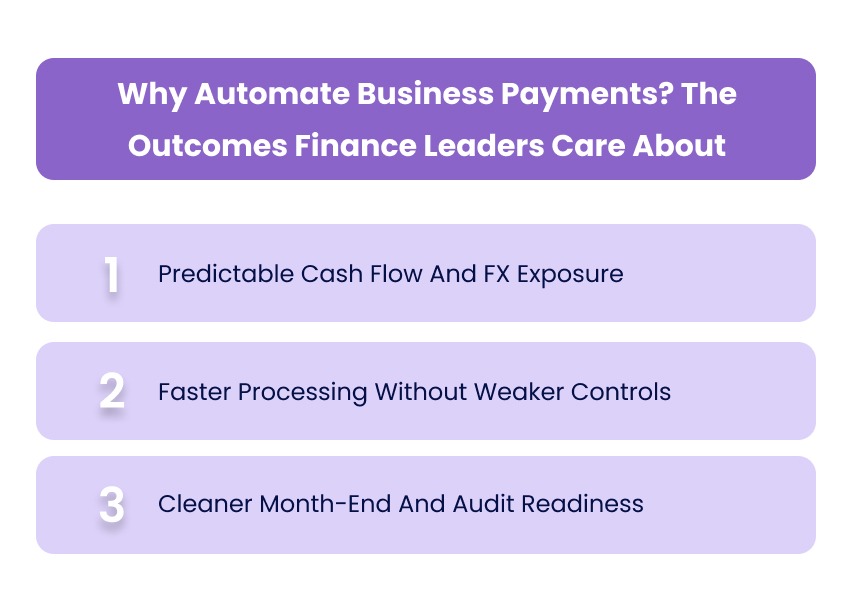
Payment automation only matters if it changes outcomes that finance leaders are measured on. In the UAE context, three outcomes stand out.
1. Predictable Cash Flow And FX Exposure
For teams paying international suppliers, FX is often treated as a post-payment issue. Rates are accepted at execution, and the true landed cost is reconciled later. Automation changes this by shifting FX visibility before approval, not after settlement.
When approvers see the FX impact upfront, payment timing becomes a deliberate decision. That alone reduces variance explanations and makes cash forecasting more defensible in front of management.
2. Faster Processing Without Weaker Controls
Automation is often misunderstood as “removing checks.” In practice, the opposite happens. Invoice capture, validation, and routing remove manual steps while tightening control points. Approvals move faster because information is complete, not because standards are lowered.
Finance teams that automate invoice intake and approvals typically see fewer exceptions and shorter processing cycles, which directly improves supplier relationships and internal SLAs.
3. Cleaner Month-End And Audit Readiness
Every manual handoff creates reconciliation debt. Automated payment workflows reduce this debt by ensuring invoices, approvals, payments, and accounting entries are linked. The benefit shows up at month-end: fewer unmatched items, fewer explanations, and faster closes.

The Real Barriers To Payments Automation In UAE Firms
Payments automation fails when it ignores how finance teams actually operate in the UAE. The barriers are consistent across industries.
1. Fragmented Systems And Parallel Workflows
Invoices arrive by email, approvals happen in messages, accounting sits in an ERP, and payments are executed in bank portals or FX apps. Automation struggles when each step lives in a different tool with no shared context.
This fragmentation forces finance teams to manually move data between systems, increasing both processing time and error rates. Until these workflows are connected, automation delivers limited value.
2. Approval Hierarchies And Local Practices
Approval culture in UAE organisations is structured and role-based. Payment tools designed for other markets often underestimate this. Systems that cannot reflect real approval hierarchies, delegation rules, or dual-approval requirements are quickly bypassed.
Automation must fit existing approval structures, not attempt to replace them.
3. Cross-Border Complexity And Corridor Limitations
Many UAE businesses rely on cross-border payments for procurement, imports, or overseas services. Cards often cannot be used, and not all corridors behave the same. FX costs, settlement times, and compliance requirements vary widely.
If automation ignores corridor coverage and FX transparency, teams revert to banks or exchange houses for critical payments.
4. Supplier Constraints
Some suppliers insist on specific payment formats or timelines. Automation must account for this reality by allowing phased adoption, starting with high-volume suppliers and expanding gradually.
Also Read: Understanding Challenges and Complexities in Global E-Invoicing System
Practical Strategies To Build Payments Automation That Works
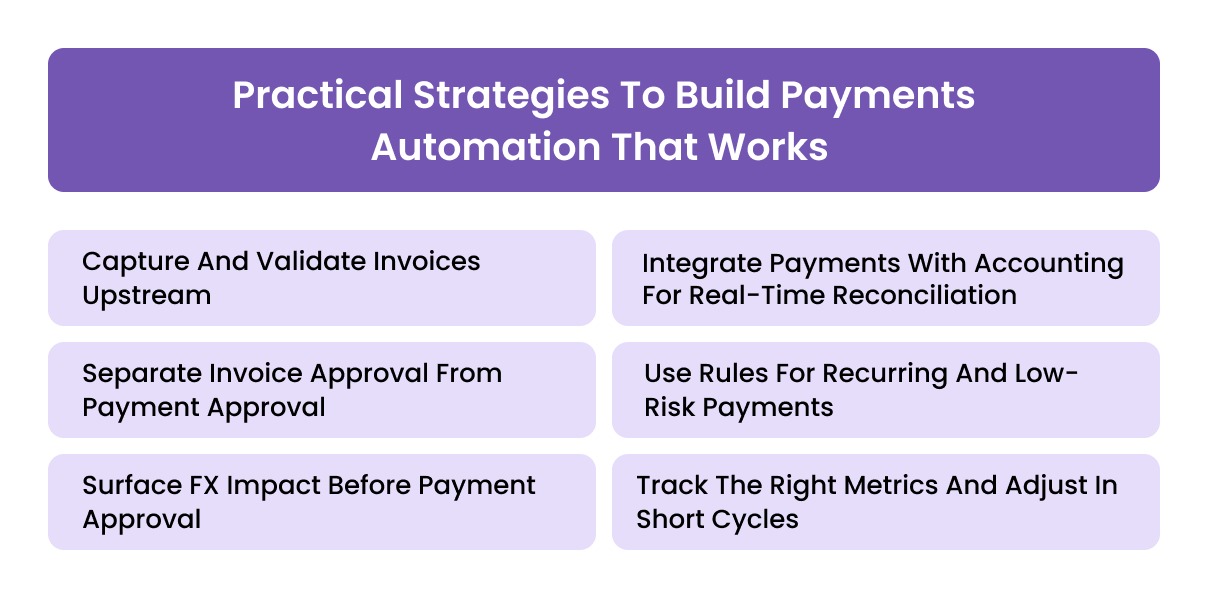
Automation succeeds when it is designed upstream and rolled out in controlled stages. The following practices are consistently effective.
1. Capture And Validate Invoices Upstream
The fastest way to break a payment process is to let incomplete invoices enter it.
High-performing finance teams enforce digital invoice submission to a single intake point. OCR and structured data extraction identify missing fields early, supplier details, invoice numbers, TRNs, and VAT amounts, before approvals begin.
A practical rollout starts with the top 20 suppliers by value. This covers most spending while allowing rules to be tested and refined before broader adoption.
Related: Understanding E-Invoices in UAE: Purpose, Types, and Elements
2. Separate Invoice Approval From Payment Approval
Treating invoice approval and payment approval as the same decision is a common source of rushed payments.
Leading teams split the process:
- Invoice approval confirms validity and coding.
- Payment approval determines timing, FX exposure, and payment rail.
This separation preserves control without slowing execution. Low-risk invoices can move quickly, while high-value or cross-border payments receive appropriate scrutiny.
Also Read: Steps to Automate Expense Management and Approvals
3. Surface FX Impact Before Payment Approval
For cross-border payments, automation fails if FX is treated as an execution detail. UAE finance teams feel this most when margins are tight and payment sizes are large. Seeing FX differences after settlement turns reconciliation into explanation work.
Effective payments automation surfaces FX impact and total landed cost before approval. That means:
- Approvers see rate, fees, and estimated settlement cost upfront
- Treasury can decide whether to pay immediately, wait, or use an alternative rail
- Variances become intentional outcomes, not surprises
This single design choice changes behaviour. Payment timing becomes a finance decision rather than an operational reflex.
It also simplifies internal reporting. When cost assumptions are approved in advance, explaining deviations to leadership becomes straightforward.
Also Read: Building a Robust Cash Management Control System for UAE Businesses
4. Integrate Payments With Accounting For Real-Time Reconciliation
Automation that stops at payment execution still leaves work on the table. The real efficiency gain comes when invoice data, approvals, and payments are reflected in accounting without manual intervention.
In practice, this means:
- Invoices post to the ERP with correct VAT treatment
- Payments automatically close open items
- Exceptions surface daily instead of at the month-end
For finance teams, this removes the CSV loop, exporting from one system, importing into another, and fixing mismatches days later. It also shortens close cycles and reduces audit preparation time.
Teams that integrate payments directly with accounting systems tend to catch issues earlier and spend less time reconciling historical data.

5. Use Rules For Recurring And Low-Risk Payments
Not every payment deserves the same level of attention. Automation works best when finance teams codify judgment into rules.
Common examples:
- Recurring vendor payments below a defined threshold
- Approved service contracts with fixed monthly amounts
- Utilities, subscriptions, or retainers
These payments can move through automated flows with audit trails, while one-off or high-value transactions retain manual approval. The result is fewer bottlenecks without sacrificing control.
Automation rules also reduce approval fatigue, a quiet but real risk when managers are asked to approve too many low-impact transactions.
6. Track The Right Metrics And Adjust In Short Cycles
Automation should be measured operationally, not theoretically. The most useful metrics for UAE finance teams include:
- Average processing time (invoice received to payment scheduled)
- Percentage of payments completed within the internal SLA
- FX variance between approval and settlement
- Exception rate per 1,000 invoices
- Volatility in Days Payable Outstanding
Teams that review these metrics weekly can adjust rules, approval thresholds, and supplier onboarding quickly. Waiting for quarterly reviews slows learning and adoption.
Also Read: How to Post Expenses with VAT in ERP Systems
An End-To-End Example: Automated Payments In Practice
Consider a UAE-based procurement firm paying overseas suppliers monthly.
- Suppliers submit digital invoices to a central intake
- Invoice data is extracted and validated, including VAT and supplier details
- Department heads approve invoice validity
- Treasury reviews FX impact and timing before approving payment
- Payments are executed using the selected rail
- Entries sync automatically to accounting, closing the loop
What changes is not just speed. Finance gains visibility into cost assumptions before money moves, reconciliation effort drops, and month-end stops feeling like a recovery exercise.
How Alaan Supports Cross-Border Payments Automation In The UAE
For many UAE businesses, payment automation challenges surface most clearly when paying international suppliers. Card rails are often unsuitable, and traditional bank or exchange workflows separate invoice review, approval, execution, and reconciliation into different systems. This fragmentation reduces visibility and increases manual work.
At Alaan, we support cross-border payments automation by connecting these stages into a governed workflow, so finance teams can review, approve, execute, and reconcile supplier payments within one environment.
- Super Pay Cross-Border Transfers For Supplier Payments
Through SuperPay, Alaan’s transfer capability, we enable domestic and cross-border supplier payments that cannot be handled through card rail. International transfers are currently available across supported corridors, including SEPA-region Europe, India, Pakistan, Egypt, the Philippines, Bangladesh, the United Kingdom, and the United States, with expansion occurring in phases.
This allows organisations to execute supplier settlements without shifting between disconnected tools. - Visibility Into Cost Before Payment Approval
For supported international transfers, payment cost implications are surfaced prior to approval. Finance teams can review this information before deciding when to release funds, helping reduce post-payment surprises and supporting more predictable cash planning. - Invoice Capture And Approval Before Execution
Invoices enter through a central intake and move through configurable approval chains before any payment is scheduled. This ensures spend validity is confirmed first, and payment timing is considered separately. The structure reflects common finance operating practices in UAE organisations. - Accounting Sync After Payment Completion
Transfer records and supporting documentation synchronise with accounting integrations, maintaining continuity between payment execution and financial reporting. This reduces manual data handling and helps teams identify reconciliation issues earlier. - Corporate Cards For Complementary Operational Spend
While supplier settlements typically use transfers, we also provide corporate cards for operational and merchant-based spending, such as employee expenses or digital services. Card activity remains connected to the same approval and accounting workflow, ensuring visibility across different payment types.
By structuring cross-border transfers alongside approvals, invoice capture, and accounting sync, we help organisations automate supplier payments without fragmenting governance or documentation. This approach supports clearer oversight as international payment activity grows.
Conclusion
Business payments automation delivers real value when it improves decision-making, not just execution speed. For UAE finance teams, that means validating invoices before payment, separating approval responsibilities, and understanding cost implications upfront, especially for cross-border transactions.
Teams that approach automation this way see fewer surprises, cleaner month-ends, and more predictable cash flow. The gains are operational at first, but they compound into stronger financial control over time.
At Alaan, we help finance teams bring invoices, approvals, payments, and reconciliation into one connected workflow, so decisions are made with clarity before money moves. If you want to see how this works in practice for your payment volumes and supplier mix, you can schedule a walkthrough with our team and evaluate it against your current process.
Frequently Asked Questions (FAQs)
1. What is the difference between payment automation and accounts payable automation?
Accounts payable automation focuses on invoice intake, validation, and approvals. Payment automation extends further, covering how and when money is released, FX visibility, settlement methods, and reconciliation. In practice, UAE finance teams need to work together to achieve predictable outcomes.
2. Is payment automation suitable for small and mid-sized businesses in the UAE?
Yes. Many UAE SMEs adopt payments automation specifically to avoid scaling manual processes. Automation helps smaller teams handle higher transaction volumes, cross-border suppliers, and VAT requirements without adding headcount.
3. How does payment automation impact supplier relationships?
When payments are automated correctly, suppliers benefit from faster processing, fewer disputes, and clearer timelines. Consistency in payment execution often improves trust and reduces follow-ups, especially for recurring or overseas vendors.
4. Can automated payment systems handle UAE VAT requirements?
Modern automation platforms are designed to support VAT workflows by validating invoice data, capturing VAT amounts, and syncing correctly with accounting systems. However, finance teams should still define internal rules to ensure VAT treatment aligns with their tax advisors’ guidance.
5. What should finance teams evaluate before choosing a payments automation platform?
Key factors include approval flexibility, accounting integration depth, cross-border payment coverage, FX transparency, audit trails, and how well the system reflects existing finance controls rather than forcing new ones.
6. How long does it typically take to see value from payments automation?
Most UAE finance teams see operational improvements within weeks, particularly in processing time and visibility. Strategic benefits, such as improved cash forecasting and reduced reconciliation effort, tend to compound over the first few closing cycles.
Gain control over business expenses with Alaan corporate cards
Invygo earned AED 100,000 in cashback using Alaan cards
Personalise approval workflows to align with your business needs with Alaan's Spend Management platform
Discover the power of automated expense tracking and smarter spend control with Alaan
Turn data into actionable insights with Alaan's spend management tools
Stay Tax Compliant with UAE's #1 Corporate Card and Spend Management Platform
Customisable corporate card policy template
Know how much Corporate Tax you have to pay this fiscal year
Easily integrate Alaan with your ERP for accurate, real-time expense tracking
Close books faster with Alaan's AI-powered accounting automation
Reconcile your books in minutes instead of hours, every single month.
Keep petty cash organized with Alaan corporate cards and automated expense management