.avif)


Cash flow and fund flow both track financial movement but answer different questions, cash flow for liquidity and fund flow for how resources moved through working capital, so finance teams should match the lens to the question.
- Pick the lens that fits the question: use cash flow when the issue is liquidity and payment capacity, and fund flow when you need to explain how resources moved through working capital over a period.
- Cash flow shows what actually happened to cash across operating, investing, and financing activities, which makes it the view for payroll timing, supplier payments, and runway.
- Fund flow explains where funds were sourced and applied, so it surfaces resources tied up in receivables or inventory that a healthy-looking cash position can hide.
- A business can post positive cash flow from short-term borrowing while working capital weakness keeps building underneath, which is why one view should not stand in for the other.
- For the operating cash layer, Alaan helps with corporate cards that carry spend controls, approvals before spend is committed, real-time visibility into spend, and cleaner reconciliation through accounting integrations.
Finance teams often use cash flow and fund flow as though they describe the same thing. They do not. Both explain financial movement across a period, but they answer different questions and support different decisions.
Cash flow tells you what actually happened to cash. Fund flow helps explain how financial resources moved through the business, especially through working capital and longer-term sources and uses of funds. When those two ideas are treated as interchangeable, finance discussions start losing precision. A business may appear stable on one view and strained on the other, depending on what exactly is being measured.
That distinction matters more than it may first seem. In practice, liquidity planning, payment control, working capital analysis, and internal financial review do not all depend on the same lens. A finance team looking at supplier pressure, short-term obligations, or runway needs a different answer from one trying to understand where resources were tied up between two reporting dates.
This distinction matters because liquidity planning, payment control, and working capital analysis do not all depend on the same lens. Finance teams need cash flow when the question is liquidity, and fund flow when the question is broader financial movement.
TL;DR / Key Takeaways
- Cash flow helps finance understand actual liquidity, while fund flow is more useful for explaining how resources moved across the business over a period.
- A business can show acceptable cash for a period and still have underlying working capital weakness, which is why one view should not replace the other.
- The more useful question is not which one is better, but which one answers the finance problem at hand more accurately.
- Fund flow is most valuable as an internal analysis lens, while cash flow carries more weight for formal reporting and day-to-day control.
- At Alaan, we help finance teams strengthen the cash control layer through better spend visibility, approvals, and reconciliation.
Also Read: Manage Business Cash Flow Effectively
Why Finance Teams Still Confuse Cash Flow And Fund Flow
The confusion persists because both terms sit close to each other in everyday finance language. Both are used to explain movement over time. Both connect to balance sheet changes. And both can appear in conversations about performance, planning, and financial control.
That overlap makes the terms sound interchangeable, especially in internal discussions where the distinction is not always made explicit. But the underlying focus is different. Cash flow is about liquidity. Fund flow is about how financial resources moved across the business, often with more emphasis on working capital and broader financial position.
This difference becomes important when finance is trying to answer a specific question. If the question is whether the business generated enough liquidity to meet near-term obligations, cash flow is the more useful lens. If the question is where funds were sourced from and where they were applied across a period, fund flow offers a different kind of explanation.
In practice, the confusion usually comes from three habits:
- Using Similar Language For Different Purposes
Teams often refer to "movement in funds" when they really mean cash generation, even though the underlying analysis is not the same. - Explaining Period Changes Without Defining The Lens
When finance reviews movement between two dates, the discussion can slide between liquidity and working capital without clearly separating the two. - Treating Internal Analysis Like Formal Reporting
Cash flow has a recognised place in statutory reporting, while fund flow is more often used as an internal analytical lens. Mixing those roles creates unnecessary ambiguity.
The result is not just semantic. It can lead to the wrong conclusion. A business may have improved its apparent fund position while still facing cash pressure, or it may show acceptable cash inflow for a period while working capital weaknesses continue to build underneath.
Related: Financial Planning Analysis FPA
What Cash Flow Actually Tells You
Cash flow focuses on what happened to cash and cash equivalents over a period. It answers the most immediate finance question: how much liquidity actually came into the business, how much left it, and through which type of activity that movement happened.

That makes cash flow one of the clearest lenses for understanding operational liquidity. It shows whether the business is generating cash from its core operations, using cash for investment, or relying on financing activity to support its position. For finance teams, this is the view that matters most when the concern is payment capacity, short-term planning, or whether reported performance is translating into real liquidity.
Cash flow is especially useful because it separates movement into recognisable categories:
- Operating Activities
Cash generated or used through the business’s day-to-day operations. - Investing Activities
Cash used for or generated from investments, asset purchases, or disposals. - Financing Activities
Cash received from or paid toward funding sources such as borrowings, repayments, or equity-related activity.
This structure makes cash flow practical as well as reportable. It helps finance distinguish between a business that is truly self-supporting operationally and one that appears stable only because financing activity is temporarily supporting liquidity.
It also makes cash flow central to decisions such as:
- supplier payment planning
- payroll timing
- cash runway assessment
- short-term liquidity management
- near-term funding needs
A profitable business can still face cash stress if collections are delayed, payments are front-loaded, or operating cash generation is weaker than reported earnings suggest. That is why cash flow remains one of the most important tools for understanding financial reality rather than just accounting outcomes. See the full statement format this narrower view is drawn from, including the three activity sections.
Also Read: Cash Flow Operating Activities Guide
What Fund Flow Actually Tells You
Fund flow looks at financial movement more broadly. Instead of focusing only on cash, it helps explain how funds were sourced and applied across the business during a period, often with close attention to changes in working capital.
This makes fund flow useful for understanding how the company’s broader financial position changed between two reporting dates. It can show whether resources were tied up in receivables, inventory, fixed assets, or other uses, and whether those uses were supported by retained earnings, borrowings, or other sources of funds.
That is why fund flow is often more useful as an internal analytical tool than as a liquidity tool. It helps answer questions such as:
- where did financial resources get absorbed
- what created the increase or decrease in working capital
- how was expansion funded
- which balance sheet changes drove the overall shift in position
A fund flow view is particularly useful when finance wants to explain why the business feels tighter or looser financially even when cash movement alone does not tell the full story. For example, a rise in receivables or inventory may represent a real use of funds, even if the income statement looks healthy and the cash pressure has not yet fully surfaced.
That makes fund flow valuable in situations involving:
- working capital analysis
- internal financial review
- growth-phase balance sheet movement
- funding structure assessment
- explanations of how resources were deployed over time
Used well, fund flow adds depth to finance analysis. It shows where resources moved, not just whether cash increased or decreased.
Related: Understanding Balance Sheet Prepaid Expenses
The Core Difference Is Liquidity Vs Working Capital Movement
The cleanest way to separate cash flow and fund flow is to recognise that they are built for different purposes.
Cash flow is a liquidity lens. It tells finance whether cash actually came in or went out, and whether the business can support its obligations through operational cash generation or needs support from elsewhere.
Fund flow is a movement lens. It explains how financial resources shifted across the business, especially through working capital and broader balance sheet changes.
That distinction matters because the two can point in different directions.
A business may record higher sales and appear to be growing, but if more capital is tied up in receivables and inventory, the fund flow view may show resources being absorbed while the cash flow view shows growing liquidity pressure. Equally, a business may report improved cash for a period because of short-term borrowing, while the fund flow picture still points to weak working capital discipline underneath.
In practical terms:
- Cash Flow Answers A Liquidity Question
Did the business generate or use real cash over the period? - Fund Flow Answers A Financial Movement Question
Where were funds sourced from and where were they applied? - Cash Flow Supports Near-Term Control
It is more useful for managing payments, obligations, and immediate financial flexibility. - Fund Flow Supports Position Analysis
It helps finance understand how the balance sheet changed and why resources feel tighter or more available across periods.

This is why strong finance teams do not use one as a substitute for the other. They use cash flow when the issue is liquidity, and fund flow when the issue is understanding the movement of financial resources more broadly.
Also Read: Cash Management Control System UAE
Where Each One Is Useful In Real Finance Work
The value of this comparison becomes clearer when finance looks at actual use cases rather than definitions. Cash flow and fund flow are not competing views. They are different tools for different management questions.
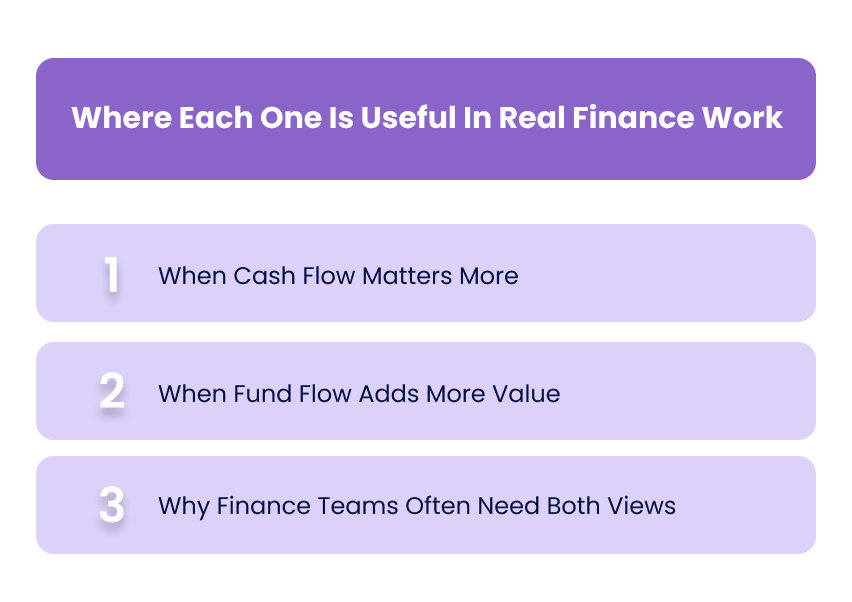
Cash flow matters more when the business needs to understand liquidity in real time or near real time. Fund flow becomes more useful when finance is trying to explain how the company’s financial position changed across a period, especially when working capital movement is part of the story.
When Cash Flow Matters More
Cash flow is the stronger lens when finance needs to make operational decisions linked to immediate liquidity and payment capacity.
This usually includes areas such as:
- supplier payment planning
- payroll timing
- short-term cash forecasting
- runway assessment
- debt servicing capacity
- near-term liquidity control
In these situations, the question is straightforward. Finance needs to know whether cash is available, when it is expected to move, and whether the business can meet obligations without strain.
When Fund Flow Adds More Value
Fund flow becomes more useful when finance wants to understand why the company’s overall financial position changed, even if the cash movement alone does not fully explain it.
This is especially relevant for:
- working capital review
- internal financial analysis
- balance sheet movement between two periods
- understanding how growth was funded
- identifying where resources were absorbed
Here, the question is less about immediate cash availability and more about where funds were sourced from and where they were applied.
Why Finance Teams Often Need Both Views
A business can remain focused on liquidity while still needing a deeper explanation of how financial resources moved over time. That is where both views become complementary.
Cash flow tells finance whether the business is generating real liquidity. Fund flow helps explain why the balance sheet feels tighter, more stretched, or more stable across periods. When used together, the two views create a more complete picture than either one used alone.
Related: Control Account Reconciliation
Common Situations Where Cash Flow And Fund Flow Tell Different Stories
This distinction becomes most useful when the two lenses point in different directions. That is usually when finance gets the clearest signal that one view alone is not enough.
In practice, several common business situations create exactly that kind of mismatch.
Rising Receivables Can Improve Sales Without Improving Cash
A company may record stronger revenue and healthier top-line growth, but if receivables rise faster than collections, the additional activity does not improve liquidity in the same period.
From a fund flow perspective, resources have been absorbed into working capital. From a cash flow perspective, the business may still feel pressure because the expected cash has not yet arrived. See where working capital actually gets trapped inside a business’s cash cycle beyond just receivables.
Inventory Build Up Can Use Funds Before It Feels Like A Cash Crisis
Inventory accumulation often looks strategic at first. It may support demand planning, expansion, or supply continuity. But it still ties up funds.
That means the business may appear operationally prepared while finance sees a growing use of funds sitting in stock rather than in available liquidity. If that pattern continues, the cash effect eventually becomes harder to absorb.
Capital Investment Can Change Financial Position Even When Operations Stay Stable
A company may be operating steadily while still deploying funds into equipment, infrastructure, or expansion-related assets. In those periods, fund flow helps explain where financial resources were directed, while cash flow shows the actual liquidity effect of those decisions.
The two views are related, but they answer different parts of the same story.
Short-Term Borrowing Can Improve Cash Without Fixing Underlying Weakness
This is one of the clearest examples of why finance should not confuse liquidity with financial health. Short-term borrowing can improve cash quickly and make the immediate position look stronger.
But that does not necessarily mean the business has solved the underlying issue. If receivables remain slow, inventory remains heavy, or working capital remains poorly managed, the fund flow view may still point to structural weakness beneath the improved cash position.
Also Read: Account Reconciliation Importance Steps
Which One Should UAE Businesses Rely On More
This is not a winner-takes-all comparison. The stronger question is which lens matters more for the decision finance is trying to make.

For formal reporting, cash flow has the clearer priority. It is the recognised financial statement lens for understanding cash and cash equivalents over a period. For internal analysis, however, fund flow can still add value where management needs a broader explanation of working capital and financial position movement.
For Statutory Reporting, Cash Flow Comes First
Cash flow has direct relevance in formal financial reporting because it shows how liquidity moved across operating, investing, and financing activities. That makes it the more important view for reporting discipline, financial communication, and external interpretation of liquidity.
For most finance teams, this means cash flow carries more immediate weight when the concern is statutory reporting or formal financial review.
For Internal Analysis, Fund Flow Still Has A Role
Fund flow is still useful where management wants to understand how funds moved across the business beyond cash alone. It can help explain why the business feels financially tighter even when revenue or profit appears stable.
That is especially relevant in businesses that are growing, holding more working capital, or funding expansion through changes in liabilities or longer-term sources of funds.
The Better Question Is What Finance Is Trying To Solve
If the issue is payment discipline, liquidity timing, or near-term financial flexibility, cash flow is the more useful lens.
If the issue is how resources were deployed, how working capital changed, or what balance sheet movement explains the current position, fund flow adds a different kind of clarity.
The mistake is not choosing one over the other. The mistake is using the wrong one for the wrong question.
Related: Cash Flow Forecasting
The Mistake Is Using One As A Substitute For The Other
Finance teams run into trouble when they treat cash flow and fund flow as interchangeable labels rather than distinct analytical views. The result is usually a loss of precision in both reporting and decision-making.
A business may rely too heavily on cash flow and miss the fact that resources are steadily being absorbed into receivables, inventory, or other working capital items. Another business may lean on broader movement analysis and underestimate immediate liquidity pressure because actual cash availability is not receiving enough attention.
Cash Flow Alone Does Not Explain Every Balance Sheet Shift
Cash flow is essential for understanding liquidity, but it does not explain every movement in financial position. If finance wants to understand how working capital has changed or why the business feels more stretched across periods, a cash-only view may not be enough.
Fund Flow Alone Does Not Protect Liquidity
Fund flow may help explain broader movement in resources, but it does not replace the need to manage actual cash. A business cannot meet payroll, settle supplier obligations, or maintain flexibility through analytical comfort alone. Liquidity still needs its own direct focus.
Better Finance Control Starts With Using The Right Lens
Stronger finance teams do not debate which concept is superior in general. They decide which one is useful for the specific issue in front of them.
That is what creates better control. Cash flow supports liquidity discipline. Fund flow supports broader financial analysis. Using each in the right context leads to clearer interpretation, better planning, and fewer blind spots.
Also Read: Financial Planning Analysis FPA
How Alaan Helps Finance Teams Strengthen The Cash Control Layer
Cash flow and fund flow may serve different analytical purposes, but both depend on one thing: finance needs accurate visibility into what the business is spending, when transactions occur, and how quickly those transactions can be reviewed and reconciled.
At Alaan, we do not position ourselves as a financial statement tool or a working capital analysis platform. We help finance teams strengthen control around the operating cash layer, where spend visibility, approvals, reconciliation, and transaction timing directly affect how confidently cash can be managed.
- Corporate Cards With Spend Controls
At Alaan, we provide corporate cards with configurable limits and policy controls, helping businesses manage company spending within approved boundaries rather than identifying issues only after money has already left the business. - Structured Approval Workflows Before Spend Happens
Our approval workflows help finance teams ensure that expenses are reviewed before they are committed, which supports better discipline around spending timing and policy enforcement. - Real-Time Visibility Into Company Spend
We give businesses centralised visibility into spend as it happens, making it easier to track where operating cash is being used across teams, categories, and vendors. - Faster Receipt Capture And Documentation
Receipts can be collected and linked to transactions more efficiently, reducing documentation gaps and making spend easier to verify. - Cleaner Reconciliation And Accounting Sync
With integrations into systems such as Xero, QuickBooks, NetSuite, and Microsoft Dynamics, finance teams can reduce manual reconciliation effort and keep spend data flowing more cleanly into accounting. - Better Control Over Everyday Cash Outflows
For finance teams focused on liquidity discipline, that day-to-day control matters. Better visibility and faster reconciliation make it easier to understand actual operating cash movement instead of reconstructing it later.

In practice, this means finance can manage the cash control layer with more confidence. The data is more visible, approvals are more structured, and the transaction trail is easier to follow across the spend lifecycle.
Related: Business Spend Management Tools Importance
Conclusion
Cash flow and fund flow are often discussed together because both explain financial movement across a period. But they are not interchangeable. Cash flow shows what happened to liquidity. Fund flow helps explain how financial resources moved across the business, especially through working capital and broader balance sheet change.
That distinction matters because finance decisions are not all solving the same problem. Some decisions depend on actual cash availability. Others depend on understanding where funds were absorbed, how the balance sheet shifted, or why the business feels tighter even when the cash picture looks acceptable.
The stronger approach is not to choose one and ignore the other. It is to use each lens deliberately. Finance teams that do that tend to interpret performance more clearly, plan with more precision, and avoid using liquidity signals as a substitute for broader financial analysis.
And when the focus shifts from analysis to control, visibility becomes critical. At Alaan, we help finance teams keep company spending visible, governed, and easier to reconcile, so the operating cash layer is easier to manage with confidence. Book a Demo Today!
A cash flow statement looks backwards, so pair it with the free cash flow stress test to see what the next few months look like if collections slow down. When you want spend, approvals and accounting sync living in one account, Alaan's AI-native business account does that and pays profit on the cash you're not using yet.
FAQs
1. Is fund flow still relevant if businesses already prepare a cash flow statement?
Yes, it can still be useful for internal finance analysis. A cash flow statement shows liquidity movement, while fund flow can help explain broader changes in working capital and how financial resources were deployed across a period.
2. Which is more important for short-term decision-making: cash flow or fund flow?
Cash flow is usually more important for short-term decisions because it helps finance assess liquidity, payment capacity, and near-term obligations. Fund flow is less useful when the issue is immediate cash availability.
3. Can a business have positive cash flow and still face financial strain?
Yes. A business may report a positive cash position for a period because of borrowing, delayed payments, or timing effects, while still carrying underlying pressure in receivables, inventory, or broader working capital structure.
4. Is fund flow part of mandatory financial reporting in the UAE?
In practice, finance teams rely on the cash flow statement for formal financial reporting, while fund flow is more commonly used as an internal analytical tool. That is one reason the two should not be treated as interchangeable.
5. Does fund flow matter more for growing businesses?
It often becomes more useful in growth-stage businesses because expansion tends to create more visible working capital movement, funding decisions, and balance sheet shifts that are not always fully explained by cash flow alone.
6. How can finance teams make cash flow analysis more reliable in day-to-day operations?
The quality of cash flow analysis improves when spend is visible early, approvals are structured, documentation is captured on time, and reconciliation happens without long delays. Without that operating discipline, even good reporting comes too late to improve control.
Gain control over business expenses with Alaan corporate cards
Invygo earned AED 100,000 in cashback using Alaan cards
Personalise approval workflows to align with your business needs with Alaan's Spend Management platform
Discover the power of automated expense tracking and smarter spend control with Alaan
Turn data into actionable insights with Alaan's spend management tools
Stay Tax Compliant with UAE's #1 Corporate Card and Spend Management Platform
Customisable corporate card policy template
Know how much Corporate Tax you have to pay this fiscal year
Easily integrate Alaan with your ERP for accurate, real-time expense tracking
Close books faster with Alaan's AI-powered accounting automation
Reconcile your books in minutes instead of hours, every single month.
Keep petty cash organized with Alaan corporate cards and automated expense management