.avif)

In hiring and retention, salary is only part of the offer. Employees also look at the wider package: health cover, allowances, flexibility, training support, and other non-salary perks that shape the day-to-day value of a role.
That broader package is often described through fringe benefits. In HR, the term generally refers to the additional benefits an employer provides on top of base salary or wages.
For UAE businesses, it is important to distinguish fringe benefits from statutory employee entitlements under the private-sector labour framework, such as annual leave, sick leave, maternity leave, parental leave, and end-of-service gratuity. Fringe benefits are the additional benefits employers choose to provide beyond those legal minimums.
This guide explains what fringe benefits mean, how they differ from statutory employee benefits in the UAE, and how businesses can structure them more clearly.
TL;DR
- Fringe benefits are non-salary benefits provided in addition to regular pay, not the same thing as legal employment entitlements.
- In the UAE, statutory benefits and fringe benefits should be treated separately, otherwise compensation communication gets messy fast.
- Common fringe benefits include enhanced medical cover, housing or transport support, flight benefits, flexibility, training support, and wellness perks.
- A good fringe benefits structure is relevant, clearly defined, and sustainable, rather than long for the sake of looking generous.
- Finance and HR both matter here, because many fringe benefits create ongoing employee-related spend that needs approval, visibility, and documentation.
Fringe Benefits Meaning In HR
Fringe benefits are the non-salary benefits or perks that an employer provides in addition to regular pay. They can be financial, practical, or lifestyle-related, and they are usually designed to make a compensation package more attractive or more supportive.
In simple terms, if salary is the core cash component of pay, fringe benefits are the extra elements that add to the overall employment package.
What Fringe Benefits Usually Include
Fringe benefits may include:
- Health Insurance Enhancements
- Housing Or Transport Support
- Annual Flight Benefits
- Flexible Working Arrangements
- Training Or Education Support
- Wellness Or Lifestyle Perks
- Company Devices Or Work-Related Perks
- Non-Cash Performance Benefits
Not every business uses the same structure, and not every benefit is offered to every employee group. In practice, fringe benefits are shaped by company policy, job level, hiring strategy, and cost priorities.
Confusion often arises when fringe benefits are mixed up with:
- Statutory Benefits
- Payroll Components
- Pure Expense Reimbursements
- Foreign Tax Rules That Do Not Apply In The UAE In The Same Way
Related: Expense reimbursement: What is it & how to manage it?
Fringe Benefits Vs Statutory Employee Benefits In The UAE
In the UAE, employees in the private sector are entitled to certain benefits and protections under the labour law. These are part of the legal employment framework. The UAE labour law covers entitlements including annual leave, sick leave, maternity leave, and end-of-service benefits.
Fringe benefits, by contrast, are the additional benefits an employer chooses to offer beyond those legal minimums.
Statutory Employee Benefits In The UAE
Examples of statutory entitlements include:
- Annual Leave
- Sick Leave
- Maternity Leave
- End-Of-Service Gratuity
- Other Leave And Employment Rights Under The Labour Law
These are baseline obligations under the employment framework, not discretionary perks.
Fringe Benefits In The UAE Context
Fringe benefits are the extras that sit on top of those legal entitlements. Depending on the employer and the role, they may include:
- Enhanced Medical Cover
- Schooling Support
- Travel Allowances
- Flexible Work Policies
- Professional Development Support
- Lifestyle And Wellness Benefits
A clear distinction between statutory entitlements and fringe benefits helps businesses present compensation more accurately, communicate policies more clearly, and manage benefit costs more effectively.
Also Read: What Are Corporate Cards and How Do They Work?
Common Examples Of Fringe Benefits
Fringe benefits can take different forms depending on the company’s size, hiring priorities, budget, and workforce mix. In the UAE, they are often used to make compensation packages more competitive without relying only on higher fixed salaries.
Common examples include:
1. Enhanced Health Insurance
Basic medical cover may meet a legal or operational baseline, but some employers offer broader coverage, better networks, or added family benefits as part of the overall package.
2. Housing Or Transport Support
Some businesses provide housing support, transport allowances, or company-arranged transport to make roles more practical and attractive.
3. Annual Flight Benefits
Annual ticket allowances or home-travel support are common in many employment packages, especially for expatriate employees.
4. Education Support
Some employers contribute towards schooling or education-related costs for employees’ dependants.
5. Flexible Working Arrangements
Hybrid work, flexible hours, or other work arrangement benefits can form an important part of the non-salary offering.
6. Training And Professional Development
Employers may offer support for certifications, courses, workshops, or other learning opportunities that help employees grow in their roles.
7. Wellness And Lifestyle Perks
Gym memberships, mental health support, wellness allowances, or employee assistance programmes can all fall within the broader fringe benefits category.
8. Company Devices And Work-Related Perks
Laptops, mobile allowances, or similar work-enabling benefits may also form part of the package, depending on role and policy.
9. Non-Cash Recognition Benefits
Gift vouchers, milestone rewards, and similar non-cash perks may be used to recognise performance or tenure.
Not every item above will be relevant for every employer. The value of a fringe benefit depends on whether it is genuinely useful to the workforce and sustainable for the business.
Also Read: Expense Policy Template With Best Practices for 2026
Why Fringe Benefits Matter For UAE Employers
Fringe benefits play a practical role in how businesses attract, retain, and support employees. In competitive hiring markets, the overall package often matters as much as headline salary.
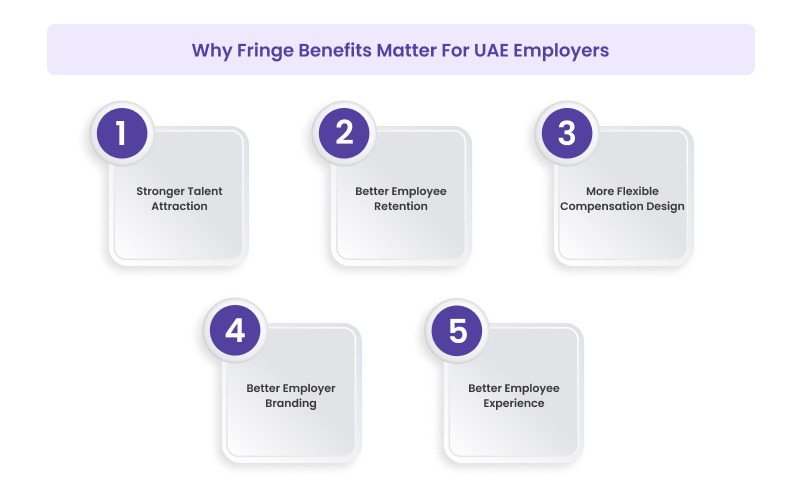
1. Stronger Talent Attraction
Candidates rarely evaluate roles on base pay alone. A more thoughtful benefits package can make an offer more competitive, especially when comparing similar salary ranges.
2. Better Employee Retention
Benefits that employees actually use and value can improve retention by making the employment experience more supportive and more stable over time.
3. More Flexible Compensation Design
Fringe benefits allow businesses to improve the overall package without relying entirely on permanent increases to fixed salary. That can be useful when employers want to target support in more practical ways.
4. Better Employer Branding
A company that offers a well-designed, clearly communicated benefits package is often perceived as more organised, more employee-focused, and more competitive in the market.
5. Better Employee Experience
Benefits such as better health cover, flexible work, or learning support can improve the day-to-day employment experience in ways that salary alone does not.
A stronger benefits structure does not mean offering everything under the sun and hoping something sticks. It means building a package that employees value and the business can support consistently.
Also Read: What Counts as a Business Expense in the UAE
How To Design Fringe Benefits More Effectively
A sensible fringe benefits strategy starts with structure, not improvisation. The most effective approach is usually the one that is clear, relevant, and sustainable.
1. Separate Statutory Benefits From Optional Perks
The first step is to distinguish legal obligations from discretionary benefits. Statutory entitlements under UAE labour law are the baseline. Fringe benefits should be defined separately so employees understand what is mandatory and what is part of the broader package.
2. Match Benefits To Workforce Needs
A benefit only has value if employees actually care about it. A growing company with a younger workforce may prioritise flexibility and learning support, while another may see more value in family medical cover or transport support.
3. Set Clear Eligibility Rules
Businesses should define:
1. Who Receives The Benefit
2. What The Coverage Or Limit Includes
3. Whether It Applies To All Employees Or Specific Grades
4. How It Is Approved And Administered
Without that clarity, fringe benefits can become inconsistent and expensive to manage.
4. Keep Costs Visible
Benefit costs should be tracked properly rather than absorbed vaguely into overhead. That helps finance and HR teams understand which benefits are being used, which are underused, and where costs are rising.
5. Communicate The Package Clearly
Employees often undervalue benefits they do not fully understand. Clear policy language and better communication help ensure the package is seen properly, not reduced mentally to base pay alone.
6. Review Benefit Value Periodically
A fringe benefit that was attractive two years ago may have much less value today. Reviewing usage, employee feedback, and cost helps keep the package relevant.
Common Mistakes Companies Make With Fringe Benefits
A fringe benefits strategy can become expensive or ineffective when the structure is unclear. Some mistakes show up repeatedly.
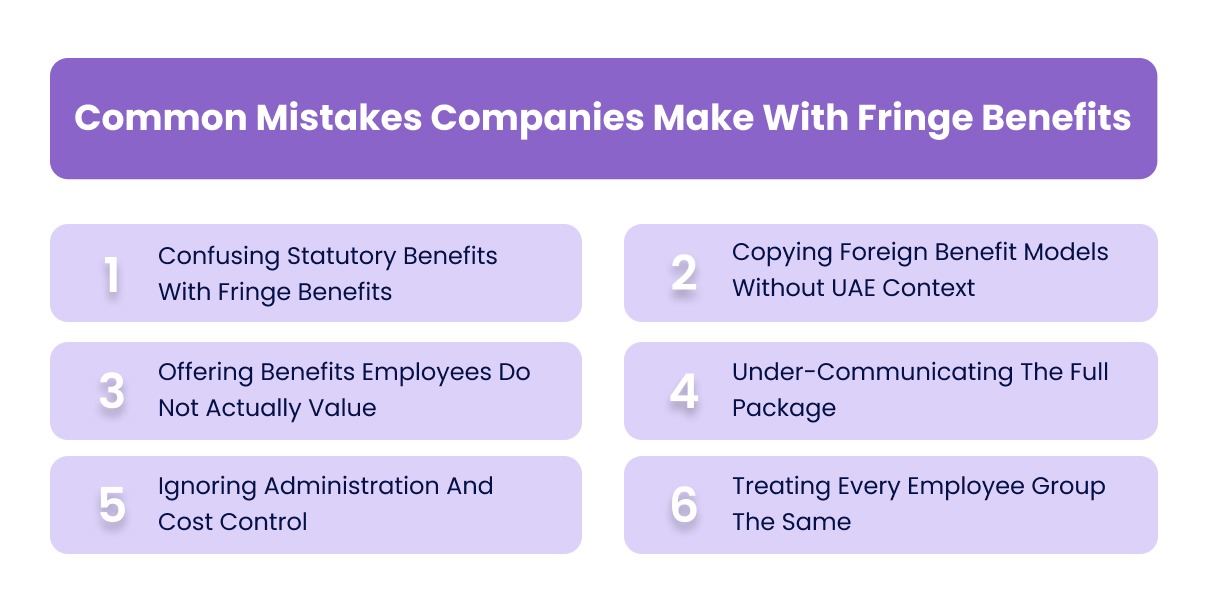
1. Confusing Statutory Benefits With Fringe Benefits
Statutory entitlements under UAE labour law are part of the legal employment framework. They should not be presented as discretionary perks. Annual leave, sick leave, maternity leave, and end-of-service gratuity are part of the baseline employment structure, not optional add-ons.
2. Copying Foreign Benefit Models Without UAE Context
A lot of online content on fringe benefits is built around foreign tax systems, especially US or Australian-style fringe benefits tax frameworks. That can create confusion in a UAE context if companies borrow terminology or policy structures without checking local relevance first.
3. Offering Benefits Employees Do Not Actually Value
A benefit looks good on paper only if employees find it useful. A long list of perks with low perceived value can cost money without improving attraction, retention, or employee experience in any meaningful way.
4. Under-Communicating The Full Package
Some companies offer meaningful benefits but explain them poorly. When employees do not understand the package, they often reduce their assessment of compensation to salary alone.
5. Ignoring Administration And Cost Control
Benefits that are vaguely defined or manually managed can create unnecessary friction for HR and finance teams. Over time, that can lead to inconsistent approvals, weak documentation, and poor visibility into employee-related spend.
6. Treating Every Employee Group The Same
A single benefits design may not make sense across all roles, grades, or workforce segments. A more structured approach to eligibility and benefit design usually works better than a one-size-fits-all policy.
Related: Strategies for Effective Corporate Spend Management
How Better Spend Controls Help Manage Employee Benefit Costs
Fringe benefits are easier to offer than to manage. Once a company starts paying for medical top-ups, travel allowances, training, wellness perks, mobile plans, or other employee-related costs, the real challenge becomes control: who can spend, what can be claimed, what documents are required, and how finance tracks it cleanly.
That is where Alaan is relevant. It helps finance teams manage employee-related spend through corporate cards, spend controls, approval workflows, receipt capture, AI verification, and accounting integrations.
- Corporate Cards With Spend Limits And Vendor Controls
For recurring employee benefit costs such as travel, mobile bills, wellness budgets, or learning subscriptions, Alaan lets businesses issue corporate cards with spending caps and vendor restrictions. That gives teams more control than relying on loose reimbursements. - Approval Workflows Based On Policy
Alaan supports custom approval workflows, so benefit-related expenses can follow the right approval path based on company policy instead of being handled inconsistently over email or chat. - Receipt Capture And Supporting Documents
Employees can upload receipts and invoices through the mobile app, Chrome extension, or email, so supporting documents stay linked to the transaction and are easier for finance to review later. - AI Verification And Duplicate Detection
Alaan extracts receipt data, matches it to transactions, and flags errors or duplicates. That reduces manual checking and helps finance review employee benefit spend more efficiently. - Real-Time Visibility Into Employee Spend
Alaan gives finance teams real-time visibility into employee expenses, making it easier to track benefit-related spend by team, category, or transaction and spot cost drift earlier. - Accounting Sync For Cleaner Review
Alaan integrates with Xero, QuickBooks, NetSuite, and Microsoft Dynamics, helping teams sync expense data in real time and reduce manual re-entry during reconciliation.
In practice, that makes fringe benefits easier to control, document, and review as an ongoing business cost.
Conclusion
Fringe benefits are the non-salary benefits employers provide on top of regular pay. They can include enhanced health cover, travel support, training budgets, flexible work perks, and other practical benefits that strengthen the overall employee package.
For UAE businesses, the key is to keep fringe benefits separate from statutory employee entitlements. Annual leave, sick leave, maternity leave, and end-of-service gratuity belong to the legal employment framework. Fringe benefits are the additional benefits a business chooses to offer beyond that baseline.
A strong fringe benefits structure is not just about choosing the right perks. It is also about managing the cost properly. Alaan helps finance teams do that with corporate cards, spend limits, approval workflows, receipt capture, AI verification, and accounting integrations that make employee-related spend easier to control and review. Book a Demo Today!
Benefits only work when they're written into a policy people can find, so our UAE HR policy guide is worth a look next, especially the part on how HR rules tie into approvals, payroll and employee spending.
FAQs
1. Are fringe benefits part of gross salary?
Not always. Some fringe benefits sit outside base salary and are provided separately, while others may be structured as allowances or packaged components depending on the employer’s compensation design. The important point is to define them clearly in policy and offer documentation.
2. Can a company offer different fringe benefits to different employee groups?
Yes. Many businesses vary benefits by grade, function, seniority, location, or employment type. What matters is that eligibility rules are documented clearly and applied consistently.
3. Are fringe benefits usually paid in cash or provided in kind?
They can be either. Some are cash-linked, such as allowances or reimbursements, while others are provided in kind, such as upgraded medical cover, learning access, or company devices.
4. Should fringe benefits be included in an employment contract or a separate policy?
Usually, both need to work together. Core entitlements may be referenced in the employment contract, while detailed rules, limits, exclusions, and approval processes are often better handled in a separate HR or benefits policy.
5. How often should companies review their fringe benefits package?
A periodic review is sensible, especially when hiring conditions, workforce needs, or cost pressures change. Many businesses review benefits annually or alongside compensation planning cycles.
6. What makes a fringe benefits package effective?
The strongest package is not the one with the longest list of perks. It is the one employees understand, actually use, and the business can afford to maintain consistently.
Gain control over business expenses with Alaan corporate cards
Invygo earned AED 100,000 in cashback using Alaan cards
Personalise approval workflows to align with your business needs with Alaan's Spend Management platform
Discover the power of automated expense tracking and smarter spend control with Alaan
Turn data into actionable insights with Alaan's spend management tools
Stay Tax Compliant with UAE's #1 Corporate Card and Spend Management Platform
Customisable corporate card policy template
Know how much Corporate Tax you have to pay this fiscal year
Easily integrate Alaan with your ERP for accurate, real-time expense tracking
Close books faster with Alaan's AI-powered accounting automation
Reconcile your books in minutes instead of hours, every single month.
Keep petty cash organized with Alaan corporate cards and automated expense management