.avif)



A comparison of miles versus cash back for business spending, explaining why cash back usually fits finance teams better.
- Nearly 30 trillion airline miles worldwide sit unused, a sign of how often earned rewards never turn into real value.
- Cash back gives a direct, measurable return that applies across any category and drops cleanly into reporting, while miles only pay off when travel is frequent and someone actively manages redemption.
- In a business the person spending, the person approving, and the person accounting for a transaction are often different, which makes miles harder to pin down than they are for an individual.
- Rewards should be judged after fees, caps, restrictions, and redemption effort, and always ranked behind spend controls, visibility into where money goes, and clean reconciliation.
- Alaan pairs cashback on business spend with preloaded limits, merchant controls, approval workflows, receipt capture, and accounting integrations, so rewards sit on top of controlled spending.
Rewards can make business spending look more valuable on paper. Teams use cards for travel, software, marketing, and operational expenses, and over time those transactions generate either miles or cash back. The assumption is simple: more spend should lead to more value.
In practice, the outcome depends on how those rewards work. Some rewards are easy to measure and apply directly to business costs. Others depend on how, when, and whether they are redeemed. For finance teams, the difference is not just about reward preference. It affects budgeting, reporting clarity, and how easily value can be realised from spend.
In this blog, we will compare miles vs cash back, explain how each reward type works, and show why businesses need to evaluate rewards alongside spend visibility, controls, and reconciliation.
TL;DR / Key Takeaways
- Cash back provides a clear and measurable return on business spend.
- Miles can offer higher value, but only when travel redemption is frequent and actively managed.
- Credit card miles vs cash back comparisons often overlook business reporting and control needs.
- Reward value should be evaluated after fees, caps, restrictions, and redemption effort.
- For most businesses, spend visibility and control matter more than reward optimisation.
What Cash Back Means
Cash back is a reward model where a percentage of spending is returned to the business as a direct monetary benefit. The value is easy to understand because it is tied directly to the amount spent.
For finance teams, this simplicity is a major advantage. Cash back can be treated as a reduction in overall expenses or as an additional financial benefit without requiring complex tracking or redemption steps.
Another key benefit is flexibility. Cash back is not tied to a specific category such as travel. It applies across different types of business spending, including subscriptions, procurement, marketing, and operational expenses. This makes it easier to align rewards with actual business activity.
In most cases, cash back also integrates more cleanly into financial reporting. The value is visible, measurable, and easier to reconcile compared to rewards that depend on external programmes or redemption conditions.

Also Read: Points Miles Cashback Corporate Card Perks
What Miles Mean
Miles are rewards earned on card spending that can be redeemed for travel-related benefits such as flights, upgrades, or hotel stays. The value of miles is not fixed. It depends on how they are redeemed, the availability of flights, and the rules of the rewards programme.
For individual users, miles can feel more valuable because they can be converted into travel experiences that may exceed the equivalent cash value. However, this value is not always easy to realise in a business context.
Miles typically require active management. Redemption often involves selecting specific routes, dates, or partners, and the actual value may vary depending on availability and timing.
This gap is reflected at scale, with industry estimates showing that nearly 30 trillion airline miles globally have gone unused, highlighting how often earned rewards fail to translate into realised value.
From a finance perspective, this introduces complexity. The reward exists, but its real value is not always immediately visible or easily applied to business costs.
Related: Understanding Spend Visibility Business Benefits
Miles Vs Cash Back
The difference between miles and cash back becomes clearer when viewed across key business factors. Each model offers a different balance between predictability, flexibility, and usability.
| Factor | Cash Back | Miles |
|---|---|---|
| Value Clarity | Easy to measure | Depends on redemption |
| Redemption Effort | Low | Medium to high |
| Flexibility | High | Mostly travel-linked |
| Reporting Simplicity | Easier | More complex |
| Best Fit | General business spend | Frequent business travel |
| Main Risk | Caps or exclusions | Expiry, restrictions, devaluation |
The key trade-off is between simplicity and potential upside. Cash back offers immediate and predictable value, while miles may deliver higher value but only under the right conditions.
Credit Card Miles Vs Cash Back For Businesses
Most comparisons of credit card miles vs cash back are written for individuals. In a business environment, the decision is more complex because the person spending, the person approving, and the person accounting for the transaction are often different.
Miles can create value if they are used effectively for business travel. In practice, most airline miles today are earned through credit card spending rather than travel, which creates a structural mismatch between how rewards are earned and how they are actually used.
Cash back avoids many of these issues. The value is returned directly to the business, does not depend on individual behaviour, and can be accounted for more easily.
For finance teams, the focus is not just on maximising reward value, but on ensuring that rewards do not create additional administrative burden or reduce clarity in financial data.
Related: Corporate Credit Card Benefits UAE
When Cash Back Works Better
Cash back is generally more effective for businesses that prioritise clarity, control, and consistent financial reporting. It aligns well with how finance teams track and manage expenses across departments.
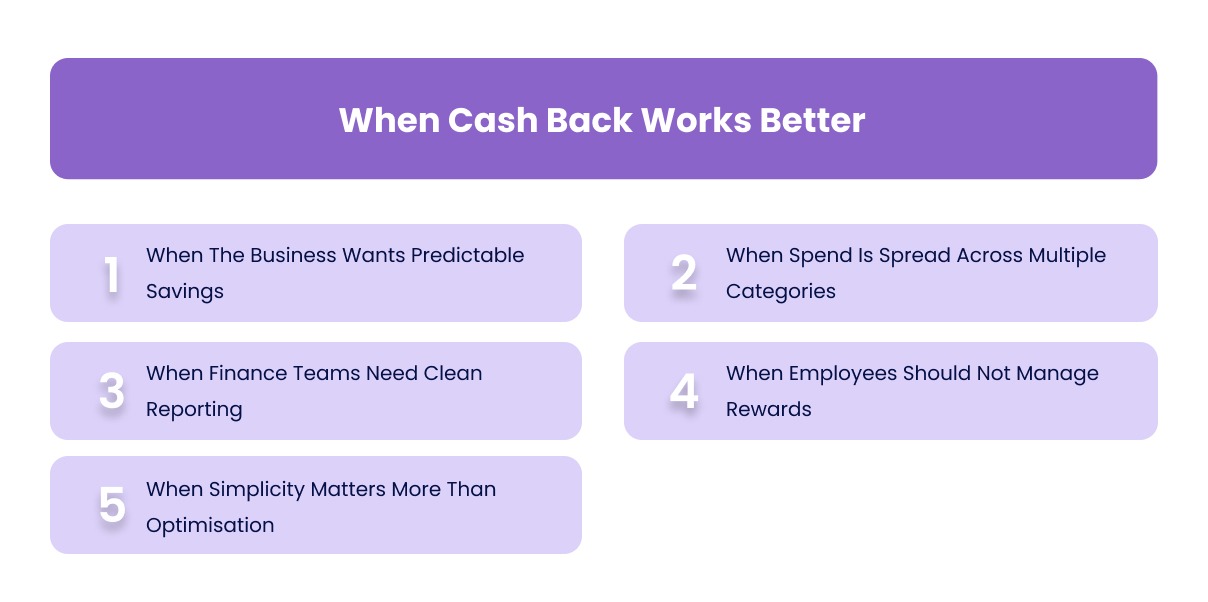
1. When The Business Wants Predictable Savings
Cash back provides a direct and measurable return on spend. Finance teams can calculate the benefit easily without relying on redemption scenarios or external programmes.
This makes it easier to factor rewards into budgets and overall cost management.
2. When Spend Is Spread Across Multiple Categories
Most businesses do not spend only on travel. Expenses typically include software, marketing, procurement, utilities, and operations. Cash back applies across these categories without requiring a specific redemption use case.
3. When Finance Teams Need Clean Reporting
Cash back integrates more naturally into financial reporting because it behaves like a reduction in cost or an additional financial benefit. There is no need to track points, conversions, or redemption value.
4. When Employees Should Not Manage Rewards
Miles often depend on individual redemption behaviour. Cash back removes this dependency by returning value directly to the business rather than to individual users.
5. When Simplicity Matters More Than Optimisation
For many businesses, the goal is not to maximise reward value at all costs, but to ensure that rewards are easy to use and do not introduce additional complexity.
Also Read: Corporate Card Benefits
Related: Track And Manage Business Expenses
When Miles Work Better
Miles can be useful in specific scenarios, particularly when travel is a significant and recurring part of business operations. However, their value depends on how effectively they are managed.
1. When Business Travel Is Frequent
Miles are most valuable when the business regularly incurs travel expenses. In such cases, accumulated miles can be redeemed for flights or upgrades that reduce travel costs.
2. When Redemption Is Actively Managed
To extract value from miles, someone must actively track and redeem them. This includes choosing optimal routes, dates, and redemption options.
Without this effort, miles may not deliver their full potential value.
3. When Travel Policies Are Clearly Defined
Businesses need clear policies on how miles are earned, who owns them, and how they can be used. Without this clarity, rewards may benefit individuals rather than the organisation.
4. When The Potential Value Justifies The Complexity
Miles can sometimes offer higher perceived value than cash back, but only if redemption is efficient. If the effort required outweighs the benefit, the advantage is lost.
Related: Corporate Travel Planning Tips
What Finance Teams Should Check Before Choosing A Reward Model
The decision between miles and cash back should be based on more than headline reward rates. Finance teams need to evaluate how each model performs in real business conditions.
1. What Is The Real Reward Value After Fees
Annual fees, minimum spend requirements, and hidden costs can reduce the effective value of rewards.
2. Are There Caps Or Excluded Categories
Some reward programmes limit how much can be earned or exclude certain types of spend, which affects overall benefit.
3. Who Owns The Reward
In a business environment, it is important to define whether rewards belong to the company or individual employees.
4. How Easy Is Redemption
Rewards should be easy to use. If redemption is complex or restricted, the actual value may be lower than expected.
5. Does The Card Support Spend Controls
Rewards should not come at the cost of losing visibility or control over spending. Approval workflows and spending limits remain critical.
6. Can Spend Be Tracked And Reconciled Easily
The reward model should not complicate reconciliation or financial reporting. Clean data and accurate records are more valuable than marginal reward gains.

Also Read:
Corporate Card Reconciliation Guide
Related:
Understanding Spend Visibility Business Benefits
Common Mistakes When Comparing Miles And Cash Back
Businesses often focus on perceived reward value without considering how that value is realised in practice. This leads to suboptimal decisions.
1. Comparing Rewards Without Considering Fees
Reward rates can be misleading if annual fees or minimum spend requirements are ignored.
2. Assuming Miles Always Have Higher Value
Miles can deliver higher value in specific cases, but this depends on how they are redeemed.
3. Ignoring Redemption Restrictions
Availability, blackout dates, and programme rules can limit how miles are used.
4. Letting Employees Capture Reward Value
Without clear policies, rewards may benefit individuals instead of the business.
5. Overlooking Spend Controls
Focusing on rewards without considering approval workflows and spend limits can create larger financial risks.
6. Prioritising Rewards Over Visibility
The ability to track and control spend is more important than maximising reward returns.
Why Cash Back Often Fits Business Spending Better
For most businesses, the value of a reward is not just how much it can be worth, but how easily that value can be realised and applied. This is where cash back tends to fit more naturally into business spending.
Cash back provides a direct financial benefit. It can be measured immediately, applied across different categories, and reflected clearly in reporting. There is no dependency on redemption strategy, availability, or individual behaviour. This makes it easier for finance teams to treat rewards as part of overall cost efficiency.
Miles, on the other hand, can offer higher upside in specific scenarios, but that value is conditional. It depends on travel frequency, redemption timing, and how well the rewards are managed. For businesses where travel is not a dominant expense, miles may accumulate without being fully utilised.
From a finance perspective, simplicity often outweighs theoretical optimisation. A predictable return that can be tracked and applied consistently is usually more valuable than a higher potential return that is difficult to realise.

How Alaan Helps Businesses Earn Rewards Without Losing Control
Rewards are only meaningful when they sit on top of a well-controlled spending environment. Without visibility and structure, even the best reward programme can lead to fragmented data and unclear financial outcomes.
At Alaan, the focus is on combining rewards with strong spend control so businesses can benefit from both.
- Corporate Cards With Cashback On Business Spend
Businesses can earn cashback on transactions while keeping reward value simple and directly usable. - Preloaded Spend Model For Better Control
Instead of relying on traditional credit, businesses can manage spending through controlled limits aligned with budgets. - Spend Limits And Merchant Controls
Finance teams can define where and how money is spent, reducing the risk of policy breaches. - Structured Approval Workflows Before Spend Happens
Expenses are reviewed before they occur, ensuring alignment with business priorities. - Real Time Visibility Across Teams And Categories
Spend can be tracked as it happens, making it easier to understand where money is going. - Receipt Capture And Automated Verification
Supporting documents are linked to transactions, improving accuracy and reducing manual work. - Seamless Accounting Integration
Integrations with systems like Xero, QuickBooks, NetSuite, and Microsoft Dynamics ensure clean and consistent financial records.
By combining cashback rewards with structured controls and visibility, Alaan helps businesses capture value from spend without adding complexity or losing financial clarity.
See how this compares directly against corporate card options more broadly.
Also Read: Best Corporate Cards UAE
Related: What Is Corporate Card Application
Conclusion
Miles and cash back are both designed to add value to spending, but they operate in very different ways. Miles can offer higher potential returns when travel is frequent and redemption is managed effectively. Cash back provides a simpler and more predictable benefit that is easier to measure and apply.
For businesses, the decision is less about maximising theoretical reward value and more about ensuring that rewards align with financial control, reporting clarity, and operational efficiency. In many cases, the ability to track, reconcile, and apply rewards consistently matters more than achieving the highest possible return.
If you want to improve how your business manages spending while still earning rewards, you can explore how Alaan helps finance teams maintain visibility, enforce controls, and capture cashback in a way that supports better financial outcomes. Book a demo to see how structured spend management can simplify both rewards and reporting.
Frequently Asked Questions
1. Why Do Businesses Usually Value Cash Back More Easily Than Miles
Cash back has a direct monetary value, which makes it easier to track, report, and apply against business spend. Miles depend on redemption rules, travel availability, route value, expiry terms, and how actively the business manages them.
2. Can Miles Earned On Company Spend Create Policy Issues
Yes. If the company does not define who owns the miles, employees may personally benefit from business spending. This can create ambiguity around reward ownership, travel policy, and how company-funded rewards should be used.
3. Are Miles Useful For Companies With Frequent Business Travel
They can be useful when travel is frequent, centralised, and actively managed. Miles work better when the business has clear travel policies and enough redemption volume to use them before expiry or programme changes reduce their value.
4. Do Cashback Rewards Affect Business Accounting
Cashback may need to be recorded according to the company’s accounting policy, often as a reduction in expense or other income depending on treatment. Finance teams should ensure cashback is visible, reconciled, and not left outside reporting.
5. Why Can Miles Be Harder To Compare Than Cash Back
Miles do not have one fixed value. Their worth depends on flight routes, class of travel, redemption timing, availability, fees, and airline programme rules. This makes headline earn rates difficult to compare with cash back percentages.
6. Should Rewards Decide Which Corporate Card A Business Chooses
No. Rewards should be secondary to spend controls, approval workflows, visibility, reconciliation, security, and policy fit. A higher reward rate is not valuable if it creates poor expense control or extra finance work.