.avif)


Top line revenue and bottom line profit answer different questions, so finance teams need to read them together to see whether growth is actually turning into profit.
- Top line revenue is the money a business earns from its core operations before any expenses are taken out.
- The bottom line is net profit, what remains once direct costs, operating expenses, interest, and tax have all worked through the income statement.
- Strong revenue growth does not automatically mean stronger profit, because costs can climb faster than sales and quietly eat into margins.
- Finance teams track the two separately since revenue shows commercial momentum while profit shows how much of that activity the business actually keeps.
- Alaan helps protect the gap between them with corporate card spend limits, approval workflows before spend happens, real-time visibility into spend, and accounting integrations for cleaner reconciliation.
Revenue can look strong on paper and still leave management with a weak profit outcome. That is the gap finance teams are trying to understand when they compare the top line with the bottom line. It is also why revenue on its own is never enough. NYU Stern’s January 2026 sector margin data shows just how wide the profitability gap can be: net margins range from -9.42% in consumer electronics to 28.89% for money-centre banks, even before you get into company-specific cost discipline.
That is what makes the distinction important. The top line shows how much income the business generated before expenses. The bottom line shows what remains after direct costs, operating expenses, interest, and tax have worked their way through the income statement. In practice, that means a company can report revenue growth while still losing ground on profitability if costs rise too quickly or margins weaken.
This article explains what top line revenue means, how it differs from the bottom line, where expenses sit between the two, and why finance teams need visibility across the full path from sales to profit.
TL;DR / Key Takeaways
- Top line revenue is the income a business generates from its core operations before expenses are deducted.
- Bottom line refers to net profit after major costs and expenses have been applied.
- Strong top-line growth does not automatically translate into stronger profitability.
- Finance teams track the top line and the bottom line separately because they answer different performance questions.
- The path between revenue and profit is shaped by cost control, approval discipline, and expense visibility.
- Alaan helps businesses protect that path with stronger spend visibility, approvals, and expense control.
Related: Analyze Business Expense Analysis
What Does Top Line Revenue Mean
Top line revenue is the revenue shown near the top of the income statement. It usually refers to the income a business generates from its normal operations before expenses are deducted, which is why it is commonly associated with gross sales or operating revenue depending on the reporting context.
It is called the top line simply because of where it appears on the income statement. From there, different categories of cost and expense are deducted as you move down the statement until you reach profit measures lower in the report, including the final net income figure.
- Why It Is Called The Top Line
Revenue appears at the top of the income statement, so “top line” became the standard shorthand for sales or revenue performance. When management talks about top-line growth, they usually mean revenue is increasing. - What Revenue Usually Includes
Revenue generally includes income from the company’s core business activities, such as selling products or delivering services. Depending on the reporting method, businesses may present gross revenue, net revenue, or break revenue out by category, product, or geography. - Why Top Line Revenue Matters
Top line revenue helps management assess whether the business is generating enough commercial activity. It is one of the clearest indicators of market demand, sales momentum, and business scale, even though it does not by itself show profitability.
Also Read: Understanding Financial Statements Beginners Guide
What Is The Bottom Line
The bottom line refers to net income or net profit. It is the amount left after the business deducts its costs and expenses from revenue, including operating expenses and, where relevant, interest and taxes. It sits at the bottom of the income statement, which is where the phrase comes from.
This is also where it helps to correct the phrase “bottom line expenses.” Bottom line is not an expense category. It is the final profit figure after expenses have already been deducted. So when people search for “bottom line expenses,” what they usually mean is the set of costs that reduce revenue on the way down to net profit.
- Why It Is Called The Bottom Line
Net income appears at or near the bottom of the income statement, so it became known as the bottom line. In management language, it usually means the final profitability result for the period. - What Gets Deducted Before You Reach It
The path from top line to bottom line usually includes direct costs, operating expenses, and other deductions such as interest and taxes. The exact presentation varies by business, but the principle stays the same: profit is what remains after those deductions. - Why Bottom Line Matters To Management
Bottom line matters because it shows whether the business is retaining enough value after its cost structure has been applied. A strong bottom line suggests that the company is not only generating revenue, but also converting enough of that revenue into profit.
Related: Types Of Expenses Business Expense Management
Top Line Revenue Vs Bottom Line
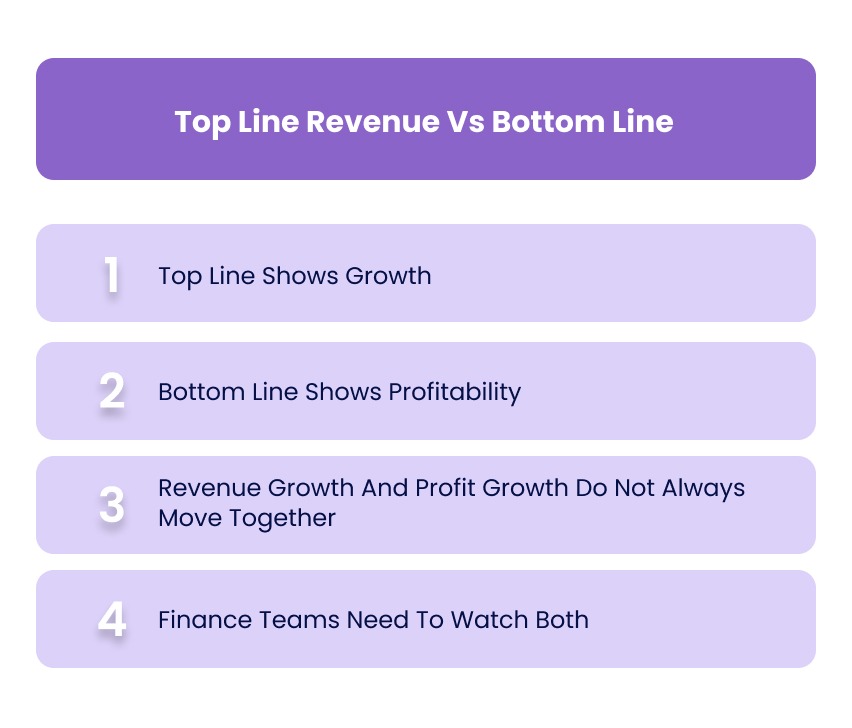
Top line revenue and bottom line profit are related, but they are not interchangeable. The top line shows how much money the business brings in. The bottom line shows how much of that money remains after the business has absorbed its cost base. That is why finance teams use them for different questions.
1. Top Line Shows Growth
Top line revenue is often used to assess commercial growth. If revenue is rising, it usually signals that the business is selling more, charging more, expanding into new markets, or improving customer demand in some way.
2. Bottom Line Shows Profitability
Bottom line shows whether that revenue is turning into actual profit after costs. A company can report impressive revenue growth and still produce weak profitability if expenses rise too quickly at the same time.
See how this same margin dynamic shows up in a profitability ratio investors track directly.
3. Revenue Growth And Profit Growth Do Not Always Move Together
The relationship between top line and bottom line is important precisely because they do not always move in the same direction. Revenue may increase while net income falls, or profit may improve because of cost cutting even when revenue stays flat.
4. Finance Teams Need To Watch Both
Management reporting is stronger when both views are read together. Revenue helps explain scale and commercial momentum, while bottom line helps explain whether the business is controlling costs well enough to convert that activity into profit.
Also Read: Difference Budgeting Financial Forecasting
Where Expenses Fit Between Top Line And Bottom Line
Expenses are what sit between top line revenue and bottom line profit on the income statement. The statement itself is designed to show how revenue is transformed into profit or loss over a period by subtracting different categories of cost and expense along the way.
- Direct Costs
These are the costs tied more directly to producing or delivering the product or service. They affect gross profit before the business even reaches operating expense analysis. - Operating Expenses
These include the costs of running the business, such as salaries, rent, software, marketing, and administrative spending. They are often the main reason strong top-line growth does not fully reach the bottom line. - Interest And Tax
After operating performance is measured, financing costs and taxes can further reduce what remains as net profit. That is part of why bottom line gives a fuller profitability view than revenue alone. - One Off Gains Or Losses Where Relevant
Some periods may also include unusual items that affect reported net profit. These do not always reflect core operating strength, which is why finance teams usually interpret bottom line in context rather than in isolation.
See exactly where this split happens on the actual statement, line by line.

Related: Direct Indirect Expenses Differences
Why Finance Teams Track Top Line And Bottom Line Separately
Finance teams track top line and bottom line separately because they answer different management questions. Revenue helps explain commercial momentum, while bottom line helps explain whether that momentum is turning into profit after the business has absorbed its cost base. Looking at only one of them can create a distorted picture of performance.
That distinction becomes more important as the business grows. Revenue can rise because of higher sales, pricing changes, or expansion, but profitability can still weaken if operating costs, fulfilment costs, or overhead increase faster than expected. Equally, profit can improve in the short term because of cost cuts even if revenue quality is not strengthening in a sustainable way.
- Revenue Growth Does Not Guarantee Margin Strength
A business may be selling more without protecting enough gross profit or operating margin. That is why top-line growth still needs cost context. - Cost Control Alone Does Not Guarantee Healthy Growth
A company can improve its bottom line through tighter cost discipline, but that does not automatically mean the revenue engine is getting stronger. - Pricing, Sales Mix, And Expense Discipline Need To Be Read Together
Finance teams usually need more than headline numbers. They need to understand which products, customers, or channels are driving growth and what those choices are doing to margins. - Management Reporting Needs Both Views
Stronger reporting usually shows both how much the business earned and how much it retained. That gives management a more balanced view of performance and decision quality.
Also Read: Create Effective Financial Plan
What Can Improve Top Line Revenue
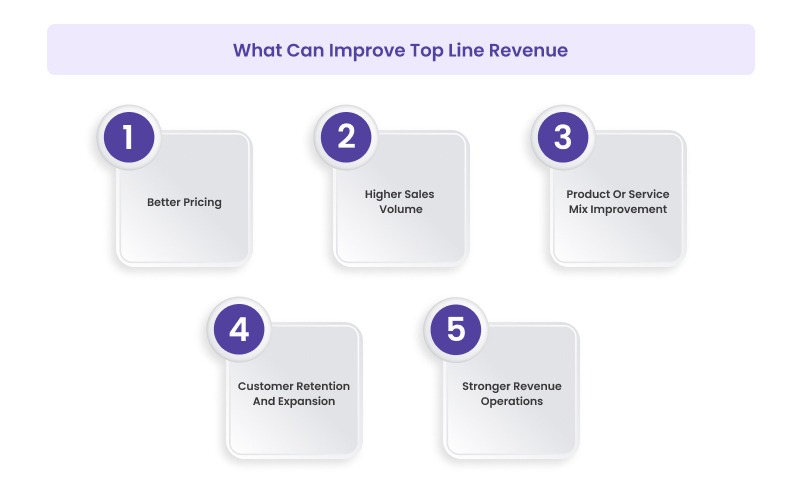
Improving top line revenue usually means improving how much the business earns from its core operations. That can come from better pricing, more volume, stronger retention, or a better product and customer mix. Revenue growth does not always need a dramatic strategic shift. In many cases, it comes from improving how the business converts demand into actual income.
1. Better Pricing
If a business has room to improve pricing without damaging demand materially, top line revenue can increase even when sales volume stays relatively stable. This is why pricing is often one of the most direct drivers of revenue growth.
2. Higher Sales Volume
Top line can also rise because the business sells more units, serves more customers, or expands its market reach. This is the route most people associate first with revenue growth.
3. Product Or Service Mix Improvement
Not all revenue is equally valuable. A better mix of higher-value products, services, or customers can strengthen top line performance while also supporting better profitability.
4. Customer Retention And Expansion
Revenue growth is often easier to support when existing customers stay longer, buy more, or expand their use of the product or service. That is why retention quality can matter as much as new customer acquisition.
5. Stronger Revenue Operations
Revenue improves more consistently when quoting, billing, collections, and sales data are better organised. Cleaner revenue operations help businesses convert commercial activity into reported income more reliably.
Related: Understanding Financial Statements Beginners Guide
What Can Improve The Bottom Line
Improving the bottom line is about increasing the amount of profit the business keeps after costs and expenses are deducted from revenue. That does not always require dramatic revenue growth. In many cases, bottom-line improvement comes from stronger cost control, cleaner workflows, and fewer leaks between spending and reporting.
The important distinction is that bottom-line improvement is not just about spending less everywhere. It is about spending with more control, reducing waste, and understanding which costs are actually helping the business grow versus which costs are quietly weakening profitability.
1. Lower Unnecessary Operating Costs
Businesses often improve bottom line by reducing costs that do not create enough value, such as duplicated tools, low-value subscriptions, uncontrolled discretionary spend, or avoidable administrative inefficiency.
2. Better Procurement And Spend Control
A stronger purchasing process can reduce cost leakage, improve vendor discipline, and prevent expenses from rising without visibility or justification. This is one of the clearest ways finance teams protect profitability without undermining operations.
3. Cleaner Approval Processes
When approval workflows are weak, the business often loses control of when money is spent, by whom, and for what reason. Better approval structure improves cost discipline before spend happens rather than after it needs explanation.
4. Fewer Expense Leaks
Expense leaks often come from small but repeated issues such as missing controls, duplicate purchases, poor policy adherence, or weak documentation. These do not always look dramatic individually, but together they can erode the bottom line steadily.
5. Better Margin Visibility
Bottom-line improvement is easier when the business understands which products, teams, or cost centres are creating margin pressure. Visibility makes it easier to act on weak profitability before it becomes embedded in the operating model.
Also Read: Understanding Cost Management Key Steps Benefits
What Management Should Look At Alongside Top Line And Bottom Line
The top line and bottom line are important, but on their own, they are still incomplete. Management usually needs a broader set of signals to understand whether revenue is healthy, profit is sustainable, and cost performance is improving for the right reasons.
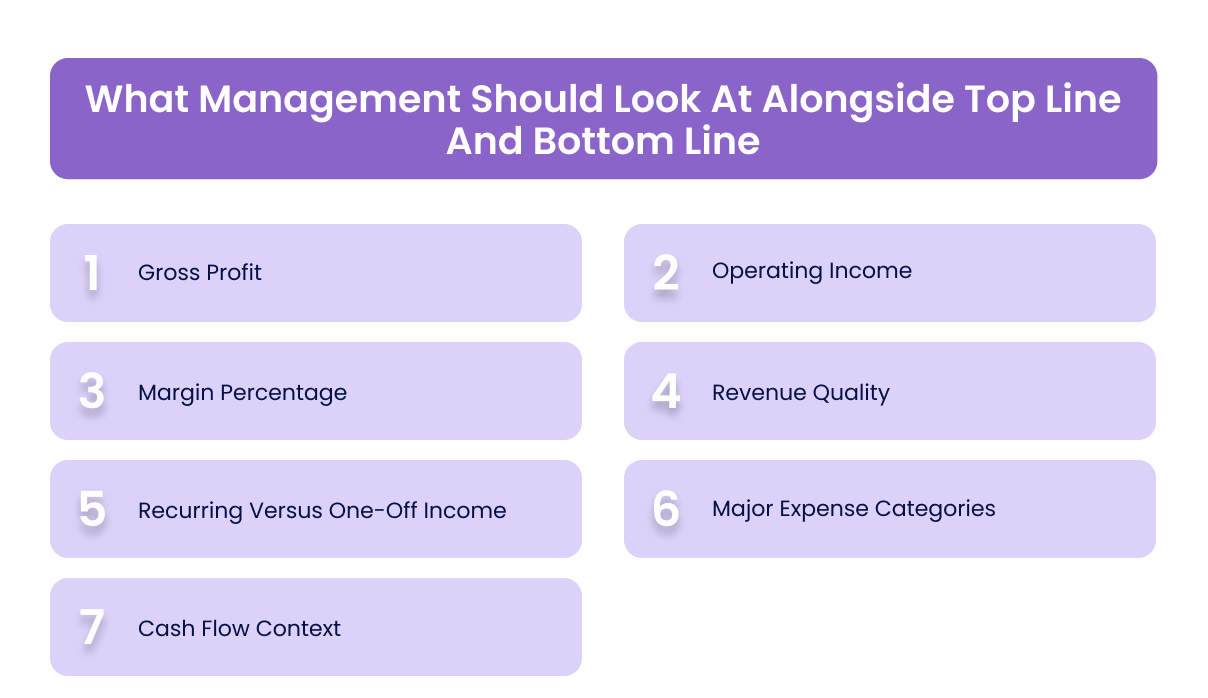
That is why reporting should not stop at two headline figures. It should also show what sits between them, how cash behaves around them, and whether the underlying quality of revenue and expenses is actually improving.
- Gross Profit
This helps management see how much revenue remains after direct costs and whether the business is preserving value before operating expenses are applied. - Operating Income
This gives a clearer view of profitability from normal operations before interest and tax effects are considered. - Margin Percentage
Revenue growth matters more when margins are healthy enough to convert that growth into usable profit. - Revenue Quality
Management should know whether growth is recurring, repeatable, and commercially strong rather than inflated by one-off activity. - Recurring Versus One-Off Income
This distinction matters because temporary revenue can make the top line look stronger than the long-term business model really is. - Major Expense Categories
Finance teams usually need visibility into where costs are rising and which categories are doing the most to pressure profitability. - Cash Flow Context
A business can report revenue and even profit while still facing cash pressure, which is why cash flow remains an essential part of the full picture.
Related: Cash Flow Operating Activities Guide
How Alaan Helps Businesses Protect The Path From Top Line To Bottom Line
Alaan fits into this conversation at the point where revenue starts being reduced by day-to-day spending decisions. It does not affect the top line directly. What it helps with is giving finance teams more control over the expenses that sit between revenue and net profit, so profitability is not weakened by poor visibility, weak approvals, or fragmented expense tracking.
- Corporate Cards With Spend Limits And Vendor Controls
Alaan lets businesses issue corporate cards with spending limits and vendor restrictions. That helps control operational spend before it turns into unnecessary cost leakage. - Approval Workflows Before Spend Happens
Alaan supports custom approval workflows, so purchases and expenses can be reviewed before money is committed. That improves cost discipline earlier in the process instead of relying on clean-up later. - Real-Time Visibility Into Business Spend
Finance teams can see spend live across employees, vendors, and categories, making it easier to understand where costs are building and which areas are creating pressure on profitability. - Receipt Capture And Supporting Documentation
Employees can upload receipts and invoices through the mobile app, Chrome extension, or email, so each transaction carries cleaner supporting records from the start. - AI Verification And Duplicate Detection
Alaan extracts receipt data, matches it to transactions, and flags inconsistencies or duplicates. That reduces manual checking and helps finance teams review expenses more efficiently. - Accounting Integration For Cleaner Reconciliation
Alaan integrates with Xero, QuickBooks, NetSuite, and Microsoft Dynamics, allowing expense data to sync in real time. That makes it easier to reconcile costs accurately and connect spending back to management reporting.

In practice, that gives businesses better control over the operating expenses that shape how much of the top line actually survives to the bottom line.
Conclusion
Defining top line revenue properly matters because revenue is only the beginning of the performance story. It shows how much money the business is bringing in, but it does not show how much of that value the business is actually keeping after costs and expenses are applied.
That is why top line and bottom line need to be read together. Revenue helps explain commercial momentum, while profit shows whether the business is converting that activity into real financial value with enough discipline.
Alaan helps businesses strengthen that link through corporate cards, spend limits, approval workflows, real-time visibility, cleaner documentation, and faster reconciliation. That gives finance teams better control over the cost side of the equation and makes it easier to protect profitability as revenue grows. Book a Demo Today!
Profit on paper still has to turn into cash in the bank, which is where the steps to manage cash flow come in. The cash flow stress test shows what happens to your runway if revenue dips, and an AI-native business account from Alaan keeps bills, cards and approvals in one place so costs don't quietly eat the margin.
FAQs
1. Is top line revenue always the same as sales?
Usually, but not always in how it is presented. In many businesses, top line refers to sales or operating revenue, but some financial statements may break revenue into categories or present net revenue after certain deductions.
2. Can a company improve its bottom line without growing revenue?
Yes. Profit can improve through better cost control, stronger pricing discipline, lower waste, or cleaner operating efficiency, even if revenue stays relatively flat.
3. Why do investors and management care so much about top-line growth?
Because top-line growth helps show demand, scale, and commercial momentum. But on its own, it is incomplete, which is why it still needs a margin and a cost context.
4. What is the biggest mistake people make when comparing top line and bottom line?
Treating them as if they should always move together. In practice, revenue can grow while profit weakens, and profit can improve while sales quality remains under pressure.
5. Does stronger top-line growth always make a business healthier?
No. If the business is buying that growth through weak pricing, heavy discounting, or rising operating costs, the top line may look stronger while the economics underneath get worse.
6. What should management review between top line and bottom line?
Usually gross profit, operating expenses, margin percentage, major cost categories, and cash flow context. Those measures help explain how revenue is turning into profit or where it is being lost.
Gain control over business expenses with Alaan corporate cards
Invygo earned AED 100,000 in cashback using Alaan cards
Personalise approval workflows to align with your business needs with Alaan's Spend Management platform
Discover the power of automated expense tracking and smarter spend control with Alaan
Turn data into actionable insights with Alaan's spend management tools
Stay Tax Compliant with UAE's #1 Corporate Card and Spend Management Platform
Customisable corporate card policy template
Know how much Corporate Tax you have to pay this fiscal year
Easily integrate Alaan with your ERP for accurate, real-time expense tracking
Close books faster with Alaan's AI-powered accounting automation
Reconcile your books in minutes instead of hours, every single month.
Keep petty cash organized with Alaan corporate cards and automated expense management