.avif)

E-payment systems capture each transaction, approval, and invoice at payment time, which keeps UAE VAT recovery and spend control accurate rather than retroactive.
- An e-payment system is more than a faster way to move money. It is the layer that captures each transaction, its approval, and its documentation at the moment of payment rather than weeks later at reconciliation.
- That timing is the whole point in the UAE, where 80% of payments are now digital and VAT recovery depends on having a valid tax invoice with TRN details recorded when the payment is booked, not after.
- The real advantage is control before spend: approval workflows and limits that block off-policy transactions upfront, instead of catching them during month-end cleanup.
- Alaan brings corporate and virtual cards, approvals, receipt capture, and cross-border payments through SuperPay into one workflow, and syncs to tools like NetSuite, QuickBooks, and Xero so records stay accurate and audit-ready.
Electronic payments may seem like a simple upgrade for finance operations, but the challenge grows when teams track spending, verify invoices, and enforce approvals. In the UAE, this pressure is rising as businesses handle more digital transactions across vendors, subscriptions, and operational expenses.
Recent research shows that 80 % of all payments in the UAE are made digitally, with mobile payments accounting for 21 % of all transactions and 68 % of consumers being largely non-cash users.
As a result, electronic payment systems are no longer optional. They provide visibility into spending, enforce policies consistently, improve reconciliation accuracy, and support audit readiness.
In this blog, you’ll explore the types of electronic payment methods used in UAE B2B operations and how e-payment systems improve financial visibility, control, compliance, and governance.
TL;DR Key Takeaways:
- Cost Timing Defines Financial Accuracy: E-payment systems ensure transactions, approvals, and documentation are captured at the point of execution, preventing reporting delays and margin distortion.
- Control Must Exist Before Payment Execution: Built-in approval workflows and spend restrictions prevent unauthorised transactions instead of relying on post-reconciliation corrections.
- VAT Compliance Depends on Data Capture Timing: Linking transactions with valid tax invoices and TRN details at the time of booking improves VAT recovery and reduces audit risk under FTA requirements.
- Fragmented Payment Channels Create Financial Risk: Consolidating cards, transfers, and vendor payments into a single workflow improves visibility, reduces duplication, and strengthens audit trails.
- Structured Workflows Reduce Operational and Compliance Risk: Platforms like Alaan ensure payments, approvals, and documentation are captured together, improving reporting accuracy and financial control across the organisation.
5 E-Payment Methods UAE Finance Teams Use to Control Cost Visibility & Financial Accuracy
Payment methods decide when costs show up in financial systems and whether teams record them in the right reporting period. In UAE businesses, delays in capturing invoices, getting approvals, and recording payments often distort margins and delay VAT recovery.
Because of this, finance teams choose payment methods based on how well they enforce control before spending and how accurately they capture costs in real time.
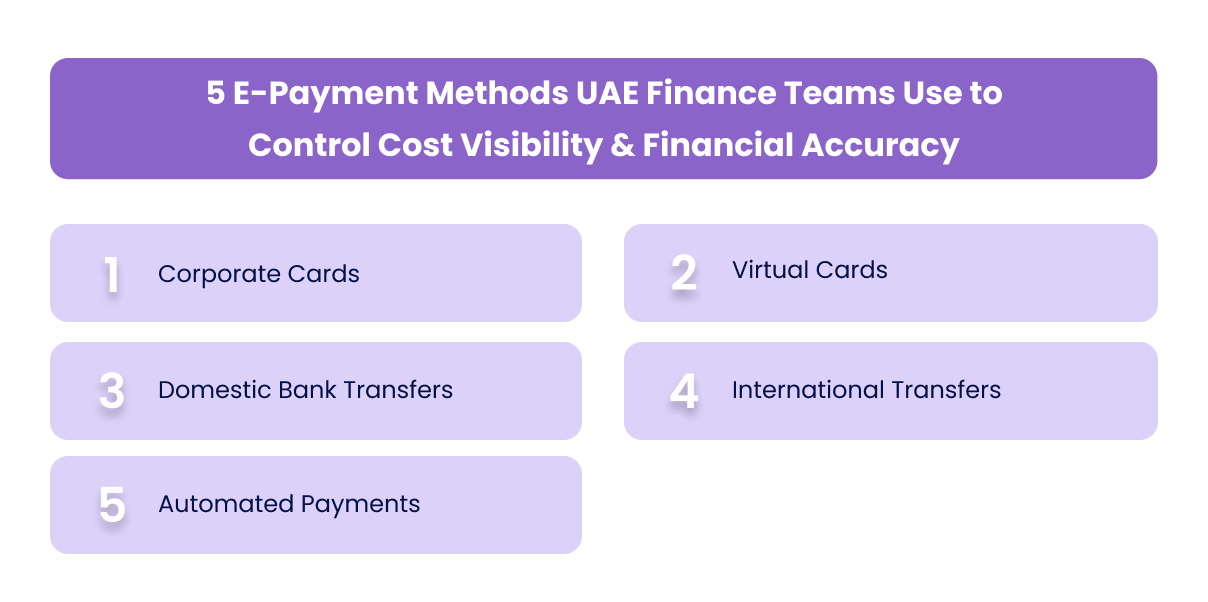
Below are the electronic payment methods used to control cost visibility and financial accuracy.
1. Corporate Cards: Ensuring Costs Are Captured Within the Reporting Cycle
Operational spend turns into a reporting problem when teams record costs after the transaction period. Late receipt submission and missing VAT-compliant invoices lead to overstated margins and delayed VAT claims. Finance teams focus on corporate cards workflows that capture transactions, documentation, and approvals at the point of spend.
Key control considerations:
- Teams record expenses at the time of the transaction, not after submission cycles
- VAT-compliant documents are captured at source in line with FTA requirements
- Approvals happen before spend, not during reconciliation
At Alaan, we record corporate card transactions, receipts, and approvals in real time before syncing them with accounting systems. This improves reporting accuracy and ensures VAT documentation is ready at the time of booking.

Suggested Read: What are corporate cards, and how do they work?
2. Virtual Cards: Enforcing Control Over Vendor-Level Spend
Recurring vendor costs often increase without clear ownership or regular review. When different teams subscribe on their own, overall visibility exists, but not at the individual vendor level. Finance teams use virtual cards to assign ownership and set limits at the source.
Key control considerations:
- Spend can be restricted to a specific vendor or contract
- Teams can track vendor-level costs across billing cycles
- Duplicate or overlapping subscriptions can be identified
This helps finance teams control vendor exposure, spot redundant tools, and align spend with procurement decisions.
3. Domestic Bank Transfers: Linking Invoice Validation to Cost Recognition
Supplier payments create reporting risks when invoice checks, approvals, and payments happen separately. When teams verify invoices after making payments, they record costs late and create uncertainty around VAT compliance. Finance teams therefore prioritise workflows where validation happens before payment.
Key control considerations:
- Supplier invoices are validated before payment is made
- There is a clear link between invoice, approval, and payment
- VAT requirements (TRN, tax invoice) are verified at the time of booking
4. International Transfers: Capturing the Full Cost of Cross-Border Payments
Cross-border payments bring in extra costs that teams often miss at the transaction stage. FX spreads and transfer fees usually appear later, which leads to understated procurement costs and distorted margins. Finance teams assess international payments based on cost visibility and timing.
Key control considerations:
- FX rates and transfer costs are visible at the transaction level
- Total cost can be linked to procurement or project budgets
- Settlement timing matches how costs are recorded in financial systems
Without this visibility, procurement costs remain incomplete, which affects pricing decisions and forecasting.
5. Automated Payments: Preventing Unreviewed Recurring Cost Build-Up
Automation reduces manual work but can remove important review checkpoints. Recurring payments often continue without reassessment, which leads to growing overhead costs and lower visibility into contract-level spend. Finance teams make sure automation still includes clear controls.
Key control considerations:
- Renewal approvals are triggered before payments go through
- Cost increases are flagged before recurring payments are processed
- Teams review recurring spend regularly against usage and budgets
This keeps recurring costs aligned with operational needs and financial targets.
Beyond understanding the types of digital payments, it’s important to see how these systems improve financial visibility, control, and governance.
How E-Payment Systems Strengthen Financial Visibility, Control, & Governance in UAE Finance Workflows?
E-payment systems improve financial control by making sure transactions, approvals, and supporting documents are captured within a single workflow at the time they happen.
In UAE businesses, this is especially important because VAT compliance depends on having valid tax invoices at the point of recording, and supplier payment cycles often extend beyond reporting periods.
By structuring how teams initiate, approve, and record payments, e-payment systems ensure cost data flows into financial systems in real time rather than being added later during reconciliation.
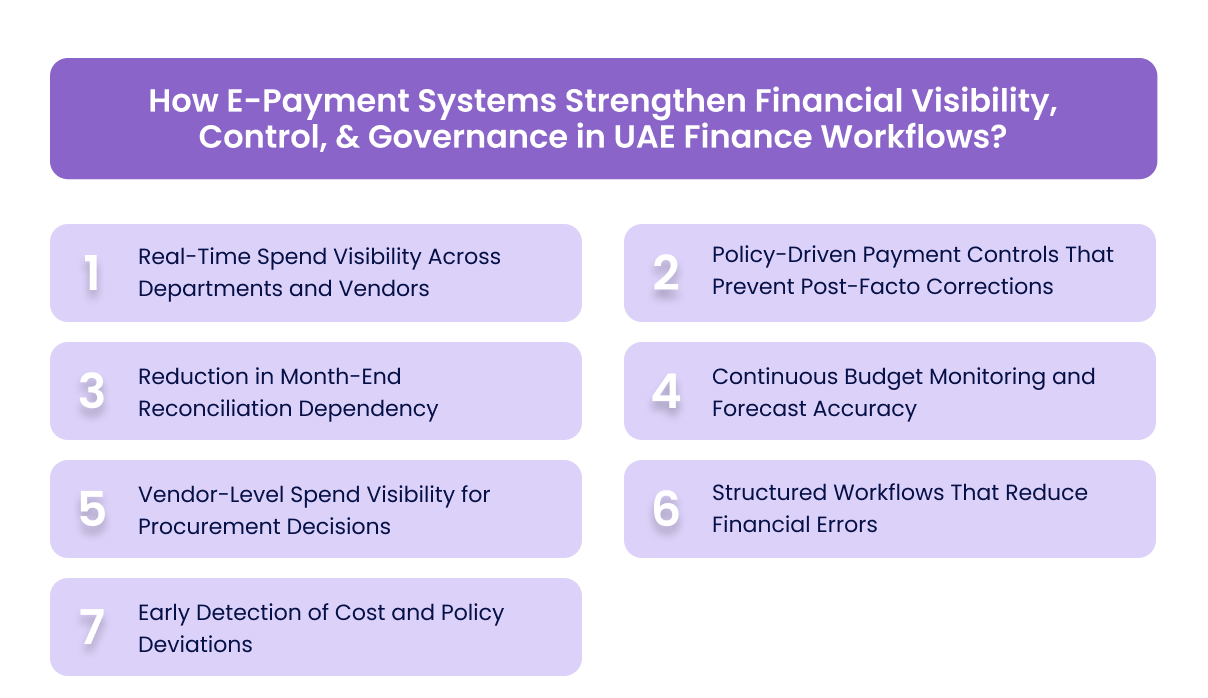
Here's how electronic payment systems support financial visibility, control, and governance:
1. Real-Time Spend Visibility Across Departments and Vendors
Finance teams lose control when they only see cost data after reconciliation cycles. In UAE businesses working with 30 to 90 day supplier terms, this delay means teams exceed budgets before they can take corrective action.
What improves when visibility shifts to the transaction stage:
- Teams track department-level spend before budgets are breached
- Vendor payments become visible alongside procurement commitments
- Teams spot cost spikes early enough to adjust pricing or spending
2. Policy-Driven Payment Controls That Prevent Post-Facto Corrections
Teams often enforce policies after transactions happen, which means they rely on manual fixes. This creates risk, as teams only identify unauthorised spend during reconciliation.
What changes when controls are built into the payment stage:
- Systems enforce spending limits before teams make commitments
- Approval workflows block off-policy transactions
- Budget controls apply at the transaction level, not after reporting
This shifts financial governance from after-the-fact checks to upfront control.
3. Reduction in Month-End Reconciliation Dependency
Month-end delays usually happen because invoices, payments, and documentation do not link properly. In UAE VAT workflows, teams often validate tax details only after recording expenses.
What improves when teams structure transactions at the source:
- Payments are recorded with supporting invoices at the time they are made
- VAT documentation is ready during booking, not after closing
- Accounting systems receive consistent and properly categorised data
This reduces the need for adjustments after the reporting period and improves accuracy.
4. Continuous Budget Monitoring and Forecast Accuracy
Forecast accuracy drops when cost data reflects past activity instead of what is happening now. In UAE businesses with changing procurement and logistics costs, delayed data leads to reactive planning.
What improves with continuous visibility:
- Budget tracking reflects real operational spend in real time
- Teams identify cost increases before they affect margins
- Forecast inputs match current transaction data
This allows finance teams to adjust budgets and pricing decisions earlier.
5. Vendor-Level Spend Visibility for Procurement Decisions
Procurement decisions weaken when vendor payments are spread across multiple channels. This makes it hard to see total supplier costs or spot pricing inefficiencies.
What improves with consolidated vendor data:
- Total spend per supplier is visible across all payment channels
- Teams track recurring vendor costs consistently
- Procurement teams renegotiate using accurate cost data
This strengthens supplier evaluation and contract decisions.
Also Read: Vendor Invoice Processing: Stages, Challenges & Automation
6. Structured Workflows That Reduce Financial Errors
Errors increase when teams rely heavily on manual payment processes. Duplicate payments, incorrect categorisation, and missing documents usually surface only after financial close.
What improves with structured workflows:
- Transactions follow clear approval paths
- Payment records stay consistent across systems
- Teams capture and validate supporting documents at the source
This reduces the need for fixes during reconciliation.
7. Early Detection of Cost and Policy Deviations
Delayed visibility makes it harder to spot financial issues early. In fast-moving UAE operations, this can allow cost overruns to go unnoticed for long periods.
What improves with continuous monitoring:
- Teams identify unexpected vendor charges early
- Systems detect duplicate or overlapping payments before they escalate
- Teams flag departmental spend that exceeds policy limits in real time
This strengthens both cost control and overall financial governance.
At Alaan, we bring corporate cards, approvals, and expense data into one unified workflow so finance teams can monitor spending as it happens. This gives you real-time visibility into operational payments while ensuring transactions follow internal policies.
The improved visibility and control provided by electronic payment systems also make it easier for organisations to stay VAT-compliant and audit-ready.
6 Ways E-Payment Systems Support VAT Compliance & Audit Readiness in the UAE
VAT compliance in the UAE depends on when and how teams capture transaction data, not just whether records exist. Under Federal Tax Authority requirements, businesses can only recover input VAT when they have valid tax invoices with complete TRN details at the time of recording.
In fragmented workflows, delays in capturing and validating invoices often lead to deferred claims, rejected input VAT, and higher audit scrutiny.
E-Payment systems support VAT compliance and audit readiness in the UAE in the following ways:
1. Capturing Transaction Data at the Point of Payment
VAT accuracy depends on recording transaction data at the moment a payment happens. When teams enter data later, differences in dates, vendors, and categorisation create gaps in reporting.
E-payment systems record transaction data at the point of execution.
This helps finance teams to:
- Match transaction dates with the correct VAT reporting period
- Capture vendor and payment details without manual input
- Keep expense categorisation consistent across records
As a result, teams avoid timing mismatches that can delay VAT recovery or force adjustments in later filing periods.
2. Linking Payments to VAT-Compliant Tax Invoices
VAT recovery depends directly on having valid tax invoices at the time of booking. Missing TRN details or incomplete invoices are some of the most common reasons for rejected claims in UAE audits.
E-payment systems connect transactions directly to supporting invoices.
This ensures that:
- Every payment is backed by a valid tax invoice before it is recorded
- TRN, invoice number, and VAT amount are available at the time of entry
- Documentation is attached before transactions move into accounting systems
3. Structuring Records for VAT Filing and Audit Access
The Federal Tax Authority requires businesses to maintain complete and accessible financial records. When documentation is disorganised, it slows down VAT return preparation and audit reviews.
E-payment systems store transaction data in structured, searchable formats.
This allows finance teams to:
- Access supporting documents instantly during VAT filing
- Maintain consistent records across reporting periods
- Respond to audit requests without rebuilding transaction history
This reduces audit friction and keeps compliance records easy to access.
4. Continuous Visibility Into VAT-Eligible Spend
Teams often identify VAT gaps late, during return preparation, when they can no longer fix missing documentation in the same cycle.
E-payment systems provide ongoing visibility into VAT-related transactions.
This helps finance teams to:
- Spot missing or invalid invoices before filing deadlines
- Fix discrepancies within the same reporting period
- Capture all eligible input VAT without missing anything
This improves both compliance accuracy and cash flow by avoiding delays in VAT recovery.
5. Creating Clear Audit Trails for FTA Reviews
During audits, the Federal Tax Authority expects clear proof of how transactions were recorded, approved, and supported. Weak audit trails increase the risk of adjustments and penalties.
E-payment systems create structured records for every transaction.
This ensures that:
- Each transaction links to its approval and supporting documents
- Authorisation history is clearly recorded
- Expense categorisation stays consistent across systems
This strengthens audit readiness and reduces the risk of compliance issues.
6. Reducing Risk From Incomplete or Invalid Documentation
Incomplete documentation at the time of reporting is a common cause of VAT errors in UAE businesses. This often leads to rejected claims and corrections in future filings.
E-payment systems bring payments and documentation into one workflow.
This allows finance teams to:
- Identify missing invoices at the time of the transaction
- Validate supplier details and TRN information early
- Keep payments aligned with supporting records
This reduces errors and ensures VAT reporting stays accurate from the start.
While electronic payment systems strengthen compliance and audit readiness, finance teams must also be aware of operational risks that come with these systems.
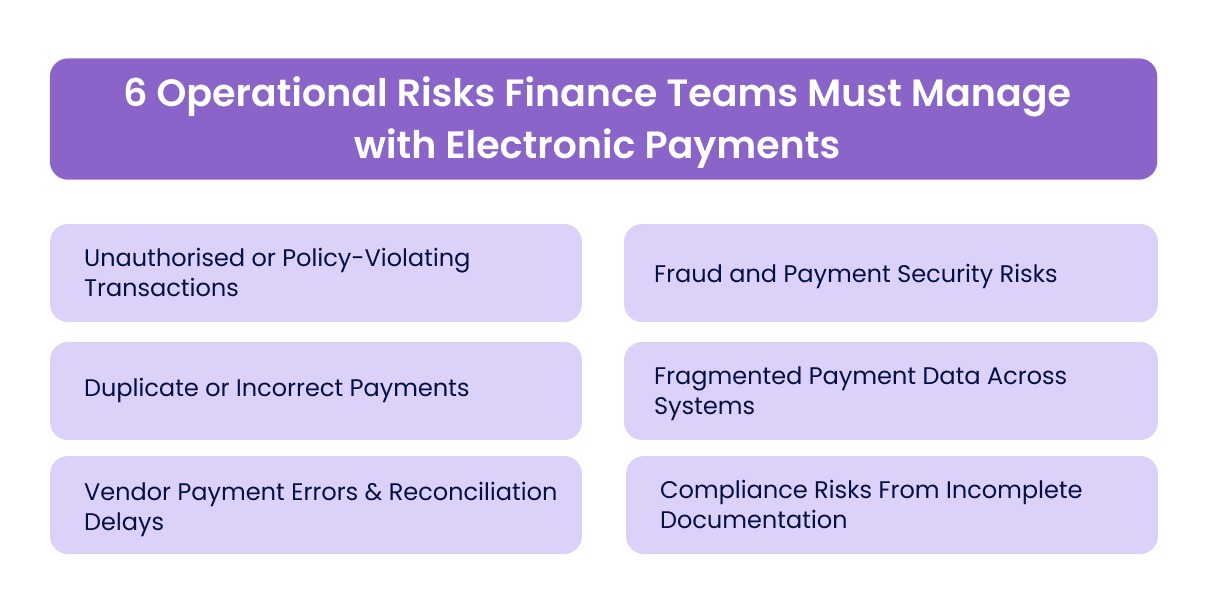
6 Operational Risks Finance Teams Must Control in E-Payment Workflows
Electronic payments make transactions faster, but they also bring financial risk forward in the process. In UAE finance operations, the real challenge is making sure teams apply controls, validation, and documentation before the transaction goes through.
When these controls are missing, teams only spot errors, compliance gaps, and financial leakage later during reconciliation or audit. Below are six operational risks finance teams must control in e-payment workflows.
1. Unauthorised or Policy-Violating Transactions
When teams give payment access without built-in controls, transactions can bypass approvals and budget limits. These issues rarely show up at the point of spend and usually come to light during reporting cycles.
E-payment systems enforce policies at the transaction level.
This helps finance teams to:
- Restrict transactions based on set vendor, category, or budget rules
- Trigger approvals before payments go through
- Assign expenses to the correct department at the source
This moves policy enforcement from after-the-fact checks to upfront control, reducing unauthorised spend before it affects budgets.
2. Fraud and Payment Security Risks
Payment fraud in digital systems usually comes from compromised credentials or changed vendor details. In UAE businesses that deal with a large number of suppliers, these risks increase when payment validation is not consistent.
E-payment systems add structured access and approval layers.
This helps finance teams to:
- Control system access based on roles and responsibilities
- Require multiple approvals for high-value or sensitive payments
- Validate vendor payment details within controlled workflows
This reduces the risk of fraudulent payments and ensures teams apply controls before releasing funds.
3. Duplicate or Incorrect Payments
Duplicate payments and incorrect settlements do not happen just because of high volume. They happen when teams handle invoice checks and payment execution separately.
E-payment systems standardise how invoices match with payments.
This helps finance teams to:
- Link every payment to a verified invoice before it is made
- Detect duplicate invoices using transaction data
- Validate payment amounts against approved records
This prevents financial leakage and reduces the need to recover funds after payment.
4. Fragmented Payment Data Across Systems
When teams process payments across different banking platforms, expense tools, and accounting systems, financial data becomes inconsistent. This fragmentation delays reporting and reduces visibility.
E-payment systems bring all transaction data into a single workflow.
This helps finance teams to:
- Keep records consistent across domestic and cross-border payments
- Capture FX-related costs within the same transaction layer
- Ensure all payment data flows directly into accounting systems
This improves reporting accuracy and reduces delays during financial close.
5. Vendor Payment Errors and Reconciliation Delays
Vendor payments often involve several teams, which creates gaps between invoice validation, approval, and payment. These gaps lead to delays in reconciliation and incomplete records.
E-payment systems bring vendor workflows together into one process.
This helps finance teams to:
- Validate invoices before making payments
- Complete approvals within structured workflows
- Link payments directly to supporting documents
This reduces reconciliation effort and keeps vendor balances accurate in financial records.
Must Read: Vendor Payments in the UAE: Methods, Tools, and Best Practices
6. Compliance Risks From Incomplete Documentation
In UAE VAT workflows, compliance risks increase when documentation is incomplete at the time of recording. Missing invoices or incorrect supplier details often lead to rejected VAT claims and audit adjustments.
E-payment systems integrate documentation capture into the payment process.
This helps finance teams to:
- Ensure every transaction has valid supporting documents
- Validate supplier details, including TRN, before recording
- Maintain complete records aligned with Federal Tax Authority requirements
This reduces compliance risk and avoids corrections in future VAT filing periods.
Finance teams need to consider these risks carefully when assessing which digital payment systems best suit their operations.
How Alaan Helps Finance Teams Strengthen Electronic Payment Control?
Many finance teams adopt electronic payments to move money faster. However, fragmented channels such as bank transfers, employee cards, and vendor invoices reduce visibility, complicate reconciliation, and make it harder to maintain audit-ready records.
At Alaan, we bring corporate cards, expense capture, approvals, and accounting integrations into one unified spend management platform. This gives you real-time visibility into operational payments, strengthens policy enforcement, and improves the accuracy of financial records.
What Alaan Covers Across the E-Payment Lifecycle
Effective electronic payment management depends on how transactions are captured, approved, and recorded across the organisation. At Alaan, we strengthen each stage of the payment lifecycle so you can maintain control while payments move quickly.
1. Corporate Cards With Built-In Spend Controls
At Alaan, we provide corporate cards with configurable limits and policy controls, so finance teams can manage spending before payments are made.
Admins can:
- Set spend limits by employee, team, or department
- Restrict merchant categories
- Issue virtual or physical cards instantly
- Freeze or block cards in real time.
This ensures operational payments stay within approved budgets while preventing unauthorised spending.
2. Automated Expense Capture and Receipt Verification
When payments are made with Alaan corporate cards, transactions are recorded instantly and linked to receipts on the platform.
This helps finance teams:
- Capture payment data in real time
- Match receipts with transactions automatically
- Maintain complete payment documentation.
By capturing expense data at the moment of payment, finance teams reduce reconciliation effort and improve the accuracy of financial records.
3. Policy-Driven Approval Workflows
Payments and expenses flow through structured approval workflows that adhere to company spending policies.
This ensures that:
- Payments align with departmental budgets
- Approvals occur before financial commitments are finalised
- Unusual transactions are reviewed early.
Structured approval workflows strengthen financial governance and reduce the risk of uncontrolled spending.
4. International Supplier Payments Through SuperPay
For UAE businesses working with overseas vendors, managing cross-border payments alongside domestic expenses is critical for financial visibility.
With SuperPay, finance teams can execute international supplier payments through the same structured workflows used for operational spending.
This helps teams:
- Review FX costs before approving payments
- Maintain approval controls for cross-border transfers
- Keep international payment records connected with invoices and documentation
By integrating international payments into the same workflow, finance teams avoid fragmented payment channels and maintain clearer oversight of vendor spending.

5. Integrated Payment and Accounting Workflows
At Alaan, we integrate with accounting systems such as:
- NetSuite
- QuickBooks
- Xero
- Microsoft Dynamics
- Zoho Books
- Odoo.
Approved transactions synchronise automatically with your accounting system, ensuring accurate categorisation, consistent financial records, and smoother reconciliation.
6. Real-Time Visibility Into Company Spending
We provide dashboards that show operational spending as transactions occur across the organisation.
Finance teams can monitor:
- Card transactions across teams
- Vendor payments
- Department-level spending
- Outstanding expenses await approval.
This real-time visibility allows finance leaders to identify spending trends early and maintain stronger control over operational budgets.
What Alaan Is (And Is Not)
Alaan is a spend management platform designed to strengthen financial control over operational payments.
It helps finance teams:
- Enforce spending policies
- Centralise payment data
- Maintain accurate financial records.
Alaan does not replace your accounting or ERP system. Instead, we integrate with your existing financial infrastructure to improve spend visibility, streamline approvals, and support reliable financial reporting.
Final Thoughts
Electronic payment systems do more than move money faster. They structure workflows so transactions, approvals, and documentation are captured before reporting, improving cost visibility, VAT compliance, and reducing post-period corrections.
As payment volumes grow across vendors, subscriptions, and cross-border transactions, finance teams need control at the point of execution. This ensures financial data reflects actual activity and supports audit and compliance requirements.
At Alaan, we bring corporate cards, approvals, expense capture, and supplier payments into a single workflow. This allows finance teams to maintain real-time visibility, enforce policy controls, and ensure every transaction is recorded with complete documentation.
Book a free demo to see how Alaan helps you strengthen financial control, improve VAT compliance, and manage company-wide spending with greater accuracy.
Paying overseas suppliers brings its own set of rules and fees, and our guide to cross-border payments from the UAE covers CBUAE requirements, FX costs and how to choose a provider. To see what a transfer would actually cost, the SuperPay FX calculator shows how much your recipient gets and what you'd save.
FAQs
1. Which types of businesses benefit most from electronic payment systems?
Technology companies, e-commerce businesses, logistics providers, real estate firms, and professional services organisations often use digital payments. These electronic payments help manage remote teams, supplier networks, and recurring subscription expenses.
2. How do electronic payment systems compare to traditional finance workflows?
Electronic payment systems centralise payments, approvals, and expense tracking, providing real-time visibility and simplifying reconciliation. Traditional workflows rely on fragmented tools, making tracking, reporting, and compliance harder.
3. Do electronic payment systems improve financial reporting accuracy?
Yes. Electronic payments record transactions instantly and attach supporting documentation to each payment. This allows finance teams to prepare more accurate reports and spend less time on manual reconciliation.
4. How do digital payment systems support better vendor management?
Digital payment systems bring all vendor transactions into one place. Finance teams can analyse supplier spending, track recurring payments, and spot high-cost vendors during procurement reviews.
5. Can electronic payment systems reduce reconciliation workload for finance teams?
Yes. Electronic payments automatically capture transaction details and link them with invoices and receipts. This reduces the time finance teams spend matching bank statements with expense records at month-end.
Gain control over business expenses with Alaan corporate cards
Invygo earned AED 100,000 in cashback using Alaan cards
Personalise approval workflows to align with your business needs with Alaan's Spend Management platform
Discover the power of automated expense tracking and smarter spend control with Alaan
Turn data into actionable insights with Alaan's spend management tools
Stay Tax Compliant with UAE's #1 Corporate Card and Spend Management Platform
Customisable corporate card policy template
Know how much Corporate Tax you have to pay this fiscal year
Easily integrate Alaan with your ERP for accurate, real-time expense tracking
Close books faster with Alaan's AI-powered accounting automation
Reconcile your books in minutes instead of hours, every single month.
Keep petty cash organized with Alaan corporate cards and automated expense management