.avif)


A guide to setting up mileage and vehicle reimbursements for UAE businesses, covering the process, documentation, and tax compliance.
- A company mileage allowance is a fixed payment per kilometre driven for business use, replacing ad hoc reimbursements with one consistent rate.
- The UAE has no government-set mileage rate, so each company decides its own based on budgets, fuel prices, and industry norms.
- VAT recovery and corporate tax deductions need valid receipts, supplier TRNs, and trip logs proving the travel was wholly for business under FTA and ZATCA rules.
- Alaan captures mileage automatically, matches receipts to corporate card transactions, checks each claim against policy, and syncs to tools like Xero and QuickBooks.
Every month, company and employee vehicles in the UAE clock up hundreds of kilometres meeting clients, inspecting sites, or managing deliveries. Each of those journeys carries a cost, yet many businesses still lack a structured way to record and reimburse them.
Mileage claims exist to bridge that gap. They capture the distance driven for official purposes and help organisations compensate employees fairly while maintaining visibility over travel-related expenses. When there’s no clear policy, reimbursement becomes inconsistent and reconciliation drags on, costing both time and accuracy.
In the UAE and wider MENA region, where employees frequently use personal vehicles for work, businesses must define their own standards for calculating and approving mileage claims. There’s no government-mandated rate, so companies rely on internal benchmarks shaped by their budgets, industry practices, and fuel trends.
Handled properly, mileage tracking transforms a routine administrative task into a source of financial insight, helping finance leaders analyse spending patterns, forecast costs, and ensure compliance with tax and audit requirements.
Key Takeaways
- Purpose of Mileage Claims: Mileage reimbursements compensate employees for business-related travel using personal or company vehicles, ensuring fairness and expense visibility.
- UAE Context: The UAE has no government-set mileage rate — companies define their own based on internal budgets, fuel prices, and industry norms.
- Building a Reliable Process: Clear policies, defined reimbursement rates, and structured documentation keep claims consistent, transparent, and audit-ready.
- Compliance Essentials: Valid receipts, supplier TRNs, and accurate business-use logs are required for VAT recovery and corporate tax compliance under FTA and ZATCA regulations.
- Automation Advantage: Platforms like Alaan automate mileage capture, policy enforcement, and VAT validation — helping finance teams eliminate manual errors, reduce processing time, and maintain full visibility over travel-related expenses.
What Is a Company Mileage Allowance?
A company mileage allowance is a fixed payment per kilometre travelled for business use. It replaces ad hoc reimbursements with a consistent, transparent approach that’s easy to manage across departments.
By establishing a set rate, organisations eliminate ambiguity and make budgeting more predictable. Employees are reimbursed based on verified distance rather than itemised bills, while finance teams can process claims faster with fewer disputes.
A well-structured allowance policy defines eligibility, claim submission timelines, and approval flows. It also distinguishes business travel from personal commutes, ensuring only genuine work-related mileage is reimbursed.
This clarity keeps records audit-ready and supports compliance with UAE corporate tax principles that recognise expenses “wholly and exclusively” for business purposes.
How to Build and Manage a Mileage Reimbursement Process
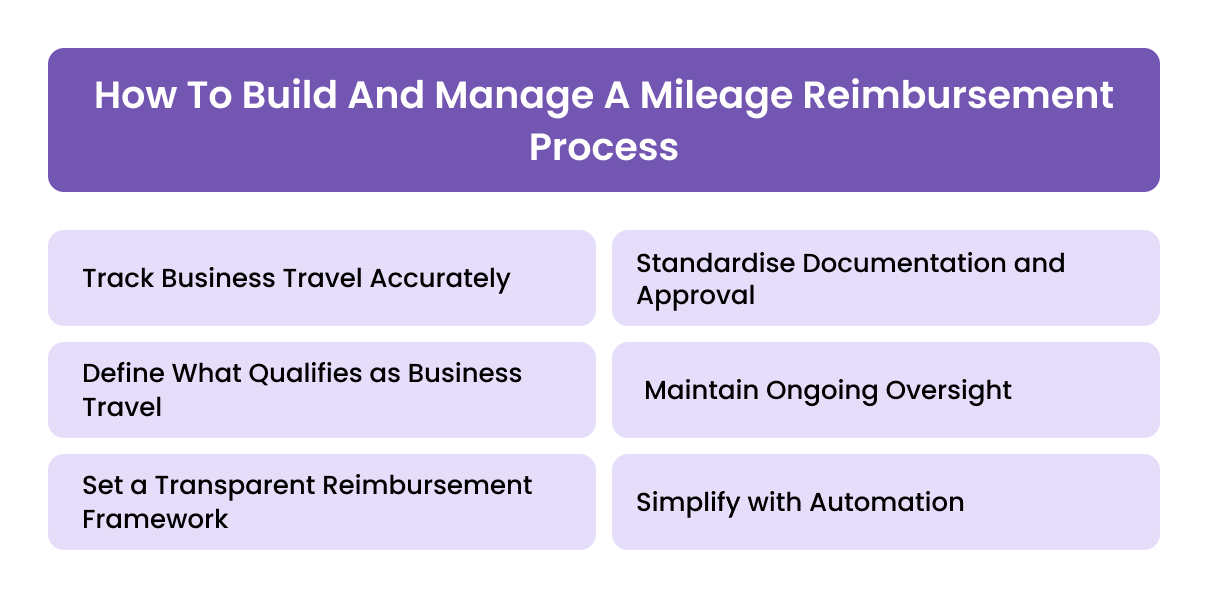
A reliable mileage reimbursement system runs on two essentials: a clear process and a well-defined policy. Together, they ensure that every kilometre claimed is verifiable, compliant, and easy to reconcile across departments.
1. Track Business Travel Accurately
Employees should record each trip made for official purposes using consistent methods such as GPS apps, digital mileage logs, or odometer readings. Each entry should include the date, route, business purpose, and total distance travelled.
This documentation forms the foundation of compliance and prevents disputes during audits or approvals.
2. Define What Qualifies as Business Travel
Your policy must specify which trips are claimable. Travel between office branches, client meetings, and vendor visits typically qualify, while daily commutes do not.
Clear definitions eliminate ambiguity and help managers verify that all claims align with genuine business needs.
3. Set a Transparent Reimbursement Framework
Establish a standard mileage rate or allowance for all eligible employees. Keep it consistent across departments to maintain fairness, and revisit the rate periodically to reflect changing fuel prices or company budgets.
Define payment timelines, for example, submitting claims within 15 days of travel and processing reimbursements in the following pay cycle.
4. Standardise Documentation and Approval
Consistency in recordkeeping reduces friction.
- Require supporting documents such as toll or parking receipts where relevant.
- Use standard claim templates or digital submission forms.
- Assign clear approval roles, such as line managers or finance controllers, with digital timestamps to maintain accountability.
5. Maintain Ongoing Oversight
Mileage claims should not be a “set and forget” process. Conduct regular audits to identify repeated errors, duplicate entries, or outdated rates. Periodic reviews ensure the system evolves with operational and regulatory needs.
6. Simplify with Automation
Manual tracking and paper-based approvals often lead to delays, lost receipts, and inconsistent records. A digital expense-management system removes those gaps by automating receipt collection, checking entries for duplication, and storing every reimbursement detail in one place.
Alaan is built to do exactly that. Tailored for businesses in the UAE and MENA region, it helps finance teams record mileage automatically, validate claims as they’re submitted, and keep every entry compliant with internal policy and regional tax standards.
With all data captured in real time, finance teams can review expenses as they happen, close reports faster, and rely on accurate, verified information when auditing or planning budgets.
[cta-9]
A structured process supported by automation transforms mileage reimbursement from a manual chore into a reliable financial control, one that maintains accuracy, consistency, and accountability across the organisation.
For employees using company or leased vehicles, mileage is tracked through a separate reimbursement process that records fuel, maintenance, and other operating costs.
How Vehicle Reimbursements Work for Company and Leased Cars
While mileage allowances work well for employees using their own vehicles, many organisations operate company cars or leased fleets for official travel. In such cases, costs are reimbursed through a structured business vehicle expense reimbursement policy that captures fuel, maintenance, insurance, and other operational spend.
The objective is consistency and audit readiness. Every expense from fuel top-ups to periodic servicing should be documented with receipts or digital records. Finance teams can then approve or reject claims based on internal policies and ensure that expenses align with business-use criteria.
Typical reimbursable costs include:
| Expense Type | Description | Supporting Document |
|---|---|---|
| Fuel | Petrol or diesel purchased for company vehicles used in business operations | Fuel receipt or e-invoice |
| Maintenance | Routine servicing, tyre replacement, and oil changes | Service invoice |
| Tolls & Parking | Charges incurred during business trips | Toll or parking ticket |
| Insurance | If not centrally billed, partial reimbursement for business use | Policy or invoice copy |
To maintain control, many finance teams link their reimbursement systems to corporate cards or expense-management platforms that automatically match receipts with transactions. This reduces manual oversight and ensures that every vehicle expense, regardless of driver or department, is traceable.
When managed systematically, vehicle reimbursements become a data asset that helps finance teams forecast costs, control spend, and maintain tax compliance.
Tax and Compliance Considerations in the UAE and MENA

Accurate mileage and vehicle reimbursements play a crucial role in ensuring financial compliance. Beyond fairness, they determine whether expenses can be claimed as tax-deductible or VAT-recoverable under local laws.
1. Corporate Tax Requirements
- The UAE’s Federal Tax Authority (FTA) recognises business expenses only when they are “wholly and exclusively” incurred for work purposes.
- Personal or mixed-use mileage cannot be deducted unless businesses can prove the exact business portion.
- Maintaining trip-level documentation (dates, routes, and purpose of travel) helps substantiate claims during tax reviews.
2. VAT Compliance
- Fuel and maintenance costs used purely for business can be eligible for input VAT recovery, provided valid tax invoices are available.
- To qualify, the invoice must show the supplier’s Tax Registration Number (TRN) and a clear business-use description.
- For vehicles used partly for personal and official purposes, businesses must calculate proportional VAT recovery to avoid overclaiming.
3. Record-Keeping and Audit Readiness
- The FTA and KSA’s ZATCA require companies to retain digital or physical proof of expenses for several years.
- Inconsistent or missing documentation can lead to rejected claims or delayed reimbursements.
- Digital audit trails from expense-management tools provide timestamped evidence, simplifying compliance reporting.
4. Role of Automation in Compliance
Automated systems can:
- Flag incomplete or duplicate claims before submission.
- Auto-capture TRN and VAT data from uploaded receipts.
- Generate FTA-compliant expense summaries for monthly or quarterly audits.
- This approach not only maintains cross-department consistency but also builds the financial discipline needed for sustainable growth.
By aligning mileage and vehicle reimbursements with regional tax laws and automating record management, businesses can replace reactive compliance with proactive financial control, ensuring every kilometre claimed stands up to audit scrutiny.
Yet, manual logs, paper receipts, and layered approvals, while compliant, rarely match the speed and accuracy modern finance teams need.
To gain full visibility and control over business travel costs, companies are now turning to automation led by platforms like Alaan, which simplify how mileage reimbursements are tracked, verified, and approved.
How Alaan Simplifies Mileage Reimbursements Through AI-Powered Expense Management
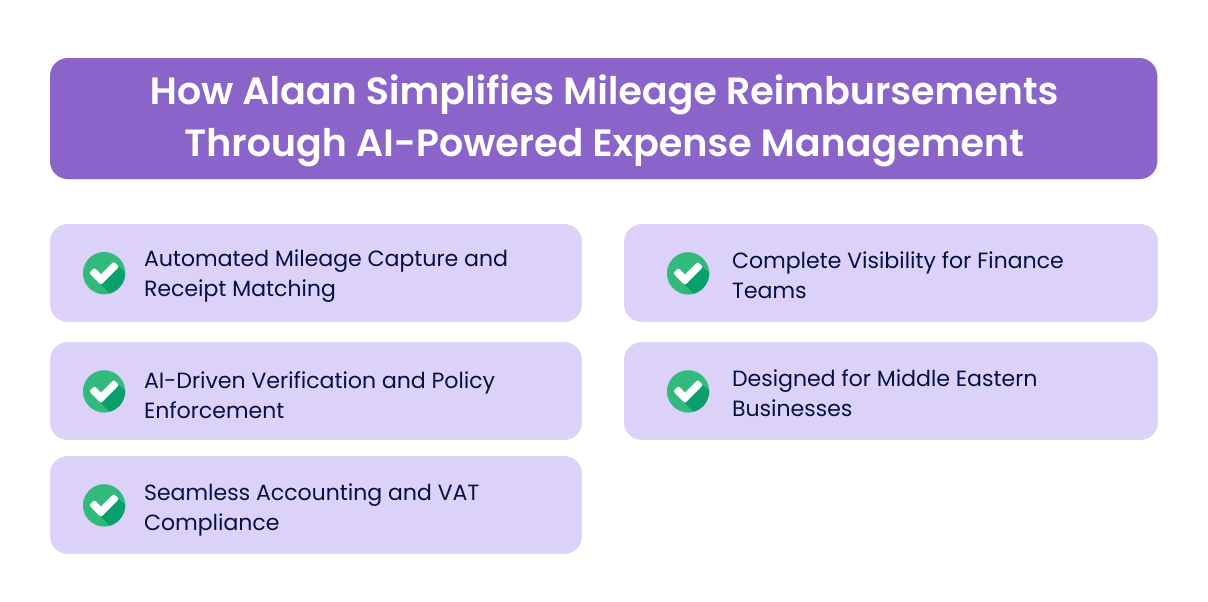
Most businesses still manage mileage reimbursements manually through spreadsheets, email approvals, or basic expense apps. These methods might work for small teams, but they quickly collapse under scale, resulting in missing receipts, duplicate entries, and time lost to manual verification.
Alaan eliminates those bottlenecks. As the Middle East’s leading AI-powered spend management platform, it brings together corporate cards, expense automation, and accounting integrations to simplify how companies record, approve, and reconcile every kilometre travelled for business.
1. Automated Mileage Capture and Receipt Matching
Employees can log trips directly through Alaan’s mobile or web app, attach receipts instantly, and have them automatically matched with transactions made using Alaan corporate cards.
This creates a single digital trail from payment to approval, eliminating paperwork and improving data accuracy.
2. AI-Driven Verification and Policy Enforcement
Alaan Intelligence cross-checks each receipt and mileage entry against company policy. It flags missing data, identifies duplicate submissions, and ensures every claim meets internal spending rules.
The result: faster approvals, fewer disputes, and compliance that scales automatically across teams and departments.
3. Seamless Accounting and VAT Compliance
Alaan integrates with leading accounting tools such as Xero, QuickBooks, NetSuite, and Microsoft Dynamics, syncing expense data in real time.
VAT details are auto-extracted from receipts, verified for supplier TRN, and stored for audits, aligning directly with UAE Federal Tax Authority (FTA) and KSA ZATCA requirements.
4. Complete Visibility for Finance Teams
Through centralised dashboards, finance leaders can view travel-related expenses by employee, team, or project.
They can analyse mileage trends, track reimbursement turnaround times, and make better decisions about budgets and travel policies, all without manual reconciliation.
5. Designed for Middle Eastern Businesses
Built for companies operating in the UAE and wider MENA region, Alaan adapts to local compliance frameworks and business realities.
Whether employees use personal cars or company fleets, every expense recorded in Alaan is tax-ready, policy-aligned, and easy to audit.
By automating every stage of the mileage reimbursement process, from trip recording to accounting integration, Alaan transforms reimbursement management from a manual task into a source of financial clarity and control.
Schedule a demo with Alaan to see how you can streamline your expense workflows.
Conclusion
Mileage reimbursements are more than a routine administrative process; they reflect how efficiently a business manages its operational costs. When handled through a clear framework and supported by automation, they become a source of measurable financial control.
For finance teams, the shift from manual tracking to intelligent systems marks a move towards precision and agility. Alaan enables this transformation by digitising every step from journey logging to approval and accounting sync, so reimbursements are faster, transparent, and always compliant.
Explore how Alaan streamlines mileage reimbursements.
Mileage claims usually end up in the same messy folder as petty cash, so our guide to petty cash for UAE businesses is the natural next read, with controls, reconciliation and when it makes sense to move to cards.
Frequently Asked Questions
1. Is there a standard mileage rate in the UAE?
No. The UAE does not prescribe an official mileage reimbursement rate. Each company sets its own based on internal budgets, fuel prices, and industry norms. Many businesses establish fixed per-kilometre allowances to maintain fairness and consistency across teams.
2. What qualifies as business mileage?
Business mileage includes travel made exclusively for work — such as client meetings, inter-branch visits, or project site inspections. Daily commutes between home and the office do not qualify unless explicitly authorised for business purposes.
3. Can companies in the UAE recover VAT on mileage or fuel expenses?
Yes, but only when the expenses are linked directly to business activities and supported by a valid tax invoice showing the supplier’s TRN. For vehicles used for both personal and business purposes, only the business-use portion of VAT can be claimed.
4. What documents are needed to support mileage claims?
Employees should provide digital logs or GPS-based records of distance travelled, along with supporting receipts for tolls, parking, or fuel where applicable. These documents help finance teams verify claims and maintain audit-ready records.
5. How does automation improve mileage reimbursement accuracy?
Automation eliminates manual errors by matching mileage entries with digital receipts, enforcing company policies, and syncing verified data with accounting software. Platforms like Alaan also capture VAT details automatically and generate compliant reports for audits.
Gain control over business expenses with Alaan corporate cards
Invygo earned AED 100,000 in cashback using Alaan cards
Personalise approval workflows to align with your business needs with Alaan's Spend Management platform
Discover the power of automated expense tracking and smarter spend control with Alaan
Turn data into actionable insights with Alaan's spend management tools
Stay Tax Compliant with UAE's #1 Corporate Card and Spend Management Platform
Customisable corporate card policy template
Know how much Corporate Tax you have to pay this fiscal year
Easily integrate Alaan with your ERP for accurate, real-time expense tracking
Close books faster with Alaan's AI-powered accounting automation
Reconcile your books in minutes instead of hours, every single month.
Keep petty cash organized with Alaan corporate cards and automated expense management