.avif)


How UAE finance teams build discounted cash flow models and why the underlying assumptions decide whether a valuation holds up.
- In a DCF model the assumptions carry the result, so finance teams stress-test growth, margins, capex, working capital, and the discount rate before trusting the valuation.
- Terminal value often accounts for 60 to 70% of a total DCF valuation, which puts most of the weight on long-term growth assumptions.
- Free cash flow is built from operating drivers like operating profit after tax, capex, depreciation, and working capital changes, not just revenue forecasts.
- UAE teams lean on DCF for big capital calls such as acquisitions, infrastructure and capacity expansion, technology investments, and GCC market entry, with H1 2025 alone drawing 613 greenfield FDI projects worth $5.42 billion.
- Alaan supports the inputs side with real-time visibility into operational spending, invoice capture, and accounting integrations, giving teams more reliable cost and working capital assumptions to feed the model.
Finance teams rarely question whether an investment looks promising. The real challenge comes when assumptions enter the model. Small changes in growth forecasts, operating costs, or discount rates can have a big impact on valuation results.
This is especially true in the UAE, where companies in logistics, real estate, and technology continue investing heavily in expansion and infrastructure. In the first half of 2025, the UAE attracted 613 greenfield FDI projects worth $5.42 billion (AED 19.90 billion), with Dubai accounting for $3.03 billion (AED 11.13 billion).
When capital deployment reaches this scale, investment decisions need structured valuation models. Discounted cash flow analysis helps finance teams estimate the present value of future cash flows and assess whether an investment is likely to generate real financial value.
In this article, you’ll explore how finance teams build DCF models, the assumptions that influence results, and how these models guide capital decisions in UAE businesses.
TL;DR Key Takeaways:
- Discounted Cash Flow Supports Major Capital Decisions: UAE finance teams rely on DCF models to evaluate acquisitions, infrastructure expansion, technology investments, and regional growth initiatives.
- DCF Models Depend on Operating Drivers: Free cash flow projections are built from operating profit, working capital changes, capital expenditure, and tax assumptions, not just revenue forecasts.
- Discount Rate Selection Shapes Valuation: Finance teams construct WACCs based on equity expectations, borrowing costs, capital structure, and sector-specific risk adjustments.
- Terminal Value Drives Most Valuations: Terminal value often represents 60–70% of total DCF valuation, making long-term growth assumptions critical.
- Reliable Financial Data Improves Forecast Accuracy: Platforms like Alaan help finance teams track operational spending in real time, improving the cost visibility and financial inputs used in DCF models.
How Finance Leaders Structure Discounted Cash Flow?
Across the UAE, DCF models guide evaluations of logistics, real estate, technology, and GCC market-entry projects. These capital-intensive investments demand close scrutiny of free cash flow, discount rates, and assumptions.
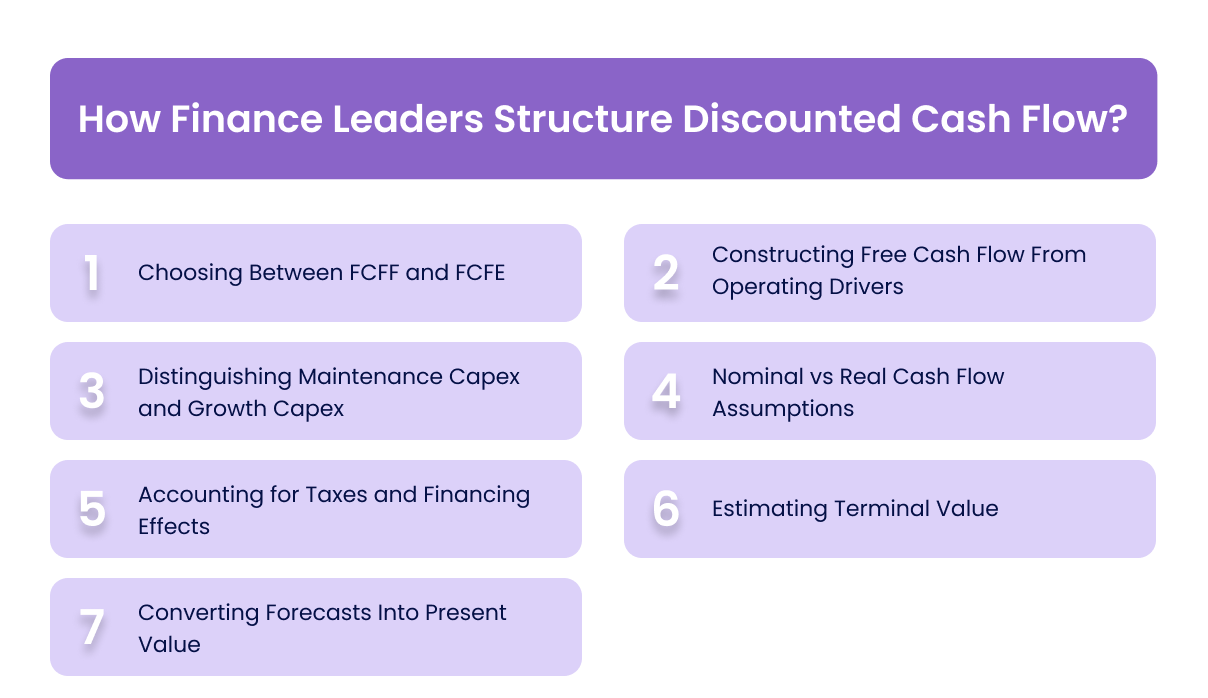
Investment committees focus on revenue growth, working capital, and terminal value, while finance teams run sensitivity analysis to see how small changes affect valuations.
Below are the core modelling decisions finance teams address when structuring a DCF model.
1. Choosing Between FCFF and FCFE
Finance teams start by deciding whether to model Free Cash Flow to the Firm (FCFF) or Free Cash Flow to Equity (FCFE).
- FCFF: It measures cash flows available to all capital providers and is commonly used to estimate enterprise value, especially for acquisitions, infrastructure projects, or strategic expansions.
- FCFE: It focuses on cash flows available to shareholders after debt obligations and is often used to assess equity returns or shareholder value creation.
In capital-intensive sectors like logistics infrastructure and real estate development in the UAE, finance teams often model FCFF first to understand enterprise value before factoring in financing decisions.
2. Constructing Free Cash Flow From Operating Drivers
DCF models are built from operating forecasts, not just revenue projections. Finance teams typically construct free cash flow using key financial components:
- Operating profit after tax
- Capital expenditure requirements
- Depreciation adjustments
- Changes in working capital
Working capital assumptions are especially important in industries with large receivables or inventory cycles. Logistics operators, retail distributors, and e-commerce businesses in the UAE often experience significant expansion of working capital during growth phases.
As a result, a project may look profitable on an accounting basis but generate lower free cash flow if receivables increase quickly or inventory requirements grow alongside revenue.
3. Distinguishing Maintenance Capex and Growth Capex
Capital expenditure assumptions are another area where judgement matters. Finance teams usually separate:
- Maintenance capex: Sustains current operations
- Growth capex: Supports expansion initiatives
Example:
In 2025, ADNOC Gas allocated $1.22 billion to growth projects and $217 million to sustaining assets and turnaround activities, showing how phased investments in infrastructure require careful planning to manage cash flow and financing.
This distinction is especially important for infrastructure and property development projects, where capital spending occurs in phases. Real estate and infrastructure projects in the UAE are often financed through project-based debt, meaning capex timing can significantly influence cash flow projections.
4. Nominal vs Real Cash Flow Assumptions
Another key decision is whether to forecast cash flows in nominal or real terms.
- Nominal models include expected inflation in revenue, operating costs, and capex.
- Real models exclude inflation and apply inflation-adjusted discount rates instead.
In sectors like construction, healthcare infrastructure, and logistics in the UAE, inflation assumptions can significantly affect long-term project valuations. Finance teams ensure discount rates and cash flow projections remain consistent within the chosen approach.
5. Accounting for Taxes and Financing Effects
Tax policy also affects free cash flow modelling. With the introduction of the UAE corporate tax, finance teams now include tax impacts when projecting operating profit and financing costs.
Interest payments may create tax shields that increase cash flow available to investors. When these effects aren’t modelled carefully, the estimated investment value can change significantly.
6. Estimating Terminal Value
Most investments generate value beyond the forecast period, so finance leaders calculate terminal value to capture the business value after the projection window.
Two common methods:
- Perpetual growth method: It assumes long-term cash flow growth at a stable rate
- Exit multiple method: It applies a valuation multiple based on comparable market transactions
Research shows that terminal value often accounts for 60–70% of total DCF valuation, so finance teams scrutinise long-term growth assumptions carefully.
7. Converting Forecasts Into Present Value
Once free cash flows and discount rates are defined, finance teams discount projected cash flows to estimate present value.
The standard formula is:
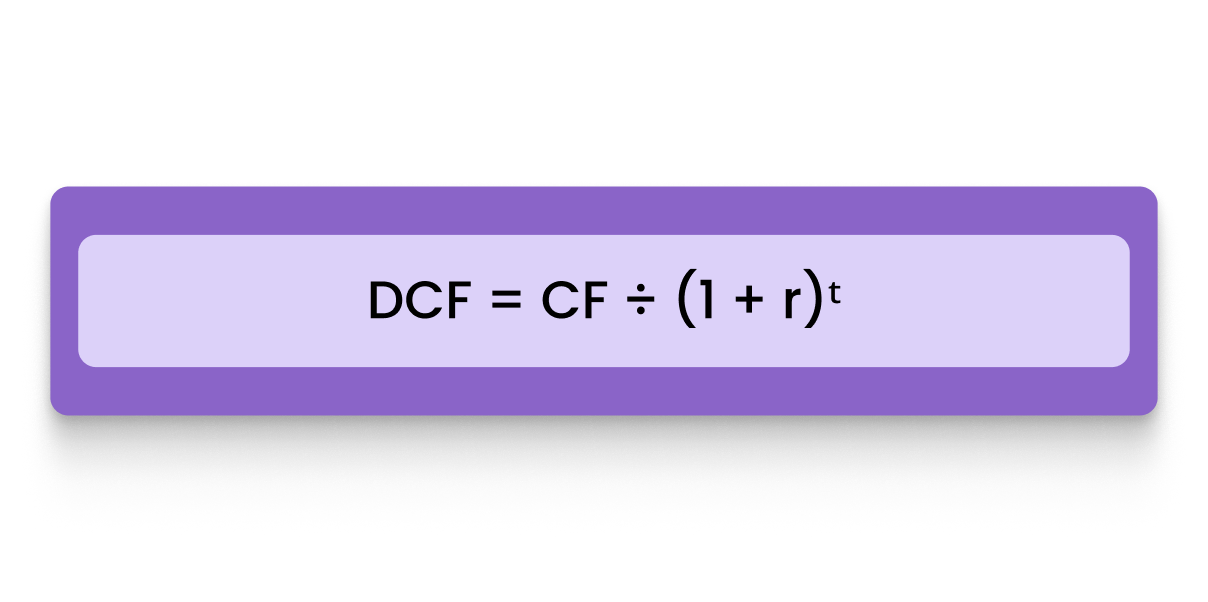
DCF = CF ÷ (1 + r)ᵗ
Where:
- CF is the projected cash flow
- r is the discount rate
- t is a time period
Each projected cash flow is discounted to today’s value, then combined with the discounted terminal value to estimate the overall investment or business value.
Why Reliable Cost Data Matters in DCF Models?
DCF outcomes are highly sensitive to operating assumptions. Even small inaccuracies in cost projections, working capital estimates, or operating expenses can materially affect valuations.
At Alaan, we help finance teams maintain real-time visibility into operational spending through corporate cards and automated expense tracking. Reliable cost data improves operating expense forecasts and working capital assumptions that feed directly into the free cash flow projections used in valuation models.

Once the DCF structure is in place, selecting the appropriate discount rate is a key step in achieving an accurate valuation.
How Do UAE Finance Teams Choose a Discount Rate in DCF Models?
Selecting the discount rate is often the most debated step in a DCF model. It captures both the true cost of capital and the project’s risk profile.
Even small changes can significantly alter valuation outcomes, which is why investment committees review the rate construction before approving major capital projects.
Most businesses calculate the discount rate using the Weighted Average Cost of Capital (WACC).
1. Building WACC in Practice
In theory, WACC combines the cost of equity and the cost of debt based on the company’s capital structure.
In practice, finance teams spend most of their time validating the assumptions behind these inputs, including:
- Risk-free rate benchmarks
- Equity return expectations
- Borrowing costs across financing structures
- Capital structure assumptions
For UAE companies with access to international capital markets, teams often benchmark the risk-free rate against US Treasury yields and adjust return expectations to account for regional market risk.
Another key decision is whether to use:
- Corporate WACC, reflecting the company’s overall cost of capital
- Project-specific discount rates, used for new infrastructure projects, real estate developments, or international expansion
Project-specific rates are common when a project's risk profile differs significantly from the company’s existing operations.
2. Estimating Equity Return Expectations
The cost of equity reflects the return investors expect for taking on business risk. Finance teams typically estimate this using the Capital Asset Pricing Model (CAPM).
The critical decisions lie in selecting inputs for the model. Teams evaluate factors such as:
- Whether beta should be adjusted for private or high-growth companies
- How to estimate the market risk premium
- Whether additional country risk should be incorporated for cross-border expansion
These adjustments are particularly relevant when UAE businesses evaluate investments in the GCC or emerging markets, where economic and regulatory conditions differ from those in the domestic market.
3. Evaluating Debt Costs in Regional Financing Structures
The cost of debt reflects interest paid on borrowed capital, but financing structures vary widely across UAE industries.
Typical patterns include:
- Real estate and infrastructure projects financed through project-based debt structures
- Logistics infrastructure investments funded through long-term financing tied to asset cash flows
- Technology companies are relying more heavily on equity funding during early growth phases
Because these structures differ, finance teams often adjust discount rates to reflect the expected funding mix over the investment’s life.
4. Accounting for Country and Market Risk
When evaluating regional expansion, finance teams often add country risk premiums to the discount rate.
Adjustments may consider factors such as:
- Regulatory stability
- Economic volatility
- Currency exposure
- Differences in market maturity
These ensure the valuation model reflects the true investment environment rather than assuming identical risk conditions across markets.
5. Applying Sector-Specific Risk Premiums
Industry dynamics also influence assumptions about the discount rate. For example:
- Infrastructure and real estate projects involve long investment horizons and higher leverage
- Logistics businesses require significant upfront capital but may generate stable long-term cash flows
- Technology companies face lower capital intensity but higher uncertainty in revenue growth
Finance teams adjust discount rates to reflect the capital needs and operational risks of each sector.
Selecting the right discount rate is just one part of the process; finance teams also need to verify the key assumptions that ensure the DCF model’s reliability.
Key Assumptions to Check in Discounted Cash Flow Models
Discounted cash flow models help finance teams assess major investments and capital allocation decisions. However, the accuracy of a DCF model depends heavily on the assumptions used to project future cash flows.
Experienced finance teams review these assumptions carefully before presenting valuation models for investment approval. Even small changes to margins, capital expenditure, or terminal growth rates can significantly affect valuation outcomes.
Below are the key assumptions finance leaders typically stress-test when building DCF models.
| DCF Assumption | What Finance Teams Check |
|---|---|
| Operating Margins | Historical margin trends, supplier costs, labour expenses, and potential efficiency improvements. |
| Capital Expenditure | Infrastructure investments, equipment replacement cycles, technology upgrades, and expansion spending. |
| Working Capital | Receivables cycles, inventory requirements, supplier payment terms, and procurement timing. |
| Terminal Value | Long-term growth assumptions and exit multiples benchmarked against industry valuations. |
Data accuracy also matters.
At Alaan, we help finance teams track operational spending and invoices in real time. This visibility improves understanding of payment cycles and working capital behaviour, supporting more reliable cash flow forecasts used in valuation models.

These assumptions form the foundation of the model and shape how finance leaders apply discounted cash flow in major capital decisions.
5 Ways to Use Discounted Cash Flow in Major Capital Decisions
Finance leaders across UAE businesses rely on discounted cash flow models when assessing large capital commitments. These models help investment committees decide whether projected returns justify the required capital and the risks involved.
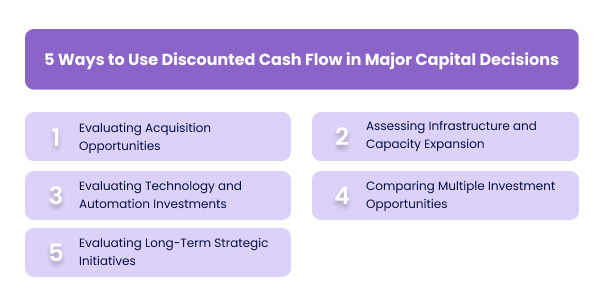
Here are common situations where DCF modelling supports capital allocation decisions.
1. Evaluating Acquisition Opportunities
Acquisitions require significant capital and long integration timelines. Finance teams use DCF models to assess whether the target company’s projected cash flows justify the acquisition price.
The models also test whether expected synergies realistically improve long-term returns.
Key assessment factors:
- Projected revenue growth after acquisition
- Operating margin improvements from integration
- Achievable cost synergies
- Long-term cash flow stability
Finance teams often present multiple DCF scenarios to investment committees before approving acquisition funding.
2. Assessing Infrastructure and Capacity Expansion
Large infrastructure projects need substantial upfront capital and long payback periods. In the UAE, this often includes logistics hubs, warehousing networks, industrial facilities, and real estate developments.
DCF modelling helps finance teams determine whether future operating cash flows justify these investments.
Key assessment factors:
- Projected revenue from expanded capacity
- Operating costs tied to new infrastructure
- Capital expenditure and maintenance requirements
- Expected payback timeline
Infrastructure projects frequently involve international suppliers, equipment imports, and cross-border service providers.
3. Evaluating Technology and Automation Investments
Technology investments often focus on improving efficiency rather than immediately increasing revenue. Finance teams use DCF models to estimate how operational savings translate into long-term financial value.
This helps leadership justify automation investments during capital allocation reviews.
Key assessment factors:
- Reduction in operational costs
- Productivity improvements from automation
- Implementation and maintenance expenses
- Long-term operational efficiency gains
4. Comparing Multiple Investment Opportunities
Finance leaders often evaluate several projects competing for limited capital. DCF models provide a consistent framework for comparing investments with different risk levels and time horizons.
By converting projected returns into present value, teams can prioritise projects that generate the strongest long-term outcomes.
Key assessment factors:
- Projected free cash flows for each project
- Capital required for each investment
- Risk-adjusted return expectations
- Strategic fit within the company’s capital allocation plan
Also Read: How IRR Guides Smart Investment Decisions in the UAE?
5. Evaluating Long-Term Strategic Expansion
Strategic initiatives like entering new GCC markets or launching new product lines often require sustained investment over several years.
DCF models help finance teams determine whether long-term revenue potential justifies the capital required for expansion.
Key assessment factors:
- Projected long-term revenue growth
- Operating costs tied to market expansion
- Capital investment needed to scale operations
- Timeline to reach positive financial returns
For UAE companies expanding regionally, DCF analysis helps leadership teams evaluate whether strategic growth initiatives can deliver sustainable financial value.
These capital decisions are typically guided by the financial outputs generated from the discounted cash flow model.
How Finance Teams Use DCF Outputs to Evaluate Net Present Value?
Once a discounted cash flow model is complete, finance teams convert projected free cash flows into Net Present Value (NPV). NPV shows whether an investment is expected to deliver returns above the company’s cost of capital.
Finance leaders use NPV during capital allocation reviews to decide whether a project should proceed, be revised, or be rejected.
Here’s how you can interpret DCF outputs when evaluating NPV:
| Decision Area | How NPV Is Used | Key Factors |
|---|---|---|
| Project Viability | Assess whether projected free cash flows justify the capital required. | Present value of cash flows, Initial investment, Revenue and cost sensitivity |
| Investment Approval | Compare NPV against internal approval thresholds before committing capital. | Minimum NPV threshold, Buffer above threshold, Downside scenarios |
| Project Comparison | Rank competing investments using risk-adjusted returns. | NPV across projects, Capital required, Return vs cost of capital |
| Sensitivity Testing | Test how changes in assumptions affect valuation outcomes. | Revenue growth, Operating margins, Capex, Discount rate |
Because DCF outputs are only as reliable as their inputs, the right platforms can help finance teams strengthen the accuracy and efficiency of their discounted cash flow analysis.
How Alaan Helps Finance Teams Strengthen Discounted Cash Flow Analysis?
Finance teams across UAE businesses rely on discounted cash flow models to evaluate acquisitions, expansion projects, and infrastructure investments. The accuracy of these models depends on reliable forecasts of operating costs, working capital movements, and the timing of future cash flows.
When expenses, invoices, and payments are spread across multiple systems, validating cost assumptions becomes challenging. This can weaken the financial projections used in valuation models.
At Alaan, we bring corporate cards, invoice capture, approvals, and accounting integrations together in a single spend management platform. This gives finance teams real-time visibility into operational spending and financial commitments, improving the accuracy of the cash flow assumptions used in DCF models.
What Alaan Strengthens in the Financial Modelling Workflow
Accurate discounted cash flow models rely on clear visibility into operational spending and financial commitments, making future cash flow forecasts more reliable. At Alaan, we strengthen each stage of the operational spend lifecycle so finance teams can base their financial models on accurate, real-time data.
1. Corporate Cards With Built-In Spend Controls
We provide corporate cards with configurable spend controls that allow finance teams to manage operational expenses before they occur.
Admins can:
- Set spend limits by employee, team, or department
- Restrict specific merchant categories
- Issue virtual or physical cards instantly
- Freeze or block cards in real time
This helps ensure operational spending stays within approved budgets and improves the reliability of expense forecasts used in financial modelling.
2. Centralised Invoice Capture and Early Validation
We centralise invoice collection through uploads, email forwarding, and integrated workflows. Invoice data, vendor details, and tax information are captured and validated early in the process.
This helps finance teams:
- Prevent duplicate payments
- Detect invoice errors before approvals
- Maintain accurate financial records
Early validation improves financial accuracy and ensures operational liabilities are captured before month-end reconciliation.
3. Integrated Payment Workflows With Full Visibility
Once expenses are approved, payments can be executed within controlled workflows, including domestic and supported international supplier payments through SuperPay.
This keeps approvals, payments, and financial records connected, improving transparency across financial transactions.
4. Automated Sync With Accounting and ERP Systems
We integrate with major ERP and accounting systems, including:
- NetSuite
- QuickBooks
- Xero
- Microsoft Dynamics
- Zoho Books
- Odoo
Approved transactions automatically sync with accounting systems, ensuring financial records remain accurate and up to date.
5. Real-Time Visibility Into Operational Commitments
We provide dashboards that show operational spending across the organisation.
Finance teams can track:
- Outstanding invoices
- Approved but unpaid expenses
- Corporate card transactions
- Department-level spending
This visibility helps finance leaders improve financial forecasting and maintain stronger oversight of company spending.
What Alaan Is (And Is Not)
Alaan is a spend management platform built to strengthen operational financial control.
It helps finance teams:
- Enforce spending policies
- Monitor operational commitments in real time
- Maintain accurate financial records
Alaan does not replace your ERP or accounting system. Instead, it integrates with your existing financial infrastructure to strengthen upstream spend controls and improve the reliability of financial data used in planning and valuation models.
Final Thoughts
Discounted cash flow helps finance teams determine whether major investments generate returns above the cost of capital. In the UAE, companies committing capital to infrastructure, logistics, and expansion projects rely on accurate assumptions and reliable financial forecasts.
When visibility improves, DCF models become more reliable, and investment decisions become more confident.
At Alaan, we help finance teams strengthen visibility by bringing corporate cards, expense management, and real-time spend insights into a single platform. This allows teams to track operational spending against budgets, improve the accuracy of financial reporting, and maintain stronger control over company-wide expenses.
Schedule a free demo to see how Alaan helps UAE businesses improve financial visibility and make more informed capital decisions.
A DCF model is only as good as the cash flow numbers you feed it, so it helps to get the basics right with the eight steps of cash flow management. If you'd rather see how your own runway holds up in a bad quarter, the free cash flow stress test runs six preset scenarios for you. And if spare cash sits idle between projects, Alaan's AI-native business account pays profit on parked funds while handling bills, cards and approvals.
FAQs
1. What are the types of discounted cash flow models in corporate finance?
Corporate finance teams typically rely on three main types of discounted cash flow models, depending on what they are valuing. The most commonly used are Free Cash Flow to Firm (FCFF), Free Cash Flow to Equity (FCFE), and the Dividend Discount Model (DDM).
2. How often should finance teams update a discounted cash flow model?
Finance teams usually update DCF models during major planning cycles, such as annual budgeting, capital allocation reviews, or when key business assumptions change. Regular updates ensure the valuation reflects current market conditions and the company’s operational performance.
3. What forecast period do finance teams typically use in DCF models?
Most finance teams use a five- to ten-year forecast period, depending on business stability and industry predictability. Companies in stable industries can use longer projections, while fast-changing sectors often stick to shorter timeframes.
4. How do finance teams validate assumptions used in a DCF model?
Finance leaders validate assumptions by looking at historical financial data, industry benchmarks, and internal operational forecasts. Many organisations also review these assumptions with department heads before finalising investment decisions.
5. When should finance teams avoid relying solely on discounted cash flow analysis?
DCF is less reliable when a business has unstable or unpredictable cash flows. In such cases, finance teams often combine DCF with market-based valuation methods or comparable company analysis to get a more balanced view.
Gain control over business expenses with Alaan corporate cards
Invygo earned AED 100,000 in cashback using Alaan cards
Personalise approval workflows to align with your business needs with Alaan's Spend Management platform
Discover the power of automated expense tracking and smarter spend control with Alaan
Turn data into actionable insights with Alaan's spend management tools
Stay Tax Compliant with UAE's #1 Corporate Card and Spend Management Platform
Customisable corporate card policy template
Know how much Corporate Tax you have to pay this fiscal year
Easily integrate Alaan with your ERP for accurate, real-time expense tracking
Close books faster with Alaan's AI-powered accounting automation
Reconcile your books in minutes instead of hours, every single month.
Keep petty cash organized with Alaan corporate cards and automated expense management