.avif)


A practical guide to what year to date (YTD) means, how to calculate it as a total or a growth rate, and how UAE finance teams use it for budgeting and performance tracking.
- The catch with YTD is that people use it loosely, sometimes meaning a running total like YTD revenue and sometimes a percentage change like a YTD return, so it is easy to compare the wrong numbers.
- YTD stands for year to date and can start on 1 January or on the first day of a company's fiscal year, which means two businesses reporting YTD revenue may be covering different date ranges.
- A YTD figure only tells a useful story when it is set against prior-year YTD or budget YTD at the same cut-off, rather than against a full-year total.
- Good YTD reporting rests on clean, well categorised spend data, and Alaan supports that with real-time visibility into company spend, spend limits and vendor controls, approval workflows, and accounting syncs that make period reviews faster.
For most finance teams, YTD is one of the quickest ways to answer a practical question: where do we stand so far this year? It provides a running view of performance long before the year-end close, which is why it appears across management dashboards, sales reports, payroll summaries, and investment updates.
YTD works because it turns annual targets into a live performance lens. Instead of waiting for final accounts in December, finance teams can track cumulative progress throughout the year and see whether revenue, spending, margins, or portfolio performance are moving in the expected direction.
However, the term is often used loosely. In some reports, YTD refers to a running total, such as YTD revenue or YTD payroll. In others, it refers to a percentage change, such as a YTD investment return. Without understanding that distinction, teams can easily compare the wrong numbers or interpret performance incorrectly.
This guide explains what YTD means, how to calculate it correctly, and how UAE businesses use YTD reporting for budgeting, performance monitoring, and financial control.
TL;DR (Key Takeaways)
- YTD measures cumulative performance from the start of a year to the current reporting date, helping teams track progress before the year closes.
- It can represent either totals or growth rates, so the context of the metric matters when interpreting YTD numbers.
- Finance teams rely on YTD reporting for budget tracking, variance analysis, and performance pacing against annual targets.
- Comparisons are most meaningful when YTD is evaluated against prior-year YTD or budgeted YTD, rather than full-year figures.
- Better YTD reporting depends on clean spend data, timely categorisation, and stronger budget controls. Alaan helps finance teams track company spend in real time, enforce approvals, and keep records synced for faster review.
What YTD Means
YTD is a simple term, but it is often used in two slightly different ways. Sometimes it means a running total, such as YTD revenue or YTD payroll. In other cases, it means a rate of change, such as YTD return on an investment. Getting that distinction right matters because the number means something very different depending on the metric.
YTD Full Form And Definition
YTD stands for Year To Date. It refers to the period from the start of a year up to a specified reporting date within that same year. In finance, it is commonly used to track the cumulative performance of revenue, expenses, earnings, payroll, and investment returns before the year is over.
If no one specifies otherwise, YTD usually means the period starting on 1 January of the current calendar year. But that assumption only holds if the business or report is using the calendar year rather than a different fiscal year.
Calendar Year And Fiscal Year YTD
YTD can refer to either the calendar year or the fiscal year.
- Calendar Year YTD runs from 1 January to the reporting date.
- Fiscal Year YTD runs from the first day of the company’s financial year to the reporting date.
That distinction matters because two businesses can both report “YTD revenue” and still be talking about different date ranges if their fiscal years start on different dates. This is one of the easiest ways to make bad comparisons look reasonable.
YTD Totals And YTD Growth
Finance teams usually use YTD in one of two formats:
- YTD Total: A cumulative number such as total revenue, total operating expenses, or total gross pay from the start of the year to date.
- YTD Growth Or Return: A percentage change between the value at the start of the year and the current value. This is common in investing and performance tracking.
A YTD sales figure and a YTD sales growth figure are both valid, but they answer different questions. One tells you how much has happened. The other tells you how far performance has moved since the year began.
Also Read: Difference between Budgeting and Financial Forecasting
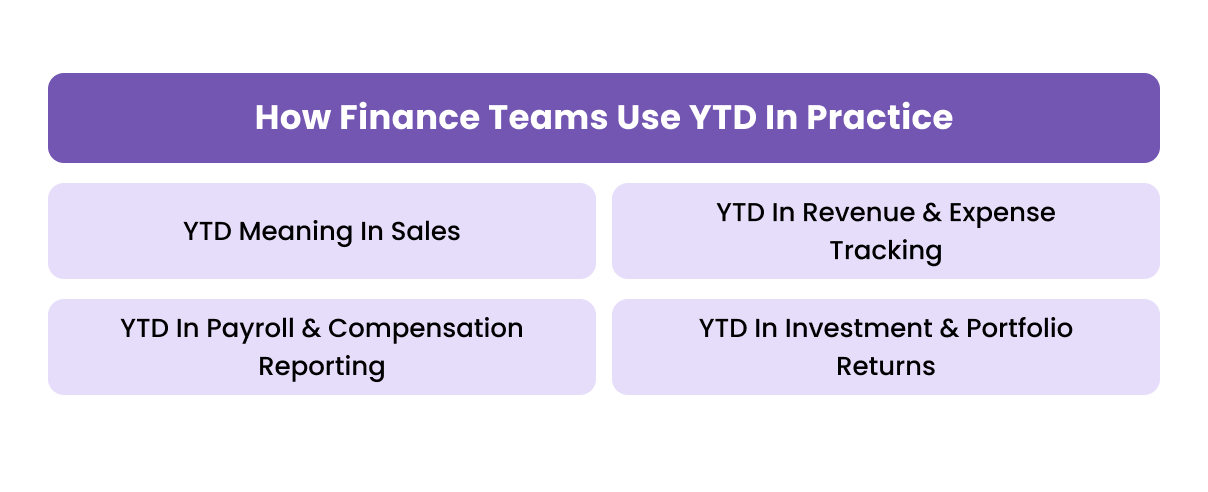
How Finance Teams Use YTD In Practice
YTD is not a theoretical metric. It is part of everyday management reporting. The reason it shows up so often is simple: it helps teams compare current performance against budget, prior-year pace, and internal targets without waiting for the full year to close.
1. YTD Meaning In Sales
In sales reporting, YTD is often used to track:
- Revenue booked so far this year
- Collections received so far this year
- Pipeline conversion against annual targets
- Performance against last year’s YTD at the same point in the year
This matters because a monthly sales number on its own can be noisy. YTD sales gives management a broader view of whether the business is genuinely ahead, flat, or behind relative to plan.
2. YTD In Revenue And Expense Tracking
For finance teams, YTD reporting is useful because it adds context to individual months. A business might have one unusually strong or weak month, but the YTD view shows whether the overall year is still on track.
That makes YTD useful for:
- Budget monitoring
- Forecast updates
- Spend discipline
- Profitability tracking
- Variance analysis against annual targets
This is where YTD becomes more than a label. It becomes a control tool.
3. YTD In Payroll And Compensation Reporting
On payslips, YTD usually appears as a running total of earnings and deductions to date. It helps employees and employers see how much gross pay, net pay, and other deductions have accumulated since the start of the year.
For UAE businesses, this is still useful, but it should be framed correctly. The UAE does not currently impose personal income tax on individuals, so YTD payroll in the UAE is more about earnings visibility, deductions, benefits, and employer reporting discipline than personal income tax planning.
4. YTD In Investment And Portfolio Returns
In investing, YTD is commonly used to measure the gain or loss on a portfolio, fund, or individual security since the first day of the year. It is a practical way to compare current-year performance against benchmarks and expectations without waiting for the full year result.
This is why you often see YTD returns alongside market indices, mutual funds, or portfolio summaries. It is a quick performance lens, not a complete investment verdict.
Also Read: Cash Flow Forecasting: Best Practices and Key Methods
How To Calculate YTD Correctly
YTD is easy to misuse because people often mix up cumulative totals and percentage changes. The cleanest way to avoid confusion is to decide first what you are measuring: a running amount, or a return/growth rate.
Calculating A YTD Total
For a cumulative metric such as sales, payroll, or expenses, YTD is simply the total from the start of the year to the latest reporting date.
For example:
- YTD sales = all sales from the year start to the reporting cut-off
- YTD payroll = all payroll amounts recorded from the year start to the reporting cut-off
- YTD expenses = all recognised expenses from the year start to the reporting cut-off
This is the version of YTD most finance teams use in internal reporting.
Example: If a company records AED 120,000 in January sales, AED 150,000 in February, and AED 130,000 in March, its YTD sales at the end of March are AED 400,000.
Calculating A YTD Percentage Change
When YTD is used as a growth measure, the calculation depends on what you are comparing. For point-in-time values, the standard calculation is:
YTD Change = (Current Value − Starting Value) ÷ Starting Value
If you want the answer as a percentage, multiply the result by 100. This is the common approach for revenue growth, earnings growth, or changes in portfolio value.
Example: If a portfolio value was AED 500,000 at the start of the year and AED 575,000 at the current reporting date, the YTD change is (575,000 − 500,000) ÷ 500,000 = 15%.
For cumulative business metrics such as revenue or expenses, a more useful comparison is often against prior-year YTD or budget YTD at the same reporting date.
A common formula for YTD growth in revenue reporting is:
YTD Growth = (Current YTD Value − Prior-Year YTD Value) ÷ Prior-Year YTD Value
Example: If revenue is AED 920,000 YTD this year versus AED 800,000 YTD at the same date last year, YTD revenue growth is (920,000 − 800,000) ÷ 800,000 = 15%.
Calculating A YTD Investment Return
For investments, the logic is the same: compare the current value with the value at the start of the year, then divide by the starting value. In practice, more complete portfolio reporting may also need to account for dividends, distributions, and cash flows, but the basic YTD return formula is the standard starting point.
Choosing The Right Reporting Cut-Off
The biggest practical mistake is not the formula. It is the cut-off.
YTD does not require you to exclude “today” as a rule. The real rule is to use the latest finalised reporting cut-off. If today’s numbers are still moving, use the most recent closed day, week, or month-end instead. That keeps the number stable and avoids false precision. The concept of YTD itself is simply from the start of the year to the chosen current date.

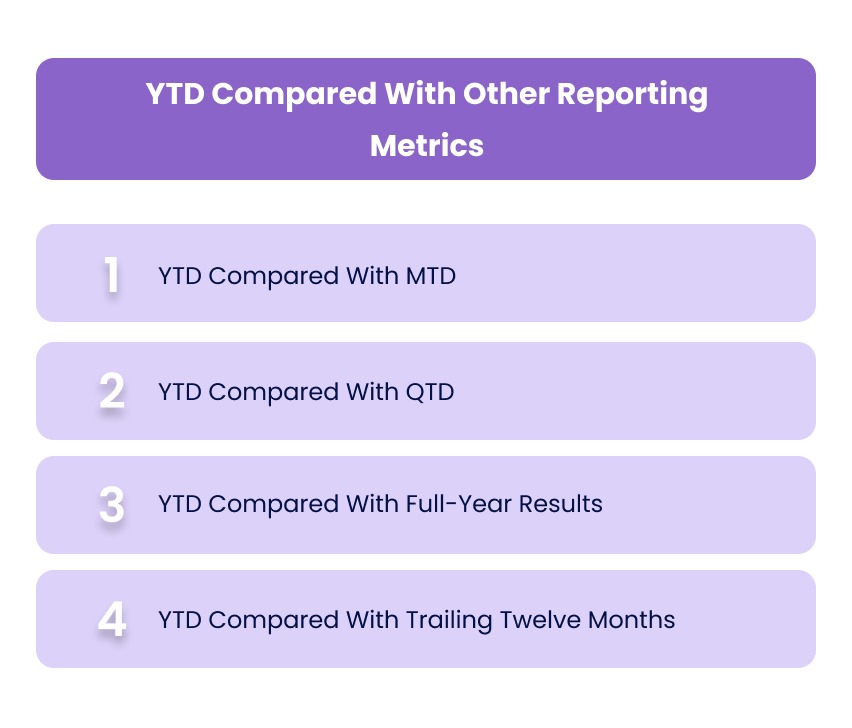
YTD Compared With Other Reporting Metrics
YTD is useful, but it is not the only time-based metric finance teams rely on. The right comparison depends on what decision you are trying to make. A month-level control question does not need the same lens as an annual performance review.
1. YTD Compared With MTD
MTD means Month To Date. It tracks activity from the first day of the current month up to the reporting cut-off. MTD is useful for short-term trend monitoring, while YTD is better for seeing the broader direction of the year.
If a company wants to know whether this month’s spend is already running ahead of plan, MTD is the right view. If it wants to know whether annual spend discipline is still intact despite one bad month, YTD is more useful.
2. YTD Compared With QTD
QTD means Quarter To Date. It tracks performance from the first day of the current quarter to the reporting date. QTD is especially useful for businesses that manage to quarterly targets or report performance to leadership on a quarter-by-quarter basis.
Compared with QTD, YTD gives more context because it includes everything that has happened since the start of the year, not just the current quarter.
3. YTD Compared With Full-Year Results
YTD is a live performance view. Full-year results are final. That distinction matters because YTD is always incomplete by definition. It tells you how the year is going so far, not how the year will definitely end.
This is why finance teams use YTD for mid-year decision-making, but still rely on full-year actuals for final performance assessment.
See the trend-analysis technique a running YTD figure is essentially a shortcut for.
4. YTD Compared With Trailing Twelve Months
Trailing Twelve Months or TTM looks at the most recent rolling twelve-month period, regardless of where the calendar year begins. This makes TTM especially helpful when seasonality distorts YTD comparisons. A business with uneven demand across the year may look weak on YTD in one month and strong in another, even when the underlying run rate has not changed much.
YTD is better for tracking annual goals. TTM is better for smoothing seasonality and understanding a rolling performance baseline.
How To Interpret YTD Without Misleading Yourself
YTD is only useful when you read it in context. A YTD number on its own can look impressive or disappointing for the wrong reasons. The real value comes from comparing it properly and knowing what it does not tell you.
1. Compare Against Prior-Year YTD
The cleanest comparison is usually against the same point in the previous year. That controls for timing differences within the year better than comparing a mid-year YTD figure to a full prior-year result.
If sales are up 12% YTD versus last year’s YTD at the same date, that tells a far more useful story than saying “sales are below last year’s full-year total,” which is obvious but not actionable.
2. Compare Against Budget And Forecast
YTD is especially useful when set against internal expectations. A business can be ahead of last year and still behind budget. Or it can be behind last year but still above plan if the business deliberately changed strategy.
This is why strong finance reporting usually puts three lines together:
- Actual YTD
- Budget YTD
- Prior-year YTD
That combination turns YTD from a raw number into a decision-making tool.
See our guide to the difference between budgeting and forecasting for how budgeting and forecasting differ as planning tools.
3. Adjust For Seasonality
YTD can create false alarms in seasonal businesses. If a business earns most of its annual revenue in one quarter, early-year YTD figures may look weak even when the business is performing normally.
Seasonality does not make YTD useless. It just means YTD should be interpreted alongside historical seasonality patterns, not in isolation.
4. Separate One-Off Events From Core Performance
A one-time rebate, delayed invoice batch, unusual bonus payment, or disposal gain can make YTD look stronger or weaker than the operating trend really is. Finance teams should isolate one-offs where material, otherwise the YTD figure can distort decision-making.
This is one reason YTD commentary matters almost as much as the number itself.
Also Read: Cash Flow Optimisation Strategies And Techniques
How UAE Finance Teams Use YTD In Reporting
For UAE businesses, YTD is primarily a management reporting tool. It helps finance teams monitor revenue, spend, collections, payroll, and working capital throughout the year without waiting for final annual statements.
1. YTD In Internal Management Reporting
YTD is useful in monthly finance packs because it shows whether the business is moving in the right direction across the year, not just whether one isolated month was good or bad. This makes it useful for:
- Budget tracking
- Spend reviews
- Revenue pacing
- Headcount cost visibility
- Working capital monitoring
2. YTD In Spend Control And Budget Reviews
A business may not notice a problem from one month of higher spend. It becomes obvious when category-level costs are reviewed YTD against plan. This is where YTD helps finance teams intervene early, before an overspend issue becomes a year-end surprise.
3. YTD In Payroll Visibility
YTD payroll is still relevant in the UAE, but it should be framed correctly. It is useful for showing gross pay, net pay, benefits, reimbursements, and running compensation totals. It is not mainly about personal income tax planning, because the UAE does not currently impose personal income tax on individuals.
4. YTD As A Planning Tool Rather Than A Compliance Metric
YTD does not drive VAT filing requirements. In the UAE, VAT returns are filed by tax period, with filing and payment due within 28 days from the end of that tax period.
Similarly, VAT registration thresholds are based on taxable supplies over a specified rolling test, not a generic YTD dashboard view.
So the right UAE framing is this: YTD supports internal finance control and planning; it is not itself the compliance rule.
Also Read: Understanding Spend Visibility And Business Benefits
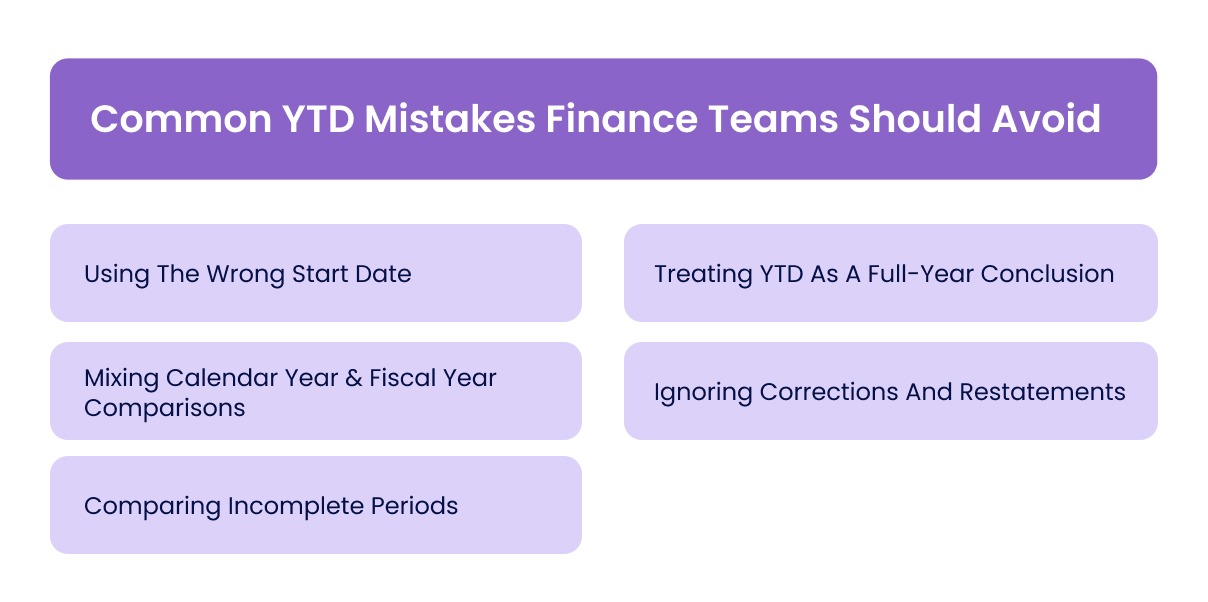
Common YTD Mistakes Finance Teams Should Avoid
Most YTD mistakes are not about formulas. They come from inconsistent dates, bad comparisons, and weak data discipline. That is why YTD can look simple while still being easy to misuse.
1. Using The Wrong Start Date
If one report uses the calendar year and another uses the fiscal year, the YTD numbers are not comparable. This error is especially common when management dashboards mix operating data from one system with accounting data from another.
2. Mixing Calendar Year And Fiscal Year Comparisons
A company can make itself look better or worse simply by comparing unlike periods. If your business uses a fiscal year, your YTD comparisons must use that same fiscal-year basis consistently.
3. Comparing Incomplete Periods
Comparing a fully closed prior-month number with a current-day partial number is a bad comparison. YTD should use a clearly defined reporting cut-off, ideally the latest finalised period.
4. Treating YTD As A Full-Year Conclusion
A strong YTD does not guarantee a strong year-end result. A weak YTD does not guarantee failure either. YTD is a progress measure, not a final verdict.
5. Ignoring Corrections And Restatements
If finance updates prior-period data for corrections, refunds, credit notes, or write-offs, the YTD figure should reflect those adjustments. Otherwise, the dashboard shows a number that looks current but is actually stale.

How Alaan Helps Teams Track YTD Performance
YTD reporting is only useful when the underlying spend data is current, categorised properly, and easy to review. Alaan helps finance teams improve that foundation by giving them tighter control over company spend throughout the year, not just at month-end.
- Real-Time Spend Visibility
Alaan gives finance teams better visibility into company spend as it happens, making it easier to monitor YTD cost movement throughout the year instead of waiting for delayed reporting cycles. - Smarter Spend Controls
With spend limits and vendor controls, finance teams can manage spend at the point of purchase and reduce budget leakage before it shows up in YTD reviews. - Approval Workflows That Support Budget Discipline
Structured approval workflows help businesses apply the right level of review before expenses are finalised, which supports cleaner policy compliance and more reliable YTD reporting. - Cleaner Records For Faster Reviews
By keeping transaction details, receipts, and supporting records organised, Alaan makes it easier for finance teams to review spend and explain YTD variances with less manual work. - Accounting Integrations That Reduce Rework
Alaan syncs spend data with accounting systems, helping teams keep records up to date and making period reviews smoother and faster. - Better Spend Analysis During The Year
Category-level visibility helps finance teams spot cost patterns, review budget drift, and respond earlier when YTD performance starts moving off plan.
In practice, that means YTD reporting becomes easier to trust. When spending is visible, controlled, and easier to review, finance teams can make faster decisions and intervene earlier in the year.
Conclusion
YTD is one of the most practical metrics in finance because it shows where performance stands so far this year without waiting for final year-end numbers. It helps finance teams track progress, compare results against budget or prior-year pace, and respond earlier when performance moves off track.
The metric itself is simple. The hard part is using it with the right date range, the right comparison base, and clean enough underlying data to support useful decisions.
Alaan helps finance teams improve the spend visibility behind YTD reporting. With better tracking, cleaner records, and stronger control over company spend, teams can review performance with more confidence and make faster decisions during the year. Schedule a Demo Today!
YTD tells you how the year is going, but it won't tell you whether you can pay suppliers next month, and our guide to managing business cash flow covers that bigger picture. You can also run a free cash flow stress test to see your runway under six preset scenarios. If your YTD spend numbers rely on chasing receipts, Alaan's expense management captures them as cards are used so the totals are ready when you report.
FAQs
1. Does YTD Always Start On 1 January
Not always. YTD can start on 1 January if the report uses the calendar year, but it can also start on the first day of a company’s fiscal year if the business reports on a fiscal-year basis.
2. Is YTD Better Than Monthly Reporting
Not better, just different. Monthly reporting is better for short-term movement and immediate performance checks. YTD is better for seeing broader progress across the year.
3. Can YTD Be Used For Non-Financial KPIs
Yes. YTD can be used for any cumulative metric that makes sense from the start of the year, such as customers won, units shipped, support tickets resolved, or marketing leads generated.
4. Why Can YTD And Full-Year Results Point In Different Directions
Because YTD is incomplete. A business may have strong YTD momentum and still miss year-end targets if later months weaken. The reverse is also true in seasonal businesses.
5. What Is The Difference Between YTD And A Rolling 12-Month View
YTD resets at the start of each year. A rolling 12-month view always looks at the most recent twelve months, which can make it more useful for smoothing seasonality.
Gain control over business expenses with Alaan corporate cards
Invygo earned AED 100,000 in cashback using Alaan cards
Personalise approval workflows to align with your business needs with Alaan's Spend Management platform
Discover the power of automated expense tracking and smarter spend control with Alaan
Turn data into actionable insights with Alaan's spend management tools
Stay Tax Compliant with UAE's #1 Corporate Card and Spend Management Platform
Customisable corporate card policy template
Know how much Corporate Tax you have to pay this fiscal year
Easily integrate Alaan with your ERP for accurate, real-time expense tracking
Close books faster with Alaan's AI-powered accounting automation
Reconcile your books in minutes instead of hours, every single month.
Keep petty cash organized with Alaan corporate cards and automated expense management