.avif)


How UAE finance teams use variance analysis to find where actual spending drifts from the budget and figure out why.
- Start with the formula: budget variance is actual spend minus the budgeted amount, so a AED 300,000 transport budget that ends the month at AED 345,000 shows a AED 45,000 overspend.
- Finance teams watch variances across five areas: departments, vendors and procurement, operations, projects or locations, and subscription or technology spend.
- The analysis is only as good as the data behind it, which means complete transaction records and consistent expense categorisation.
- Alaan brings corporate cards, expense capture, approvals and accounting sync onto one platform, so teams can track spending against budgets through the month rather than waiting for the close.
Budget discussions often seem simple during planning. The complexity begins once spending flows through departments, vendors, and operational activities, where even small deviations can quickly turn into larger budget gaps.
For example, the 2025 federal budget of the United Arab Emirates was approved at AED 71.5 billion, an 11.6% increase over 2024, showing how planned expenditures can shift across departments and projects.
For finance leaders, variance analysis provides the visibility needed to track these changes. It helps identify where spending diverges from budgets, understand the drivers behind those deviations, and maintain financial control across departments and projects.
In this blog, you’ll explore the main types of variances finance teams monitor, how budget variances are calculated, and practical techniques for analysing and managing spending deviations effectively.
TL;DR Key Takeaways:
- Budget Deviations Often Start Across Departments: Spending flows through vendors, subscriptions, travel, and projects, making it harder to track actual costs against planned budgets.
- Different Variance Types Reveal Different Cost Drivers: Finance teams monitor variances in department, vendor, operational, project, and technology spend to identify where budget gaps originate.
- Accurate Variance Analysis Depends on Reliable Data: Complete transaction records and consistent expense categorisation ensure budget comparisons reflect real financial activity.
- Structured Variance Reviews Improve Financial Control: Techniques such as trend analysis, vendor analysis, and department-level reviews help finance teams identify the drivers behind spending deviations.
- Improves Procurement Spend Visibility: Platforms like Alaan help finance teams unify card spend, invoices, and approvals on a single platform, enabling earlier identification of procurement opportunities.
5 Types of Variances Finance Leaders Monitor Across Corporate Spend
Finance leaders in the UAE track variances across corporate spend to understand where budgets deviate and identify areas of overspending or unexpected costs. Monitoring these variances in real time helps you control expenses, enforce policies, and maintain accurate, reliable financial reporting across all departments.
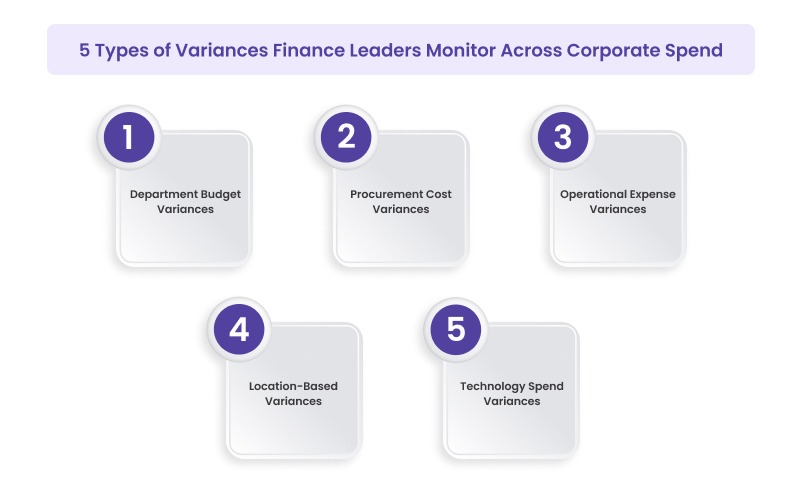
Below are the types of variances finance leaders monitor across corporate spend.
1. Department Budget Variances
Department-level variances happen when a team’s actual spending doesn’t match its allocated budget.
These usually show up in areas like:
- Marketing campaign budgets
- Sales travel and client engagement costs
- Operational team purchases
- Departmental software subscriptions
For finance leaders, these variances often signal changes in business activity or gaps in budget tracking. Spotting them early lets finance teams adjust priorities and tighten budget control.
2. Vendor and Procurement Cost Variances
Vendor-related variances occur when supplier costs differ from planned costs.
Common causes include:
- Supplier price changes
- Extra service charges
- Contract updates during projects
- Purchases made outside negotiated agreements
In sectors such as logistics, real estate, healthcare, and facilities management, procurement accounts for a large share of operational costs. Even small price changes can create noticeable gaps in budgets. Tracking these variances helps you spot inefficiencies or potential contract risks.
Suggested Read: Vendor Payments in the UAE: Methods, Tools, and Best Practices
3. Operational Expense Variances
Operational variances appear when day-to-day activities cost more or less than expected.
Examples include:
- Travel and accommodation expenses
- Logistics and transportation costs
- Equipment purchases
- Site-level operational spending
These variances often reflect shifts in operational demand or activity levels. Finance leaders need to decide whether these costs are necessary for growth or uncontrolled spending.
4. Project or Location-Based Variances
Companies running multiple projects or sites often see cost deviations linked to specific units.
Typical examples include:
- Construction or development projects
- Regional offices or retail locations
- Logistics hubs and warehouses
- Healthcare facilities or service centres
Suggested Read: Logistics Spend Management: Best Practices and Strategies
Project-level variances can come from contractor price changes, operational delays, or unexpected resource needs. Finance teams need to track these closely to keep each project financially sustainable.
5. Subscription and Technology Spend Variances
Budget deviations are increasingly driven by technology spending.
Common reasons include:
- Teams adopting new SaaS tools
- Upgrading existing software plans
- Adding user licences
- Growing cloud infrastructure usage
Each expense may seem small on its own, but together they can push technology budgets higher than planned. For tech-driven companies, monitoring subscription-related variances is key to sound financial oversight.
However, identifying these deviations consistently requires clear visibility into spending across departments, vendors, and expense categories.
At Alaan, we help finance teams consolidate corporate card transactions, invoices, and expense data into one unified spend management platform. This creates a single source of truth for operational spending, making it easier to analyse budget variances without manually compiling data from multiple systems.

How Finance Leaders Calculate Budget Variances in Real Financial Workflows?
Finance leaders calculate budget variances by comparing actual departmental and project spend against planned budgets, using data from multiple systems and payment channels. This approach helps you identify overspending, highlight inefficiencies, and take timely corrective actions to keep operations aligned with financial goals.
To apply this approach consistently, you need to use the budget variance formula to quantify differences between actual and planned spending.
Budget Variance Formula
At its simplest, variance analysis shows the difference between actual spending and the budgeted amount.
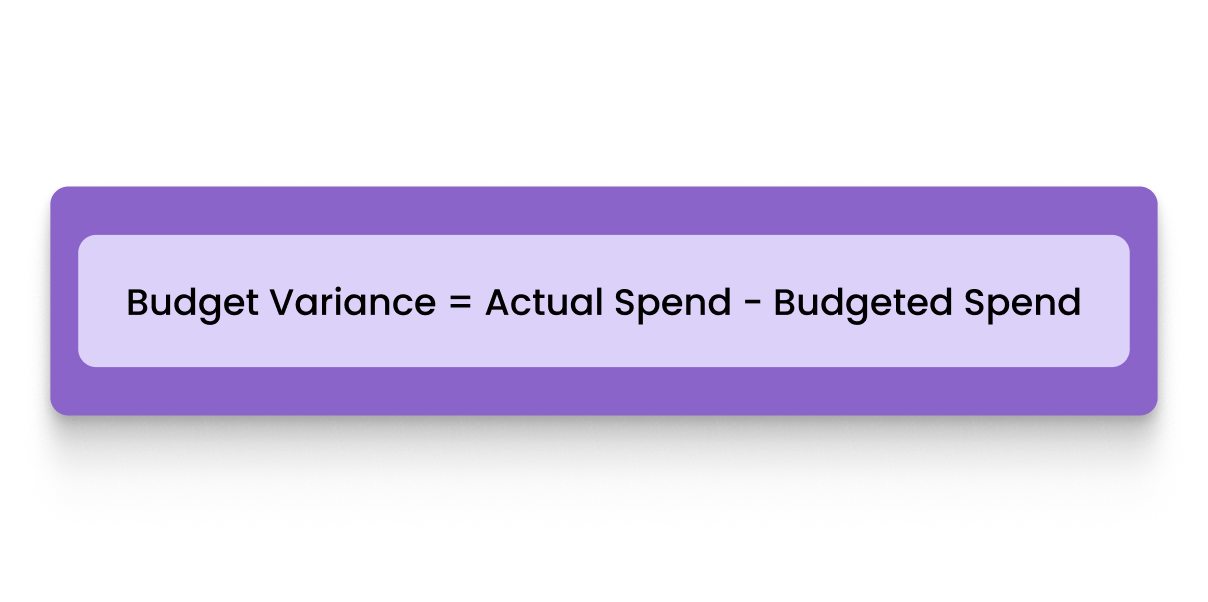
- If the result is positive, it means spending went over the budget.
- If the result is negative, spending stayed under the planned allocation.
Finance teams calculate this at different levels, including departments, projects, and vendor-related spending.
Here’s how the formula works in practice, using an operational budget scenario.
A Practical Example From an Operational Budget
Let’s take a UAE-based logistics company managing its monthly transportation budget.
- Planned transportation budget: AED 300,000 per month
- Actual transportation spending at month-end: AED 345,000
Applying the formula:
Variance = 345,000 − 300,000 = AED 45,000 overspend
This shows that transportation costs exceeded the approved budget for that month.
The next step is to interpret the results during a finance review.
Interpreting the Result in a Finance Review
The variance number highlights how much spending deviated from the plan, but it doesn’t explain why. Finance leaders need to dig into the operational factors behind the numbers.
Common drivers include:
- Higher delivery demand due to increased sales
- Vendor price changes for logistics services
- Extra transportation routes or emergency shipments
- Operational inefficiencies affecting fuel or fleet costs
By analysing these, finance teams can determine whether the overspend reflects necessary business activity or a cost control issue.
But the quality of variance analysis depends on the precision of the data collected by finance teams.
Why Data Accuracy Determines the Quality of Variance Analysis?
The accuracy of variance analysis depends entirely on reliable financial data.
Finance leaders focus on three key areas when calculating variances:
- Complete transaction records across departments
- Correct categorisation of expenses
- Consistent reporting across financial systems
When spending is tracked consistently and reviewed regularly, variance analysis becomes a powerful tool. It helps finance teams monitor budgets, enforce discipline, and keep spending aligned with organisational priorities.
Once budget variances are calculated, you can use them to guide both monthly and real-time variance analysis.
5 Steps to Conduct Variance Analysis During Monthly and Real-Time Reviews
Finance leaders perform variance analysis by comparing actual spend to budget in monthly or real-time reviews to quickly identify deviations. This process helps you identify cost overruns, operational inefficiencies, and compliance gaps, enabling timely corrective action and informed financial decisions.
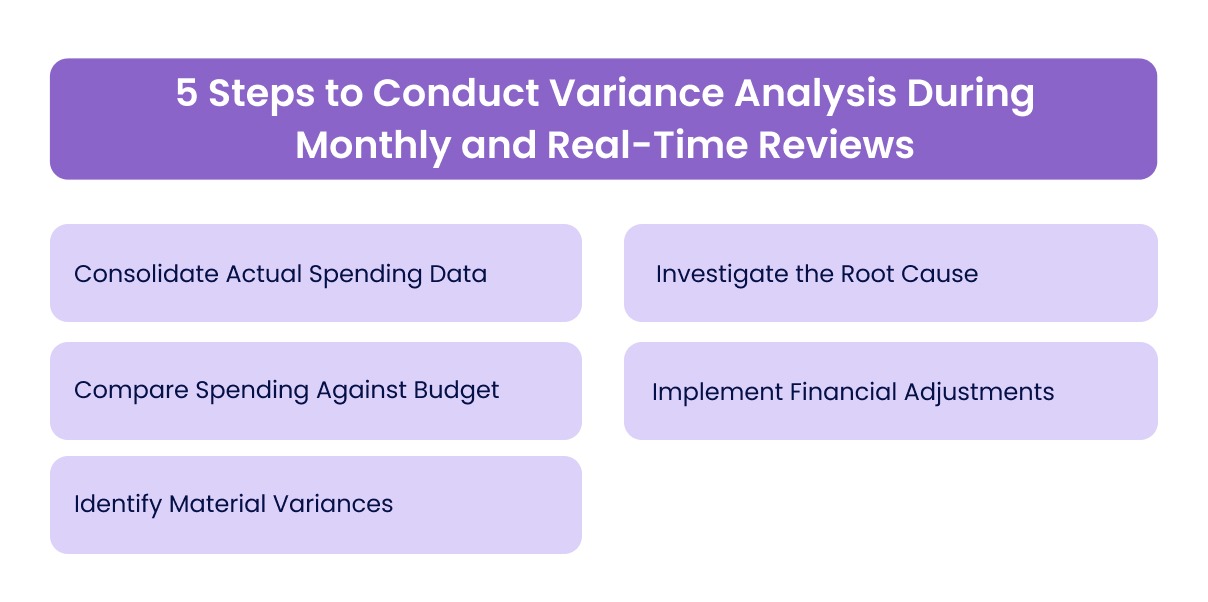
Here's how you can conduct variance analysis during monthly and real-time reviews:
1. Consolidate Actual Spending Data
The first step in any variance review is gathering accurate spending data from across the organisation. This gives a clear picture of what the company actually spent during the review period. Without complete and consistent data, variance analysis won’t be reliable.
2. Compare Actual Spending With Budget Allocations
Once actual spending is consolidated, the next step is to compare it with approved budgets for the same period.
These comparisons happen at different levels, such as:
- Department budgets
- Project budgets
- Vendor spending categories
- Operational cost centres
This step shows where spending is on track and where deviations have occurred.
3. Identify Material Variances
Finance leaders then focus on deviations that are large enough to matter, or that affect overall financial performance.
Typical triggers include:
- Significant overspending in a department
- Vendor costs exceeding contract terms
- Operational expenses growing faster than planned
- Project costs going beyond the budgeted amounts
Also Read: Vendor Invoice Processing: Stages, Challenges & Automation
4. Investigate the Root Cause
Once a variance is spotted, finance teams dig into why it happened.
They examine operational factors such as:
- Changes in business activity
- Vendor price adjustments
- Unexpected operational costs
- Spending outside approved policies
This helps determine whether the variance is due to genuine business growth, operational inefficiencies, or lapses in budget control.
5. Implement Financial Adjustments
Variance analysis only adds value if it leads to action. After identifying the cause, finance leaders may take steps like:
- Adjusting departmental spending plans
- Renegotiating vendor contracts
- Reallocating budgets between projects
- Strengthening approval processes for future spending
These actions ensure operational spending stays aligned with financial plans.
Conducting these reviews effectively often involves applying established variance analysis techniques used by modern finance teams.
Top 6 Variance Analysis Techniques to Improve Budget Accuracy
Modern finance teams in UAE businesses use variance analysis techniques to compare planned budgets with actual spend, highlighting discrepancies across departments and projects. These techniques help you pinpoint cost drivers, assess operational efficiency, and make data-driven decisions to maintain profitability and financial control.
1. Trend Analysis Across Financial Periods
Trend analysis examines how spending changes over time rather than reviewing variances in isolation.
Finance teams often track:
- Monthly operational spending trends
- Department budget usage across quarters
- Vendor cost changes over time
- Growth patterns in recurring expenses
For example, if transportation costs rise gradually over several months, the variance may reflect increasing operational demand rather than a sudden overspend. Tracking trends helps you see whether a variance is a short-term fluctuation or a longer-term cost shift.
2. Department-Level Variance Analysis
Another common approach is reviewing spending by department. This helps you see how each business unit is performing against its budget.
Finance leaders typically examine:
- Marketing campaign expenditures
- Sales travel and client engagement costs
- Operational team purchases
- Departmental technology subscriptions
Department-level analysis pinpoints where spending pressures originate and ensures each team stays accountable for its budget.
3. Vendor-Level Cost Analysis
Vendor-level analysis focuses on changes in procurement spending. Since many operational costs depend on third-party suppliers, reviewing vendor transactions helps finance teams identify pricing changes or contract deviations.
This often includes:
- Reviewing supplier invoices across financial periods
- Comparing contract pricing with actual charges
- Identifying unusual spikes in vendor spending
In industries like logistics, facilities management, and real estate, vendor-level analysis is key to keeping operational costs under control.
4. Project or Cost-Centre Variance Analysis
Companies running multiple projects, locations, or cost centres often analyse variances at the operational unit level.
Finance teams may review:
- Project budgets for construction or development initiatives
- Operating costs for regional offices or retail locations
- Logistics hub expenses
- Facility maintenance spending
This helps you see which units are driving the biggest budget deviations and evaluate each unit’s financial performance independently.
5. Volume and Activity-Based Variance Analysis
Some variances happen because business activity levels change. Finance teams check whether cost deviations match operational volume.
Examples include:
- Higher logistics costs from increased shipments
- Marketing expenses rising with campaign activity
- Customer acquisition costs growing during expansion
Activity-based analysis helps finance leaders separate normal cost growth tied to business performance from true overspending.
6. Continuous Spend Monitoring
Today, finance teams combine periodic variance reviews with continuous monitoring of operational spending. Instead of waiting until month-end, you track spending throughout the financial period. This lets you spot unusual transactions or emerging cost patterns early, before they significantly affect the budget.
Continuous monitoring improves financial oversight, helping teams investigate variances sooner and respond faster to changes in spending.
At Alaan, we enable continuous monitoring of operational spend by bringing together corporate cards, expense submissions, and approvals on a single platform. This allows finance teams to track spending against budgets throughout the financial period rather than waiting for month-end reports.

Applying these techniques effectively requires applying proven strategies that improve the accuracy and efficiency of variance analysis.
6 Best Strategies Finance Leaders Use for Effective Variance Analysis
Finance leaders use targeted strategies to make variance analysis more effective, ensuring budgets, departmental spend, and operational costs are closely monitored. These strategies help you detect deviations early, optimise resource allocation, and maintain control over profitability across projects and business units.
1. Prioritise High-Impact Cost Categories
Variance reviews are most useful when finance teams focus on the expenses that most affect profitability. High-value areas such as procurement, logistics, technology spending, and operational overhead often drive the largest budget deviations.
How to implement:
- Identify cost categories that make up the largest share of operational spending
- Focus variance reviews on vendor payments, operational costs, and major procurement items
- Give extra attention to expenses that directly affect profit margins
Must Read: Vendor Payments in the UAE: Methods, Tools, and Best Practices
2. Compare Variances With Historical Spending Trends
Looking at a variance alone can be misleading. Comparing it with past spending helps finance teams see whether the change is unusual or part of a recurring pattern.
How to implement:
- Compare current spending with historical monthly or quarterly averages
- Check if similar variances occurred in previous periods
- Use these trends to decide if a deviation needs deeper investigation
3. Investigate Recurring Variances
Some deviations continue to appear across financial periods. When the same cost category consistently goes over budget, it usually points to problems in budgeting assumptions or operational planning.
How to implement:
- Identify expense categories that frequently exceed their budgets
- Check whether the original budget assumptions still match actual operational activity
- Adjust future budgets if recurring variances continue
4. Use Variance Insights to Improve Future Budgets
Variance analysis becomes more powerful when it informs future financial planning. Lessons from past deviations help teams refine budget estimates and forecasting assumptions.
How to implement:
- Review historical variances during annual budget preparation
- Adjust cost projections based on actual spending patterns from previous periods
- Incorporate these insights into financial forecasting models
5. Document the Cause of Major Variances
Keeping a record of variance explanations helps finance teams see patterns over time. These records become a valuable reference for future reviews and investigations.
How to implement:
- Document the operational reason behind significant budget deviations
- Maintain records of variance explanations for recurring expense categories
- Refer to these historical explanations during future financial reviews.
These strategies are most impactful when paired with a platform that simplifies and strengthens variance analysis.
How Alaan Helps Finance Teams Strengthen Variance Analysis?
Many UAE finance teams perform monthly variance analysis, but fragmented spending across cards, invoices, subscriptions, and departments often limits real-time visibility and delays detection of budget deviations.
At Alaan, we bring corporate cards, expense capture, approvals, and accounting integrations on a single platform. This continuous visibility helps you monitor spending against budgets, quickly investigate variances, and maintain stronger financial control.
What Alaan Covers Across the Operational Spend Lifecycle
Accurate, timely visibility into operational spending drives effective variance analysis. At Alaan, we empower finance teams to analyse budget deviations with reliable financial data by strengthening every stage of the spend lifecycle.
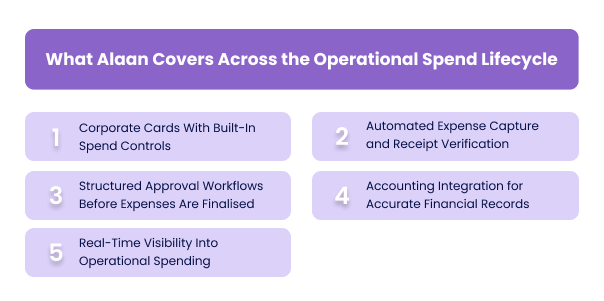
1. Corporate Cards With Built-In Spend Controls
At Alaan, we offer corporate cards with configurable spend controls so finance teams can manage spending before it affects budgets.
Admins can:
- Set spending limits by employee, team, or project
- Restrict merchant categories based on company policies
- Issue virtual or physical cards instantly
- Freeze or block cards in real time
These controls help ensure operational expenses stay within approved budgets and reduce the risk of unplanned spending that could create budget variances.
2. Automated Expense Capture and Receipt Verification
Once a payment is made using a corporate card, the transaction appears instantly in the platform, and the employee uploads the receipt.
Alaan Intelligence automatically extracts key data such as:
- Vendor name
- Transaction amount
- Invoice details
- Date and time of purchase
The system then verifies this information against the transaction record and flags any discrepancies. This ensures finance teams work with accurate expense data during variance analysis.
3. Structured Approval Workflows Before Expenses Are Finalised
Expenses and invoices move through policy-driven approval workflows aligned with company spending rules.
This ensures:
- Expenses are reviewed before being finalised
- Spending aligns with departmental budgets
- Unusual spending and policy exceptions are flagged early
By enforcing approvals upstream, finance teams prevent unapproved spending that often leads to unexpected budget variances.
4. Accounting Integration for Accurate Financial Records
At Alaan, we integrate directly with accounting systems such as:
- NetSuite
- QuickBooks
- Xero
- Microsoft Dynamics
Once an expense is approved, the transaction automatically syncs with the accounting system. This reduces manual data entry and ensures finance teams analyse variances using accurate financial records.
5. Real-Time Visibility Into Operational Spending
We provide live dashboards that show:
- Corporate card transactions
- Department-level spending
- Submitted and pending expenses
- Operational spending trends
This visibility helps finance teams track how actual spending compares with budgets throughout the financial period rather than discovering deviations only during month-end reviews.
What Alaan Is (And Is Not)
Alaan is a spend management platform designed to strengthen financial control over operational expenses.
It helps finance teams:
- Control spending through corporate cards and policy enforcement
- Capture and verify expenses automatically
- Maintain accurate, real-time financial records
Alaan does not replace your accounting or ERP system. Instead, it integrates with your existing tools to improve upstream spend control and provide the visibility finance teams need to monitor budget variances effectively.
Final Thoughts
Variance analysis provides finance leaders with a clear view of how spending aligns with budgets. For UAE businesses, it helps spot deviations early, understand their causes, and keep departmental spending on track.
Accurate, real-time visibility across departments, vendors, and projects boosts financial discipline and improves budgeting.
Alaan unites corporate cards, expense capture, approvals, and accounting sync. Finance teams track spending in real time, spot deviations sooner, and simplify variance analysis.
Book a free demo today to discover how Alaan can empower your UAE business with complete spend visibility, simplified expense management, and robust financial control. Take action now to transform your finance operations!
A variance report tells you where the budget slipped, and the next question is what that does to your cash, which our guide to managing cash flow works through step by step. You can also put your numbers into the cash flow stress test to see how long your runway lasts if the overspend keeps going for a few more months.
FAQs
1. What are the benefits of variance analysis for finance teams?
Variance analysis helps finance leaders spot where actual spending differs from the budget. It allows teams to quickly identify overspending, operational inefficiencies, or unexpected cost drivers.
2. What is the difference between favourable and unfavourable variance?
A favourable variance happens when spending is lower than planned or revenue exceeds expectations. An unfavourable variance occurs when costs go over budget or revenue falls short, signalling the need for a closer financial review.
3. What is the column method for variance analysis?
The column method puts budgeted values, actual values, and the calculated variance side by side in reports. This makes it easy for finance teams to compare planned versus actual performance across departments, projects, or cost categories.
4. What role do standards play in variance analysis?
Standards are benchmark costs or performance targets used during budgeting and planning. Finance teams compare actual spending against these standards to identify deviations and check whether spending aligns with expected performance.
5. How often should finance teams perform variance analysis?
Most finance teams review variances during the monthly financial close to compare actual spending with the budget. However, many organisations also track key expenses continuously throughout the month.
Gain control over business expenses with Alaan corporate cards
Invygo earned AED 100,000 in cashback using Alaan cards
Personalise approval workflows to align with your business needs with Alaan's Spend Management platform
Discover the power of automated expense tracking and smarter spend control with Alaan
Turn data into actionable insights with Alaan's spend management tools
Stay Tax Compliant with UAE's #1 Corporate Card and Spend Management Platform
Customisable corporate card policy template
Know how much Corporate Tax you have to pay this fiscal year
Easily integrate Alaan with your ERP for accurate, real-time expense tracking
Close books faster with Alaan's AI-powered accounting automation
Reconcile your books in minutes instead of hours, every single month.
Keep petty cash organized with Alaan corporate cards and automated expense management