.avif)


Most businesses track how much they spend, but far fewer can explain what that number actually represents. A total expense figure without proper breakdown can hide whether costs are operational, one-off, capital in nature, or even incorrectly recorded.
This is where expense formulas become useful. They help finance teams move beyond raw numbers and understand how costs are structured across the business, especially when evaluating operating performance, profitability, and cost efficiency.
In this blog, we will explain the main expense formulas, how to calculate operating expenses, what to include and exclude, and how finance teams can use expense data to improve cost control.
TL;DR
- There is no single expense formula; different formulas apply to total expenses, operating expenses, and expense ratios.
- Operating expenses represent day-to-day business costs and exclude COGS, taxes, interest, and capital expenditure.
- A commonly used formula is Operating Expenses = Revenue − COGS − Operating Income.
- Expense calculations depend heavily on accurate classification and complete data.
- Finance teams should use these formulas to identify cost trends, inefficiencies, and control gaps.
What Expense Formula Means In Business
The term “expense formula” does not refer to one fixed equation. Instead, it represents a set of financial relationships used to calculate different types of expenses depending on the objective.
A business might want to understand:
- How much it spent in total during a period
- How much it spent on operating activities
- What portion of revenue is consumed by expenses
- How expenses impact profitability
Each of these questions requires a different formula.
For example, total expenses help explain overall cost structure, while operating expenses focus specifically on recurring business costs. Similarly, an expense ratio connects expenses to revenue to measure efficiency.
Understanding which formula to use is critical. Applying the wrong one can lead to incorrect conclusions about profitability or cost performance.
The Main Expense Formulas Finance Teams Use
Different formulas are used depending on what a business wants to measure. The most commonly used ones are outlined below.
1. Total Expense Formula
Total expenses can be derived when revenue and net income are known:
Total Expenses = Revenue − Net Income
This approach is useful for understanding overall cost structure at a high level.
2. Operating Expense Formula
Operating expenses are typically derived from operating income:
Operating Expenses = Gross Profit − Operating Income
This formula helps isolate the costs associated with running the business, excluding production-related and non-operating items.
3. Operating Expense Formula From Revenue
A more direct way to calculate operating expenses from the income statement is:
Operating Expenses = Revenue − COGS − Operating Income
This version is often easier to apply when reviewing financial statements.
4. Operating Cost Formula
Operating cost includes both production and operating expenses:
Operating Costs = COGS + Operating Expenses
This formula gives a broader view of total cost required to run the business.
5. Operating Expense Ratio Formula
To understand efficiency, businesses often calculate:
Operating Expense Ratio = Operating Expenses ÷ Revenue
This shows how much of revenue is consumed by operating costs.
How To Calculate Operating Expenses
Calculating operating expenses becomes straightforward once the structure of the income statement is understood.

1. Start With Revenue
Use the total revenue for the period being analysed.
2. Subtract Cost Of Goods Sold
Remove direct costs related to production or service delivery.
3. Identify Operating Income
Operating income is usually listed on the income statement.
4. Apply The Formula
Use the formula:
Operating Expenses = Revenue − COGS − Operating Income
5. Validate With Expense Categories
Check the result against actual expenses such as salaries, rent, marketing, and administrative costs to ensure accuracy.
Also Read: Operating Expenses Include Definition Examples
What Counts As Operating Expenses
Operating expenses include the recurring costs required to run the business on a day-to-day basis.
Typical examples include:
- Salaries and wages for administrative teams
- Office rent and utilities
- Software and subscription costs
- Marketing and advertising
- Professional and consulting fees
- Insurance
- Repairs and maintenance
- Office supplies
- Travel and employee expenses
- Depreciation and amortisation
These costs support ongoing operations rather than direct production.
Also Read:
Guide To General And Administrative Expenses
Related:
Business Expense Categories Accounting Examples
What Should Be Excluded From Operating Expenses
Accurate calculation depends on excluding items that do not belong to operating expenses.
Common exclusions include:
- Cost of goods sold
- Interest expense
- Income tax
- Capital expenditure
- Loan repayments
- One-off restructuring costs
- Owner withdrawals or distributions
These items either relate to financing, taxation, or long-term investment rather than daily operations.

Also Read: Operating And Non Operating Expenses Examples
Expense Formula Example With AED Values
A simple example can help illustrate how the formula works in practice.
- Revenue: AED 900,000
- COGS: AED 420,000
- Operating Income: AED 180,000
Using the formula:
Operating Expenses = Revenue − COGS − Operating Income
Operating Expenses = AED 900,000 − AED 420,000 − AED 180,000
Operating Expenses = AED 300,000
This means the business spent AED 300,000 on operating activities during the period.
How To Find Operating Expenses In Financial Records
Knowing the formula is only one part of the process. Finance teams also need to know where the underlying numbers come from and how reliable they are. Operating expenses are usually derived from a combination of financial records rather than a single source.
This often creates delays, with regional research showing that 25% of businesses still struggle with manual expense reporting.
Common sources include:
- Income Statement
The most direct source, where operating expenses are typically grouped under selling, general, and administrative (SG&A) or similar categories. - General Ledger
Provides detailed line-by-line expense entries, allowing deeper analysis by account. - Chart Of Accounts
Defines how expenses are classified, which directly affects how operating expenses are calculated. - Accounts Payable Records
Capture supplier invoices and recurring vendor-related costs. - Expense Management Systems
Include employee expenses, reimbursements, and corporate card transactions. - Payroll Reports
Cover salaries, wages, and benefits that fall under operating expenses.
In practice, operating expenses are not “found” in one place. They are constructed from multiple data sources, which is why consistency in classification and documentation is critical.
Also Read:
Understanding Financial Statements Beginners Guide
Related:
Understanding Chart Of Accounts Guide
How To Use Expense Formulas For Better Cost Control
Expense formulas are not just accounting tools. They help finance teams identify patterns, track changes, and make decisions.
When used consistently, they provide a structured way to evaluate cost performance.

Practical applications include:
- Tracking Operating Expenses Over Time
Comparing operating expenses month over month helps identify unusual increases or inefficiencies. - Measuring Expenses As A Percentage Of Revenue
This helps determine whether costs are growing faster than the business. - Identifying Cost Drivers
Breaking down operating expenses by category highlights which areas contribute most to total cost. - Separating Recurring And One Off Costs
This improves forecasting and prevents temporary spikes from distorting analysis. - Detecting Unusual Or Duplicate Spend
Variations in expense patterns may indicate errors or control gaps. - Supporting Budgeting And Forecasting
Expense formulas help set realistic targets and monitor whether spending stays within planned limits.
The key is not just calculating the number, but understanding what is driving it and whether action is required.

Also Read:
Effective Ways Reduce Operating Expenses
Related:
Understanding Cost Management Key Steps Benefits
Common Mistakes When Calculating Expenses
Even with the correct formula, errors often occur due to incorrect classification or incomplete data.
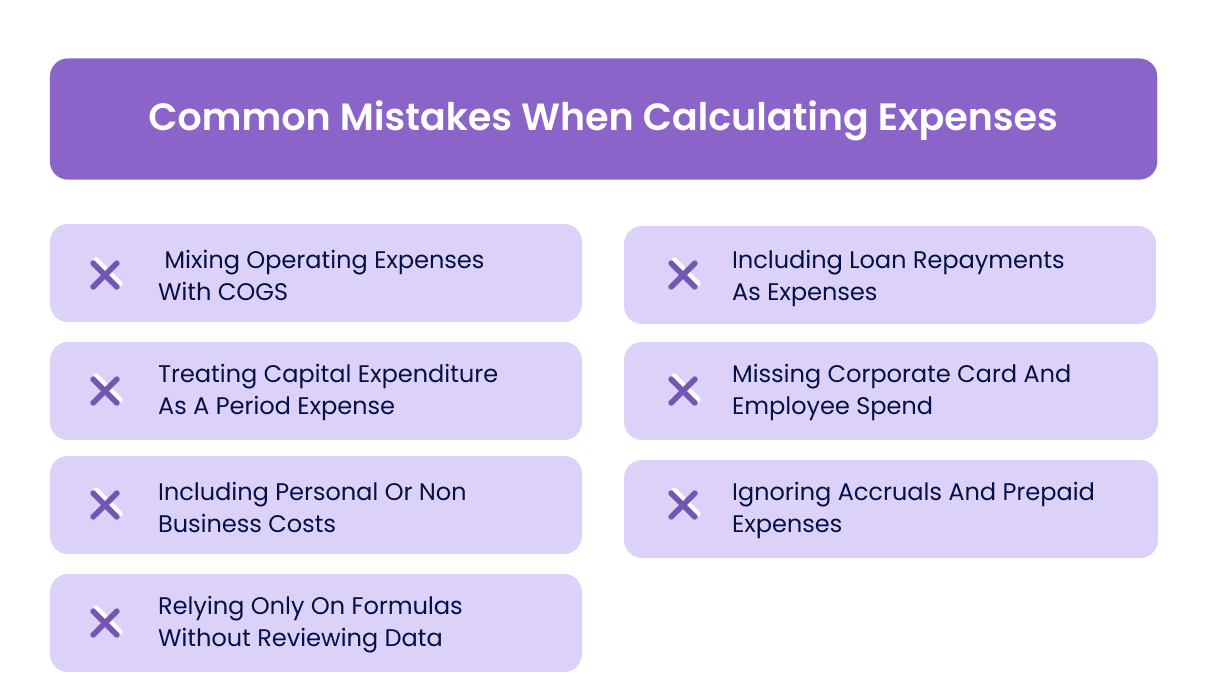
1. Mixing Operating Expenses With COGS
Including direct production costs within operating expenses distorts the calculation and affects profitability analysis.
2. Including Loan Repayments As Expenses
Loan principal repayments are financing activities, not operating expenses, and should not be included.
3. Treating Capital Expenditure As A Period Expense
Capital purchases should be recorded as assets and depreciated over time, not fully expensed immediately.
4. Missing Corporate Card And Employee Spend
Expenses incurred through cards or reimbursements are sometimes excluded from reports, leading to underestimation. The financial impact of these gaps can be substantial: in the UAE, inefficient expense processes and missing documentation are estimated to cost SMEs over AED 13,206 per employee annually.

5. Including Personal or Non-Business Costs
Non-business expenses should be removed to ensure accurate financial reporting.
6. Ignoring Accruals And Prepaid Expenses
Expenses should be recorded in the correct period. Ignoring accruals or prepayments can distort results.
7. Relying Only On Formulas Without Reviewing Data
Formulas provide results, but without reviewing the underlying data, errors can go unnoticed.
Also Read:
Fixed Variable Periodic Expenses Explained
Related:
Accrued Meaning In Accounts Principles
How Alaan Helps Finance Teams Track Expenses More Reliably
Expense formulas are only as reliable as the data behind them. When expense records are fragmented across invoices, cards, reimbursements, and manual entries, calculations become harder to trust.
Alaan helps finance teams improve this underlying data layer so that expense calculations reflect actual business activity.
- Corporate Cards With Spend Controls
Businesses can manage spending through defined limits and merchant restrictions, reducing uncontrolled transactions. - Real Time Visibility Into Expenses
Finance teams can track expenses across teams, categories, and vendors as they happen. - Centralised Receipt And Invoice Capture
Supporting documents are linked to each transaction, improving traceability and reducing missing data. - Structured Approval Workflows
Expenses are reviewed before they are finalised, helping maintain control over spending. - Seamless Accounting Integration
Integrations with systems like Xero, QuickBooks, NetSuite, and Microsoft Dynamics ensure accurate financial records. - Cleaner Reconciliation And Reporting
With structured data and documentation, finance teams can close books more efficiently and with fewer discrepancies.
By improving how expenses are captured and organised, Alaan helps ensure that expense formulas produce accurate and actionable insights.
Also Read:
Track And Manage Business Expenses
Related:
Modern Expense Management Guide
Conclusion
Expense formulas provide a structured way to understand how a business spends money, but their value depends on how accurately expenses are classified and recorded.
Different formulas serve different purposes. Total expense formulas explain overall cost structure, while operating expense formulas focus on day-to-day business activity. Using the right formula ensures that analysis reflects reality.
For finance teams, the priority should be consistency. When expense data is complete, categorised correctly, and supported by documentation, formulas become more reliable and easier to use for decision-making.
If you want to improve how your business tracks and manages expenses, you can explore how Alaan helps finance teams maintain visibility, enforce controls, and keep financial data accurate. Book a demo to see how structured expense management supports better cost control.
Frequently Asked Questions
1. Why Is There No Single Expense Formula For All Businesses
Different formulas answer different financial questions. A business may use separate formulas for total expenses, operating expenses, and expense ratios depending on what it wants to measure.
2. Should Payroll Always Be Included In Operating Expenses
Most administrative and support payroll costs are included, but production-related wages may be classified under cost of goods sold depending on the business model.
3. Are Marketing Costs Part Of Operating Expenses
Yes, marketing and advertising are typically considered operating expenses because they support ongoing business activity.
4. Why Is COGS Excluded From Operating Expenses
COGS represents direct production or delivery costs, while operating expenses represent indirect costs required to run the business.
5. How Often Should A Business Review Operating Expenses
Operating expenses should be reviewed regularly, often monthly, to identify trends, control costs, and ensure alignment with budgets.
6. Can Operating Expenses Be Too Low
Yes, extremely low operating expenses may indicate underinvestment in areas such as marketing, staffing, or infrastructure, which can affect growth and performance.
Gain control over business expenses with Alaan corporate cards
Invygo earned AED 100,000 in cashback using Alaan cards
Personalise approval workflows to align with your business needs with Alaan's Spend Management platform
Discover the power of automated expense tracking and smarter spend control with Alaan
Turn data into actionable insights with Alaan's spend management tools
Stay Tax Compliant with UAE's #1 Corporate Card and Spend Management Platform
Customisable corporate card policy template
Know how much Corporate Tax you have to pay this fiscal year
Easily integrate Alaan with your ERP for accurate, real-time expense tracking
Close books faster with Alaan's AI-powered accounting automation
Reconcile your books in minutes instead of hours, every single month.
Keep petty cash organized with Alaan corporate cards and automated expense management